Home
Class 12
PHYSICS
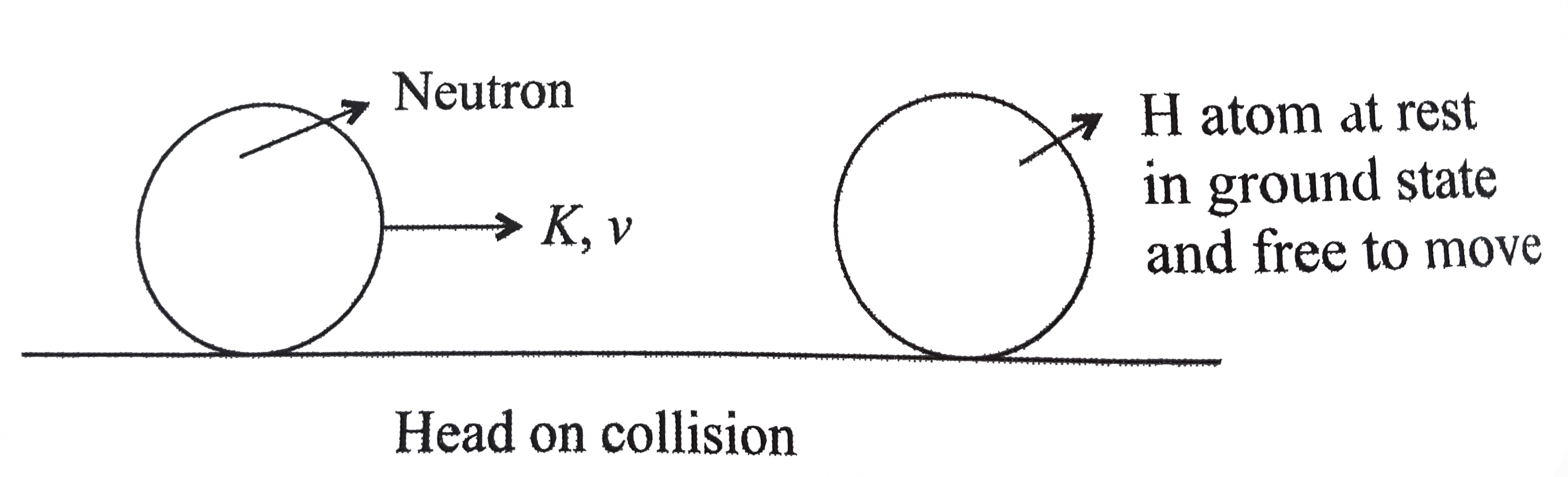
In the figure , what type of collision c...

In the figure , what type of collision can be possible , if `K = 14 eV, 20.4 eV,22 eV, 24.18 eV,(elastic // inelastic // perfectly inelastic).

Text Solution

Verified by Experts

Loss in the energy `(DeltaE)` during the collision will be used to excite the atom from one level to another.
`DeltaE={0,10.2 eV, 12.09 eV,......13.6 eV)`
According to Newtonion mechanics
minimum loss = 0. (elastic collision)

for maximum loss collision will be perfectly inelasitc if nuutron colliedrs perfectly inelastically then, Applying momentum conservation
`mv_(0)=2mv`,
`v_(f)=(v_(0))/(2)`
final `K.E=(1)/(2)xx2mxx(v_(0)^(2))/(4)=((1)/(2)mv_(0)^(2))/(2)=(K)/(2)`
maximum loss `=(K)/(2)`
According to classical mechanics `(DeltaE)=[0,(K)/(2)]`
(a) If `K=14 eV` According to quantum meachics
`(DeltaE)={0,10.2eV,12.09eV}`
According to classical mechanics
`Delta E=[0.7eV]`
loss `= 0`, hence it is elastic collision speed of particle changes.
(b) If `K=20.4 eV`
According to classical mechanics
loss `=[0,10.2 eV]`
According to quantum mechanics
loss `={0,10.2eV,12.09 eV,.....}`
loss `= 0` elastic collision.
loss `=10.2 eV` perfectly inelastic collision
(b) If `K=22 eV`
Classical mechanics `DeltaE=[0,11]`
Quantum mechanics `DeltaE={0,10.2eV,12.09eV,....}`
loss `= 0` elastic collision
loss `=10.2 eV` elastic collision
(d) If `K=24.18eV`
According to classical mechanics `DeltaE=[0,12.09eV]`
According to quantum mechanics `DeltaE={0,10.2eV,12.09eV,....13.6eV}`
loss `=0` elastic collision
loss `=10.2 eV` inelastic collision
loss `=12.09eV` perfectly in elastic collision
Promotional Banner

Topper's Solved these Questions

  • ATOMIC PHYSICS

    RESONANCE|Exercise Solved miscellaneous problems|14 Videos
  • ATOMIC PHYSICS

    RESONANCE|Exercise Exercise 1 Part-1 subjective questions|35 Videos
  • ALTERNATING CURRENT

    RESONANCE|Exercise HIGH LEVEL PROBLEMS|11 Videos
  • CAPACITANCE

    RESONANCE|Exercise High Level Problems|16 Videos

Similar Questions

Explore conceptually related problems

A free hydrogen atom in its ground state is at rest. A neutron having kinetic energy k_(0) collides head one with the atom. Assume that mass of both neutron and the atom is same. (a) Find minimum value of k_(0) so that this collision can be inelastic. (b) If k_(0) = 25 eV , find the kinetic energy of neutron after collision if its excites the hydrogen atom to its second excited state. Take ionization energy of hydrogen atom in ground state to be 13.6 eV .

Which of the following statements is false for collisions- (1)Momentum is conserved in elastic collisions but not in inelastic collisions. (2)Total-kinetic energy is conserved in elastic collisions but momentum is not conserved. (3)Total kinetic energy and momentum both are conserved in all types of collisions (4)Total kinetic energy is not conserved in inelastic collisions but momentum is conserved

A particle of mass m strikes a wedge of mass M horizontally as shown in the figure. Statement - 1 : If collision is perfectly inelastic then, it can be concluded that the particle sticks to the wedge. Statement - 2 : In perfectly inelastic collision velocity of both bodies is same along common normal just after collision.

The work function for the followtin metals is given Na: 2.75 eV, K:2.30 eV , Mo: 4.17 eV , Ni: 515 eV. Which of these metals will not give photoelectric emission for a radiation of wavelength 3300 A from a He-Cd laser placed 1m away from the photocell? What happens if the laser is brought nearer and placed 50 cm away?

The ionisation potentials of Li and K are 5.4 and 4.3 eV respectively. The ionization potential of Na will be:

A : Work function of aluminium is 4.2 eV . Emission of electrons will be possible by two photons , each of 2.5 eV energy , striking the electron of aluminium . R : Energy of a photon can be less then the work function of the metal , for photoelectron emission .

RESONANCE-ATOMIC PHYSICS-Advanved level problems
  1. In the figure , what type of collision can be possible , if K = 14 eV,...

    Text Solution

    |

  2. A small particle of mass m move in such a way the potential energy (U ...

    Text Solution

    |

  3. Suppose the potential energy between an electron and aproton at a dist...

    Text Solution

    |

  4. In atension from state n to a state of excitation energy 10.19 eV, hyd...

    Text Solution

    |

  5. Suppose in certine condition only those transition are allowed to hydr...

    Text Solution

    |

  6. Find the velocity of photoelectrons liberated by electromagnetic radia...

    Text Solution

    |

  7. (a) Find the maximum wavelength lambda(0) of light which can ionize a ...

    Text Solution

    |

  8. A beam of monochromatic light of wavelength lambda ejects photoelectro...

    Text Solution

    |

  9. Hydrogen atom in its good state is excited by means of monochromatic r...

    Text Solution

    |

  10. Average lifetime of a hydrogen atom excited to n =2 state is 10^(-6)s ...

    Text Solution

    |

  11. In a hydrogen like ionized atom a single electron is orbiting around ...

    Text Solution

    |

  12. For atoms of light and heavy hydrogen (H and D) fine the difference, ...

    Text Solution

    |

  13. An electron in the ground state of hydrogen atom is revolving in antic...

    Text Solution

    |

  14. A proton and electron, both at rest initially, combine to form a hydro...

    Text Solution

    |

  15. A neutron of kinetic 6.5 eV collides inelastically with a singly ioniz...

    Text Solution

    |

  16. Suppose the potential energy between electron and proton at a distance...

    Text Solution

    |

  17. A positronium consists of an electron and a positron revolving about t...

    Text Solution

    |

  18. In a photoelectric effect set up, a point source of light of power 3.2...

    Text Solution

    |

