Home
Class 12
PHYSICS
A neutron with an energy of 4.6 MeV coll...

A neutron with an energy of `4.6 MeV` collides elastically with proton and is retarded. Assuming that upon each collision the neutron is deflected by `45^(@)`, find the number of collisions which will reduce its energy to `0.23 eV`.

Text Solution

Verified by Experts
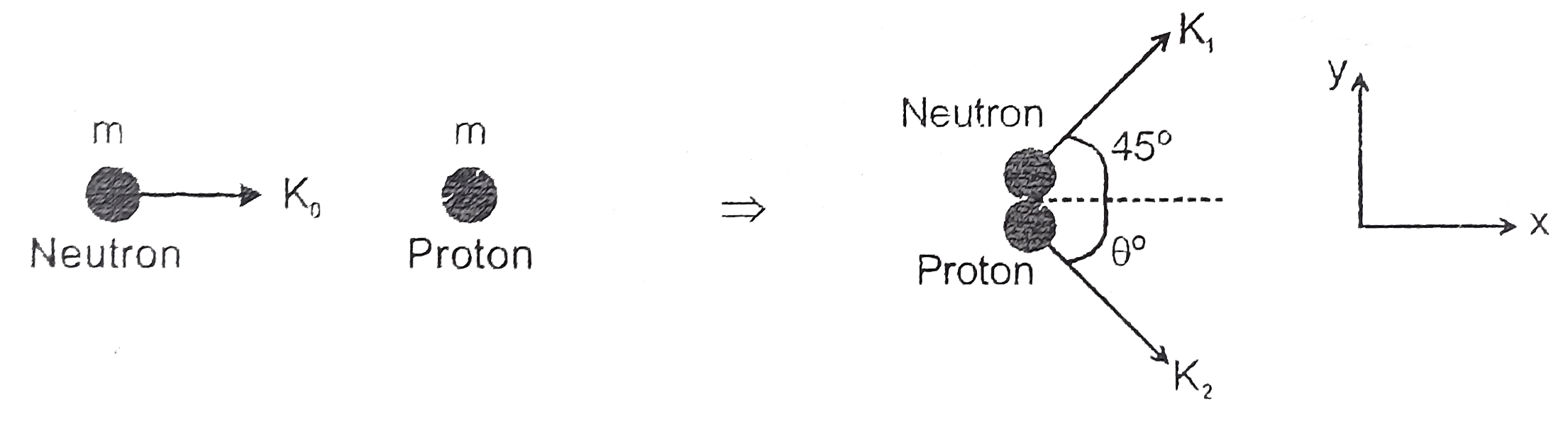
Mass of neutron`~~` mass of proton `=m`

From conservation of momentum in y-direction
`sqrt(2mK_(1)) sin 45^(@)=sqrt(2mK_(2)) sin theta`.....(i)
In x-direction `sqrt(2mK_(0))-sqrt(2mK_(1))cos 45^(@)=sqrt(2mK_(2))cos theta`.....(ii)
Squaring and adding equation (i) and (ii), we have
`K_(2)=K_(1)+K_(0)-sqrt(2K_(0)K_(1))`......(iii)
From conservation of energy
`K_(2)=K_(0)-K_(1)`.......(iv)
Solving equations (iii) and (iv), we get
`K_(1)=(K_(0))/(2)`
i.e., after each collision energy remains half. Therefore, after `n` collisions,
`K_(n)=K_(0)((1)/(2))^(n)`
`:. 0.23-(4.6xx10^(6))((1)/(2))^(n) 2^(n)=(4.6xx10^(6))/(0.23)`
Taking log and solving, we get
`n ~~ 24`
Promotional Banner

Topper's Solved these Questions

  • ATOMIC PHYSICS

    RESONANCE|Exercise Solved miscellaneous problems|14 Videos
  • ATOMIC PHYSICS

    RESONANCE|Exercise Exercise 1 Part-1 subjective questions|35 Videos
  • ALTERNATING CURRENT

    RESONANCE|Exercise HIGH LEVEL PROBLEMS|11 Videos
  • CAPACITANCE

    RESONANCE|Exercise High Level Problems|16 Videos

Similar Questions

Explore conceptually related problems

An electron with kinetic energy =E eV collides with a hydrogen atom in the ground state. The collision will be elastic

A neutron makes is a head - on elastic collision with a stationary deuteron The fraction energy loss of the neutron in the collision is

How many head-on, eleastic coillisions must a neutron have with deuterium nucleus to reduce its energy from 1 MeV to 0.025 eV .

An electron of the kinetic energy 10 eV collides with a hydrogen atom in 1st excited state. Assuming loss of kinetic energy in the collision be to quantized which of the following statements is correct?

On an average, a neutron loses half of its energy per collision with a quesi-free proton. To reduce a 2 MeV neutron to a thermal neutron having energy 0.04 eV , the number of collisions requaired is nearly .

A neutron moving at a speed v undergoes a head-on elastic collision with a nucleus of mass number A at rest. The ratio of the kinetic energies of the neutron after and before collision is :

A neutron with a kinetic energy of 6.0 eV collides with a stationary hydrogen atom in its ground state. Explain why the collision must be elastic-that is, why kinetic energy must be conserved. (Hint: Show that the hydrogen atom cannot be excited as a result of the collision.)

RESONANCE-ATOMIC PHYSICS-Advanved level problems
  1. A neutron with an energy of 4.6 MeV collides elastically with proton a...

    Text Solution

    |

  2. A small particle of mass m move in such a way the potential energy (U ...

    Text Solution

    |

  3. Suppose the potential energy between an electron and aproton at a dist...

    Text Solution

    |

  4. In atension from state n to a state of excitation energy 10.19 eV, hyd...

    Text Solution

    |

  5. Suppose in certine condition only those transition are allowed to hydr...

    Text Solution

    |

  6. Find the velocity of photoelectrons liberated by electromagnetic radia...

    Text Solution

    |

  7. (a) Find the maximum wavelength lambda(0) of light which can ionize a ...

    Text Solution

    |

  8. A beam of monochromatic light of wavelength lambda ejects photoelectro...

    Text Solution

    |

  9. Hydrogen atom in its good state is excited by means of monochromatic r...

    Text Solution

    |

  10. Average lifetime of a hydrogen atom excited to n =2 state is 10^(-6)s ...

    Text Solution

    |

  11. In a hydrogen like ionized atom a single electron is orbiting around ...

    Text Solution

    |

  12. For atoms of light and heavy hydrogen (H and D) fine the difference, ...

    Text Solution

    |

  13. An electron in the ground state of hydrogen atom is revolving in antic...

    Text Solution

    |

  14. A proton and electron, both at rest initially, combine to form a hydro...

    Text Solution

    |

  15. A neutron of kinetic 6.5 eV collides inelastically with a singly ioniz...

    Text Solution

    |

  16. Suppose the potential energy between electron and proton at a distance...

    Text Solution

    |

  17. A positronium consists of an electron and a positron revolving about t...

    Text Solution

    |

  18. In a photoelectric effect set up, a point source of light of power 3.2...

    Text Solution

    |

