Home
Class 12
PHYSICS
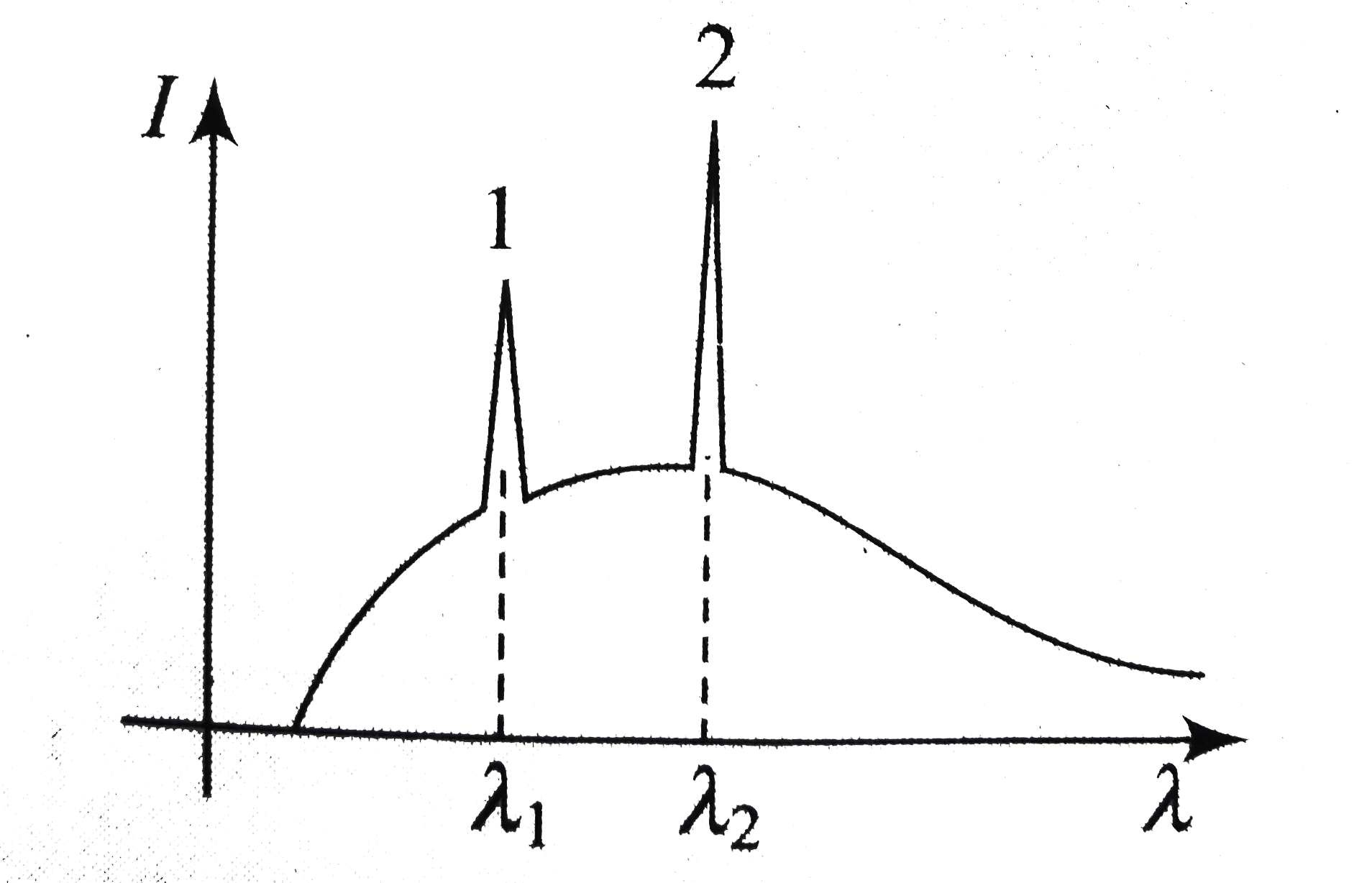
In figure find which is K(a) and K(beta)...

In figure find which is `K_(a) and K_(beta)`

Text Solution

Verified by Experts

`DeltaE=(hc)/(lambda), lambda=(hc)/(DeltaE)`
since energy difference of `K_(alpha)` is less than `K_(beta)`
`1` is `K_(beta)` and `2` is `K_(alpha)`
Promotional Banner

Topper's Solved these Questions

  • ATOMIC PHYSICS

    RESONANCE|Exercise Solved miscellaneous problems|14 Videos
  • ATOMIC PHYSICS

    RESONANCE|Exercise Exercise 1 Part-1 subjective questions|35 Videos
  • ALTERNATING CURRENT

    RESONANCE|Exercise HIGH LEVEL PROBLEMS|11 Videos
  • CAPACITANCE

    RESONANCE|Exercise High Level Problems|16 Videos

Similar Questions

Explore conceptually related problems

In figure find which is K_(a) and L_(alpha')

Figure shows K_(alpha) & K_(beta) X-rays along with continuous X-ray. Find the energy of L_(alpha) X-ray. (Use hc = 12420 evÅ)

In the figure a capacitor is filled with dielectrics K_(1) , K_(2) and K_(3) . The resultant capacitance is

If the frequency of K_(alpha), K_(beta) and L_(alpha) , X-ray lines of a substance are v_(K_(alpha)), v_(K_(beta)) , and v_(L_(beta))

In the Moseley relation, sqrt(v)=a(Z-b) which will have the greater value for the constant a for K_(alpha) or K_(beta) transition?

Four identical capacitors are connected with a battery of voltage V and two switches k_(1) and k_(2) as shown in the figure below. Initially, k_(1) is closed, now if k_(2) is also closed, find the heat loss.

Obtain a relation between the frequencies of K_(oo) K_(beta) and L_(alpha) line for a target metrial .

The X-ray spectrum of a metallic target has been shown in figure (a) What is the accelerating potential difference for bombarding electrons? (b) Two characteristic X-rays have been shown in the figure one of them is k_(alpha) X-ray and the other one is k_(beta) X-ray. What is wavelength of k_(alpha) X-ray? (c) Find the atomic number of the target atom.

If f_(1)=f_(2) ​ and f_(3) ​ are the frequencies of corresponding K_(alpha), K_(beta) ​ and L_(alpha) ​ X-rays of an element, then :-

If lambda_(K_(alpha)), lambda_(K_(beta)) and lambda_(L_(alpha)) are the wavelengths of K_(alpha), K_(beta) and L_(alpha) , lines respectively , then

RESONANCE-ATOMIC PHYSICS-Advanved level problems
  1. In figure find which is K(a) and K(beta)

    Text Solution

    |

  2. A small particle of mass m move in such a way the potential energy (U ...

    Text Solution

    |

  3. Suppose the potential energy between an electron and aproton at a dist...

    Text Solution

    |

  4. In atension from state n to a state of excitation energy 10.19 eV, hyd...

    Text Solution

    |

  5. Suppose in certine condition only those transition are allowed to hydr...

    Text Solution

    |

  6. Find the velocity of photoelectrons liberated by electromagnetic radia...

    Text Solution

    |

  7. (a) Find the maximum wavelength lambda(0) of light which can ionize a ...

    Text Solution

    |

  8. A beam of monochromatic light of wavelength lambda ejects photoelectro...

    Text Solution

    |

  9. Hydrogen atom in its good state is excited by means of monochromatic r...

    Text Solution

    |

  10. Average lifetime of a hydrogen atom excited to n =2 state is 10^(-6)s ...

    Text Solution

    |

  11. In a hydrogen like ionized atom a single electron is orbiting around ...

    Text Solution

    |

  12. For atoms of light and heavy hydrogen (H and D) fine the difference, ...

    Text Solution

    |

  13. An electron in the ground state of hydrogen atom is revolving in antic...

    Text Solution

    |

  14. A proton and electron, both at rest initially, combine to form a hydro...

    Text Solution

    |

  15. A neutron of kinetic 6.5 eV collides inelastically with a singly ioniz...

    Text Solution

    |

  16. Suppose the potential energy between electron and proton at a distance...

    Text Solution

    |

  17. A positronium consists of an electron and a positron revolving about t...

    Text Solution

    |

  18. In a photoelectric effect set up, a point source of light of power 3.2...

    Text Solution

    |
