Home
Class 12
PHYSICS
A neutron of kinetic 6.5 eV collides ine...

A neutron of kinetic `6.5 eV` collides inelastically with a singly ionized helium atom at rest. It is scattered at an angle `90^(@)` with respect to its original direction.
Find the maximum allowed value of energy of the He atom?

Text Solution

Verified by Experts

The correct Answer is:

(a) `6.36eV, 0.312eV` (of neutron), `17.84eV, 16.328eV` (of atom)
(b) `1.82xx10^(15)Hz, 11.67xx10^(15)Hz, 9.84xx10^(15)`

Let `K_(1)` and `K_(2)` be the kinectic energies of neutron and helium atom after collision and `DeltaE` be the excitation energy


From conservation of linear momentum along x-direction.
`rArr sqrt(2Km)=sqrt(2(4m)K_(2))cos theta(P=sqrt(2Km))`
Similarly.,applying conservation of linear momentum in y-direction, we have
`sqrt(2m_(1)m) = sqrt(2(4m)K_(2))sin theta`
Squaring and adding equation (1) and (2), we get
`K+K=4K_(2)`
or `4K_(2)-K_(1)=K=65 eV`
Now, during collision, electron cana be excited to any higher energy state. Applying conservation of energy we get `K=K_(1)+K_(2)+Delta`

or `65=K_(1)+K_(2)+DeltaE`
`DeltaE` can have the following values,
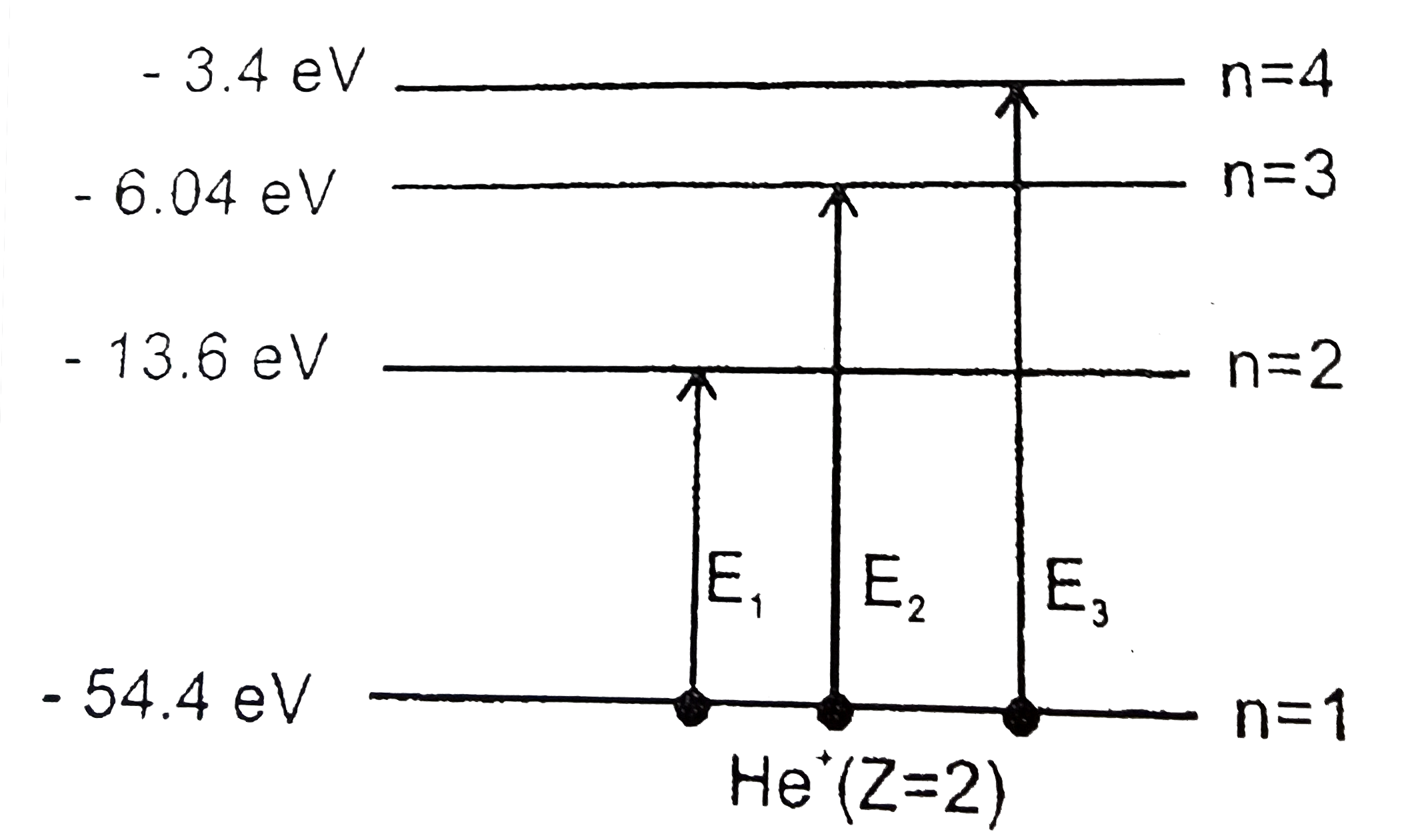
`DeltaE_(1)={-13.6-(-54.4)}eV=40.8 eV`
Substituting in `(5)`, we get
`K_(1)+K_(2)=24.2eV`
Solving (4) and (6), we get
`K_(1)=6.36 eV` and `K_(2)=17.84 eV`
Similarly, when we put `DeltaE=DeltaE_(2)`
`{-6.04-(54.4)}eV`
in equation `(5)`, we get
`K_(1)+K_(2)=14 eV`
Now, solving `(4)` and `(8)`, we get
`K_(1)= -1.8 eV` and `K_(2)=15.8 eV`
But since the Kinetic energies cannot have the values, the electron will not jump to third excited state of `n=4`.
Therefore, the allowed values of `K_(1)` ( KE of neutron) are `6.36 eV` and `0.312 eV` and of `K_(2)` (KE of the atom) are `17.84 eV` and `16.238 eV` and the electron can jump upto second exicted state only `(n=3)`
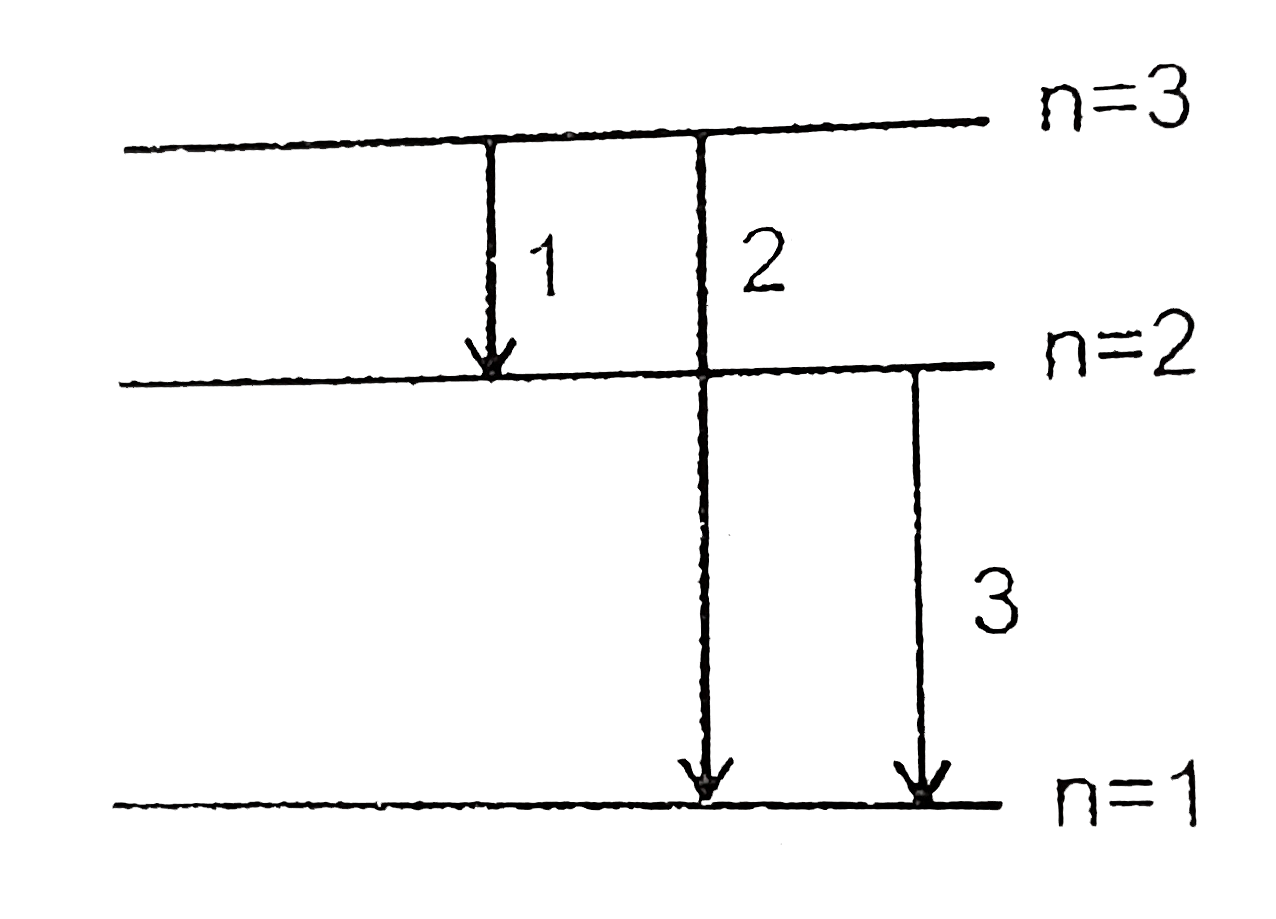
(b) Possible emission lines are only three as shown in figure. The correspinding frequencies are
`V_(1)=((E_(3)-E_(2)))/(h)`
`=({-6.04-(-13.6)}xx1.6xx10^(-19))/(6.63xx10^(-34))Hz`
`=1.82xx10^(15)Hz`
`V_(2)=(E_(2)-E_(1))/(h)`
`=({-6.04-(54.4)}xx1.6xx10^(1-9))/(6.63xx10^(-34))Hz`
`11.67xx10^(15)Hz`
and `V_(3)=(E_(2)-E_(1))/(h)`
`=({-13.6-(54.4)}xx1.6xx10^(-19))/(6.63xx10^(-34))Hz`
`9.84xx10^(15)Hz`
Hence, the frequencies of emitted radiations are `1.82xx10^(5)Hz, 11.67xx10^(15)Hz` and `9.84xx10^(15)Hz`.
Promotional Banner

Topper's Solved these Questions

  • ATOMIC PHYSICS

    RESONANCE|Exercise Exercise -3 part -I JEE (Advanced)|86 Videos
  • ALTERNATING CURRENT

    RESONANCE|Exercise HIGH LEVEL PROBLEMS|11 Videos
  • CAPACITANCE

    RESONANCE|Exercise High Level Problems|16 Videos

Similar Questions

Explore conceptually related problems

A neutron of kinetic 6.5 eV collides inelastically with a singly ionized helium atom at rest. It is scattered at an angle 90^(@) with respect to its original direction. Find the minimum allowed value of energy of the neutron.

A photon of energy 10.5eV is allowed to interact with a hydrogen atom in its ground state. Then :

A neutron with an energy of 4.6 MeV collides elastically with proton and is retarded. Assuming that upon each collision the neutron is deflected by 45^(@) , find the number of collisions which will reduce its energy to 0.23 eV .

A neutron having kinetic energy 12.5eV collides with a hydrogen atom at rest negect the difference in mass between the neutron and the hydrogen atom and assume that the neutron does not leave its of motion find the posible kinetic energy of the neutron after the event

A neutron in a nuclear reactor collides head on elastically with the nucleus of a carbon atom initially at rest. The fraction of kinetic energy transferred from the neutron to the carbon atom is

RESONANCE-ATOMIC PHYSICS-Advanved level problems
  1. A small particle of mass m move in such a way the potential energy (U ...

    Text Solution

    |

  2. Suppose the potential energy between an electron and aproton at a dist...

    Text Solution

    |

  3. In atension from state n to a state of excitation energy 10.19 eV, hyd...

    Text Solution

    |

  4. Suppose in certine condition only those transition are allowed to hydr...

    Text Solution

    |

  5. Find the velocity of photoelectrons liberated by electromagnetic radia...

    Text Solution

    |

  6. (a) Find the maximum wavelength lambda(0) of light which can ionize a ...

    Text Solution

    |

  7. A beam of monochromatic light of wavelength lambda ejects photoelectro...

    Text Solution

    |

  8. Hydrogen atom in its good state is excited by means of monochromatic r...

    Text Solution

    |

  9. Average lifetime of a hydrogen atom excited to n =2 state is 10^(-6)s ...

    Text Solution

    |

  10. In a hydrogen like ionized atom a single electron is orbiting around ...

    Text Solution

    |

  11. For atoms of light and heavy hydrogen (H and D) fine the difference, ...

    Text Solution

    |

  12. An electron in the ground state of hydrogen atom is revolving in antic...

    Text Solution

    |

  13. A proton and electron, both at rest initially, combine to form a hydro...

    Text Solution

    |

  14. A neutron of kinetic 6.5 eV collides inelastically with a singly ioniz...

    Text Solution

    |

  15. Suppose the potential energy between electron and proton at a distance...

    Text Solution

    |

  16. A positronium consists of an electron and a positron revolving about t...

    Text Solution

    |

  17. In a photoelectric effect set up, a point source of light of power 3.2...

    Text Solution

    |