Home
Class 12
PHYSICS
A positronium consists of an electron an...

A positronium consists of an electron and a positron revolving about their common centre of mass. Calculate the separation between the electron and positron in their first excited state:

Text Solution

Verified by Experts

The correct Answer is:
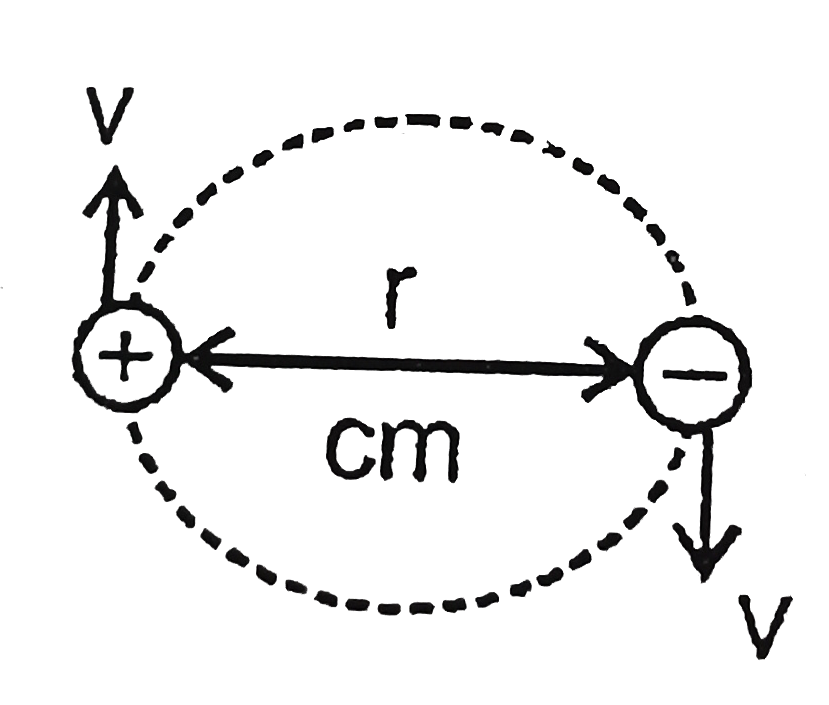
(i) ` r_(0)=(2h^(2))/(pi^(2)m)xx(4piepsilon_(0))/(e^(2))=4.23Å`
(ii) `(1)/(2)((e^(2)pi)/(4pi epsilon_(0)h))J=3.4 eV`

From Bohr hypothesis
`(mv^(2))/(r//2)=(1)/(4piepsilon_(0)).(e^(2))/(r ^(2))`
`rArr 2mv^(2)r=(1)/(4piepsilon_(0)).e^(2)`.....(1)
and `(nh)/(2pi)=mvr`.....(2)
from (1) and (2)
`v=(1)/(4piepsilon_(0)).(e^(2))/(nh)xx(2pi)/(2)`
`(1)/(4piepsilon_(0))/(e^(2)pi).(nh)`

(i) `r=(nh)/(2pi).(1)/(m).(4piepsilon_(0).n^(2)h^(2))/(pime^(2))`
(ii) `KE=(1)/(2)mv^(2)=(1)/(2)m((e^(2))/(4epsilon_(0)h))=3.4 eV`
Promotional Banner

Topper's Solved these Questions

  • ATOMIC PHYSICS

    RESONANCE|Exercise Exercise -3 part -I JEE (Advanced)|86 Videos
  • ALTERNATING CURRENT

    RESONANCE|Exercise HIGH LEVEL PROBLEMS|11 Videos
  • CAPACITANCE

    RESONANCE|Exercise High Level Problems|16 Videos

Similar Questions

Explore conceptually related problems

A positronium atom consist of an electron and a positron revolving about their common centre of mass . Calculate Separation between the electron and positron in their first excited state.

A positronium atom consist of an electron and a positron revolving about their common centre of mass . Calculate Kinetic energy of the electron in ground state

Calculate the orbital period of the electron in the first excited state of hydrogen atom.

the energy required to excite an electron in hydrogen atom to its first excited state is

Find the wavelength of electron orbiting in the first excited state of hydrogen atom.

Calculate the first excitation energy of electron in the hydrogen atom.

The positronium consisting of an electron and a positron corresponding binding energy and wavelength of first line in Lyman series of such a system.

RESONANCE-ATOMIC PHYSICS-Advanved level problems
  1. A small particle of mass m move in such a way the potential energy (U ...

    Text Solution

    |

  2. Suppose the potential energy between an electron and aproton at a dist...

    Text Solution

    |

  3. In atension from state n to a state of excitation energy 10.19 eV, hyd...

    Text Solution

    |

  4. Suppose in certine condition only those transition are allowed to hydr...

    Text Solution

    |

  5. Find the velocity of photoelectrons liberated by electromagnetic radia...

    Text Solution

    |

  6. (a) Find the maximum wavelength lambda(0) of light which can ionize a ...

    Text Solution

    |

  7. A beam of monochromatic light of wavelength lambda ejects photoelectro...

    Text Solution

    |

  8. Hydrogen atom in its good state is excited by means of monochromatic r...

    Text Solution

    |

  9. Average lifetime of a hydrogen atom excited to n =2 state is 10^(-6)s ...

    Text Solution

    |

  10. In a hydrogen like ionized atom a single electron is orbiting around ...

    Text Solution

    |

  11. For atoms of light and heavy hydrogen (H and D) fine the difference, ...

    Text Solution

    |

  12. An electron in the ground state of hydrogen atom is revolving in antic...

    Text Solution

    |

  13. A proton and electron, both at rest initially, combine to form a hydro...

    Text Solution

    |

  14. A neutron of kinetic 6.5 eV collides inelastically with a singly ioniz...

    Text Solution

    |

  15. Suppose the potential energy between electron and proton at a distance...

    Text Solution

    |

  16. A positronium consists of an electron and a positron revolving about t...

    Text Solution

    |

  17. In a photoelectric effect set up, a point source of light of power 3.2...

    Text Solution

    |

