Home
Class 12
CHEMISTRY
Oxygen differs from the other elements o...

Oxygen differs from the other elements of the group. Compounds of oxygen with metals are more ionic in nature and hydrogen bonding is more important for oxygen compounds. Oxygen is never more than divalent beacasue when it hs formed two covalent bonds, there are no low energy orbitals which can be used for form. further bonds. However, the elements S,Se,Te and Po have empty d- orbitals which may be used for bonding, and they can form four or six bonds by unpairing electrons. The higher oxidation states become less stable on decending the group.
The bond between S and O, or Se and O, are much shorter than might be expected for a single bond owing to `rho pi - dpi` interaction between the p- orbital of oxygen and d- orbital of S or Se.
Which of the following statemet is incorrect ?

A

Oxo-anions of sulpher have little tendency to pholymerise compared with the phosphates and sillicates.

B

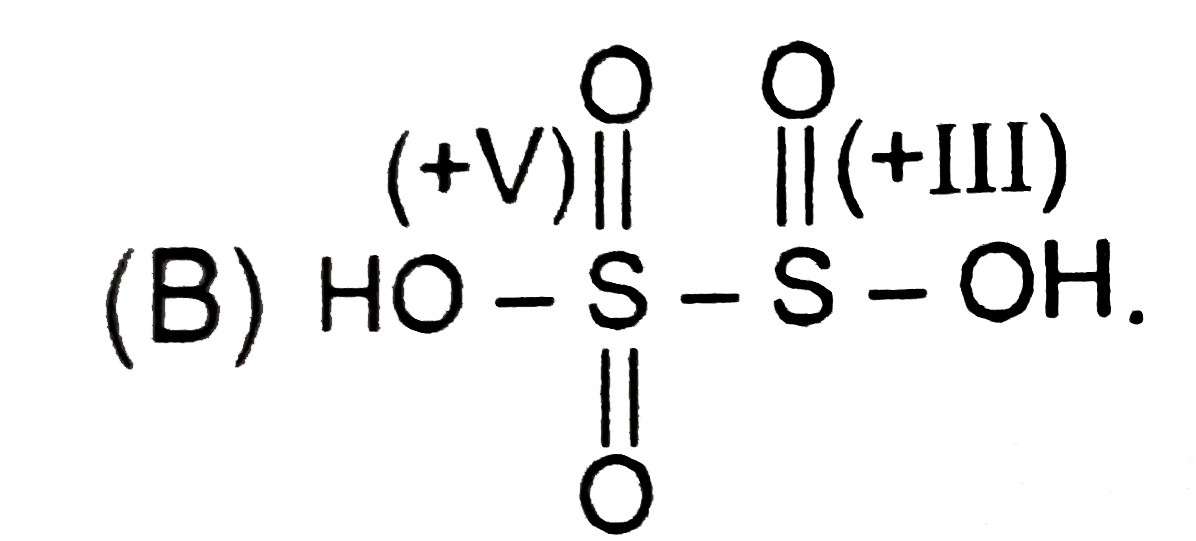
In pyrosulphurous acid `(H_(2)S_(2)O_(5))` the oxidation states of both the sulpher atoms are not same, they are `+V and +III`

C

Concentrated `HNO_(3)` oxidises both sulpher and selenium to `H_(2)SO_(4)` (+VI)` and `H_(2) SeO_(4)(+VI)` respectively.

D

Most metal oxides are ionic and basic in nature while non-metallic oxides are usually covalent and acidic in nature.

Text Solution

Verified by Experts

(A) It is true because of effictive `p pi-dpi` overlaping owing to small size of sulpher as compared to phosphorous and silicon.
(B)
They have `+V` and `+III` oxidation state.
(C ) `HNO_(3)` oxidies sulphur to `H_(2)SO_(4)` (+VI) but only oxidies selenium to `H_(2)Se_(3)` (+VI). The higher oxidation states become less stable on decending the group.
(D) In M-O electronegativity difference is large while in X-O, it is comparatively smaller `(lt 1.4)`.
M=meatal and X = non -meatal .
Promotional Banner

Topper's Solved these Questions

  • P BLOCK ELEMENTS

    RESONANCE|Exercise ALP EX #3 OBJECTIVE|1 Videos
  • P BLOCK ELEMENTS

    RESONANCE|Exercise ALP PART 1 SUBJECTIVE|3 Videos
  • P BLOCK ELEMENTS

    RESONANCE|Exercise PART -III : Match the column|2 Videos
  • NUCLEAR CHEMISTRY

    RESONANCE|Exercise STAGE-II|1 Videos
  • P-BLOCK ELEMENT (BORON AND CARBON FAMILY)

    RESONANCE|Exercise PART - III : OLYMPIAD PROBLEMS (PREVIOUS YEARS) STAGE - V (INTERNATIONAL CHEMISTRY OLYMPIAD (IChO)) Problem 3|8 Videos

Similar Questions

Explore conceptually related problems

Oxygen differs from the other elements of the group. Compounds of oxygen with metals are more ionic in nature and hydrogen bonding is more important for oxygen compounds. Oxygen is never more than divalent beacasue when it hs formed two covalent bonds, there are no low energy orbitals which can be used for form. further bonds. However, the elements S,Se,Te and Po have empty d- orbitals which may be used for bonding, and they can form four or six bonds by unpairing electrons. The higher oxidation states become less stable on decending the group. The bond between S and O, or Se and O, are much shorter than might be expected for a single bond owing to rho pi - dpi interaction between the p- orbital of oxygen and d- orbital of S or Se. Which one of the following orders represents the correct order for the properties indicated against them?

Which atom can have more than eight valence electrons when it is forming covalent bonds ?

Which of the following elements always forms covalent bonds?

The ionisation energy of nitrogen is more than that of oxygen because

Which of the following elements can form both ionic and covalent bonds ?