Home
Class 12
PHYSICS
ABC is an isosceles right angled triangu...

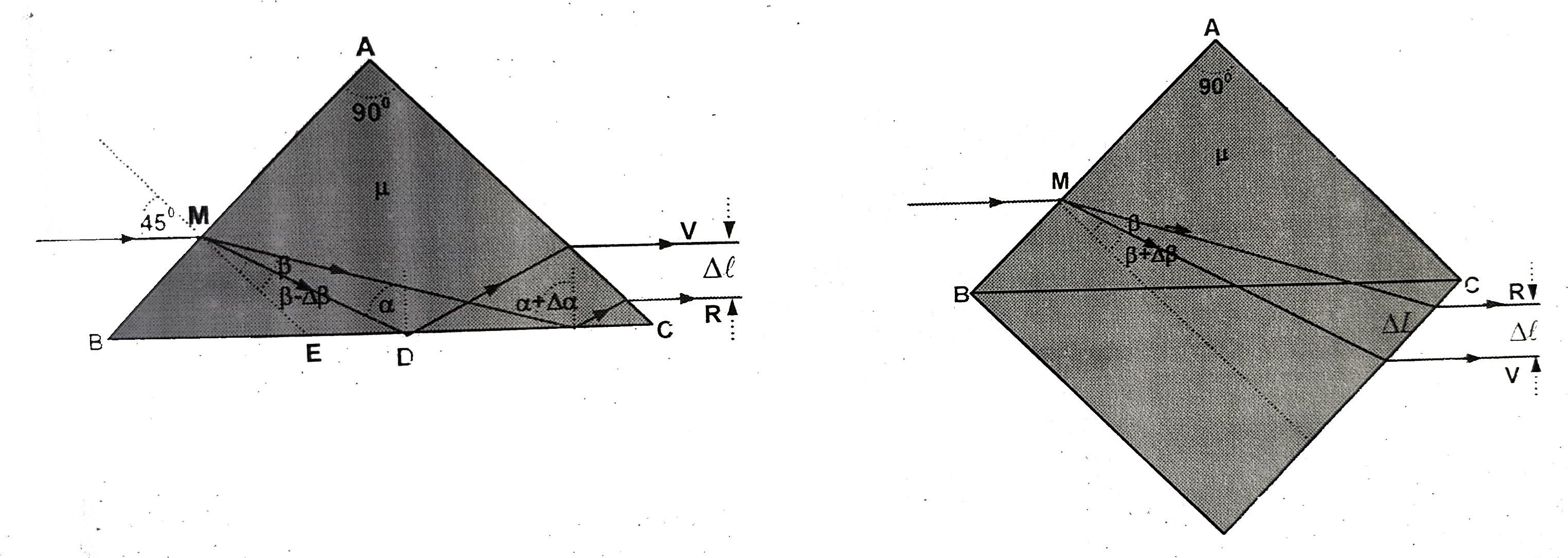
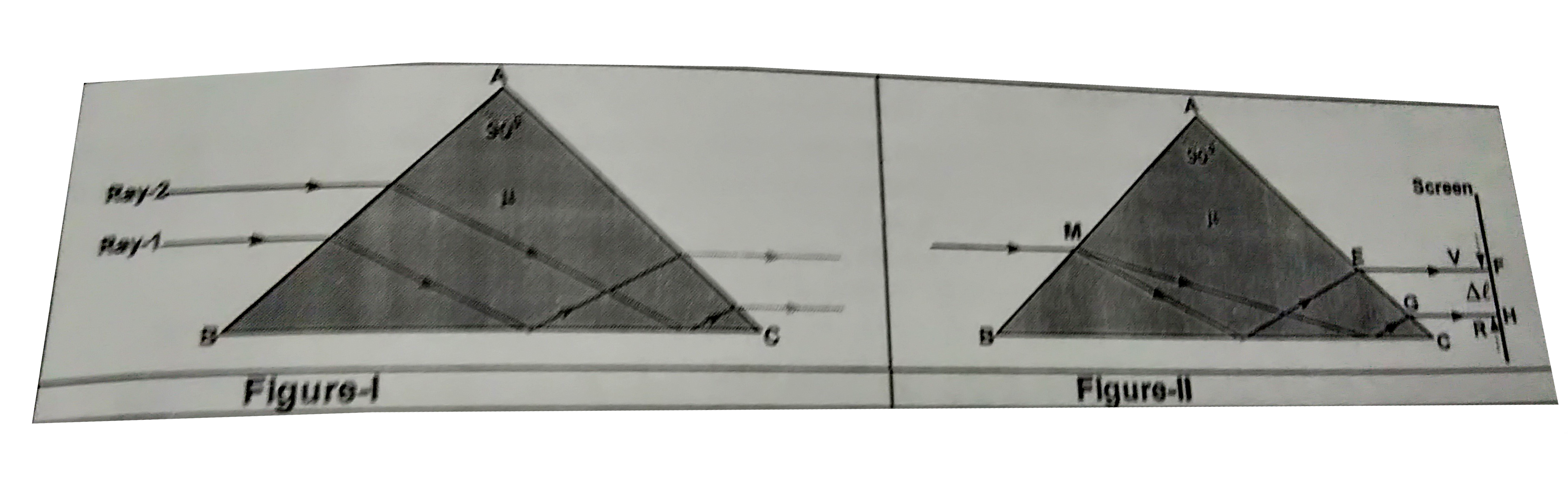
`ABC` is an isosceles right angled triangular refecting prism of average refractive index `mu`. When incident rays on face `AB` are paralel to face `BC`, then they emerges from Face `AC`, which are also parallel to Face `BC` as shown in figure-I. The prims capable to do so, known as Dove Prism. In figure II, the Dove Prism is used for dispersion of incident light containing red colour and violet colour only. The red colour and violet colour lights are separated (displaced) on screen by a distance `Deltal`. In reality, each ray of any colour has some width, whcih can be designated as `d`. It is clear that an observer candistinguish the red and violet rays that emerges from prism only if `Deltalged`. Otherwise the bundles of rays will overlap and mix.
[Given for Dove Prism in figure II: `mu_(R)=sqrt(5/2),Deltamu=mu_(V)-mu_(R)=0.02, sqrt(5)=2.25, EF1m` and `AB=4cm`]

Choose the INCORRECT option

A

As per figure-I, the average refractive index of Dove Prism may be greater than 1

B

As per figure I the average refractive index of Dove Prism may be greater than `sqrt(2)`

C

As per figure II ,the displacement `Deltal` depends upon average refractive index `mu` and length of `AB`

D

As per figure II, he displacement `Deltal` depends upon average refractive index `mu` and length of `EF`

Text Solution

Verified by Experts

The correct Answer is:
D

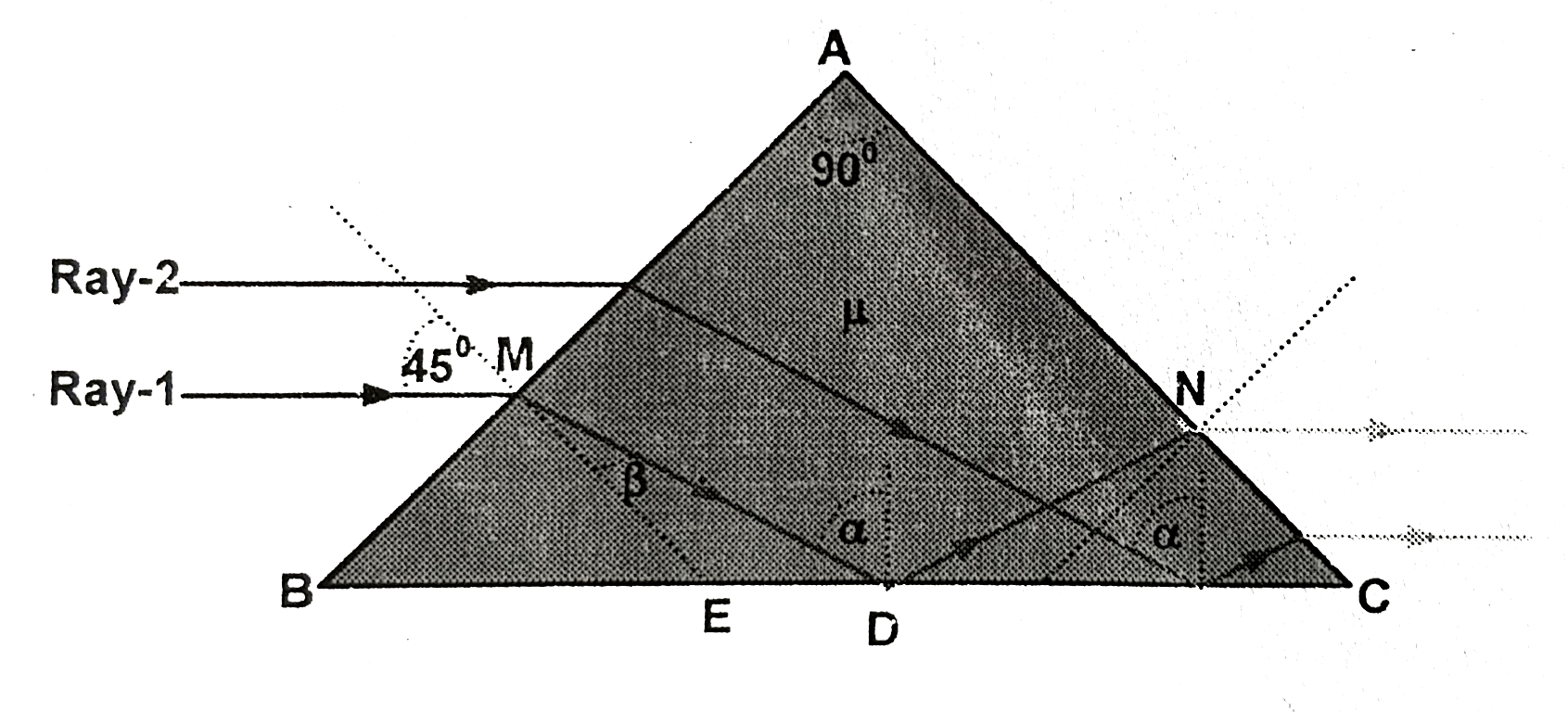
In figure -I, total internal reflection take place at face `AB`.
`/_EMD+/_MDE=/_BEM`
`implies beta(90-alpha)=45^(@)`
`impliessin(beta+45^(@))gt(1/(mu))`
`implies sin beta+cosbeta gt (sqrt(2))/(mu)`……….(1)

According to law of refraction at point `M`, we can write
`1xxsin(45^(@))=musin betaimpliessin betas=1/(musqrt(2))impliescosbeta=sqrt(1-1/(2mu^(2))`
Putting these value in equation (1), we have
`1/(musqrt(2))+sqrt(1- 1/(2mu^(2))) gt (sqrt(2))/(mu)implies sqrt(2mu^(2)-1) gt 1implies mu gt 1`
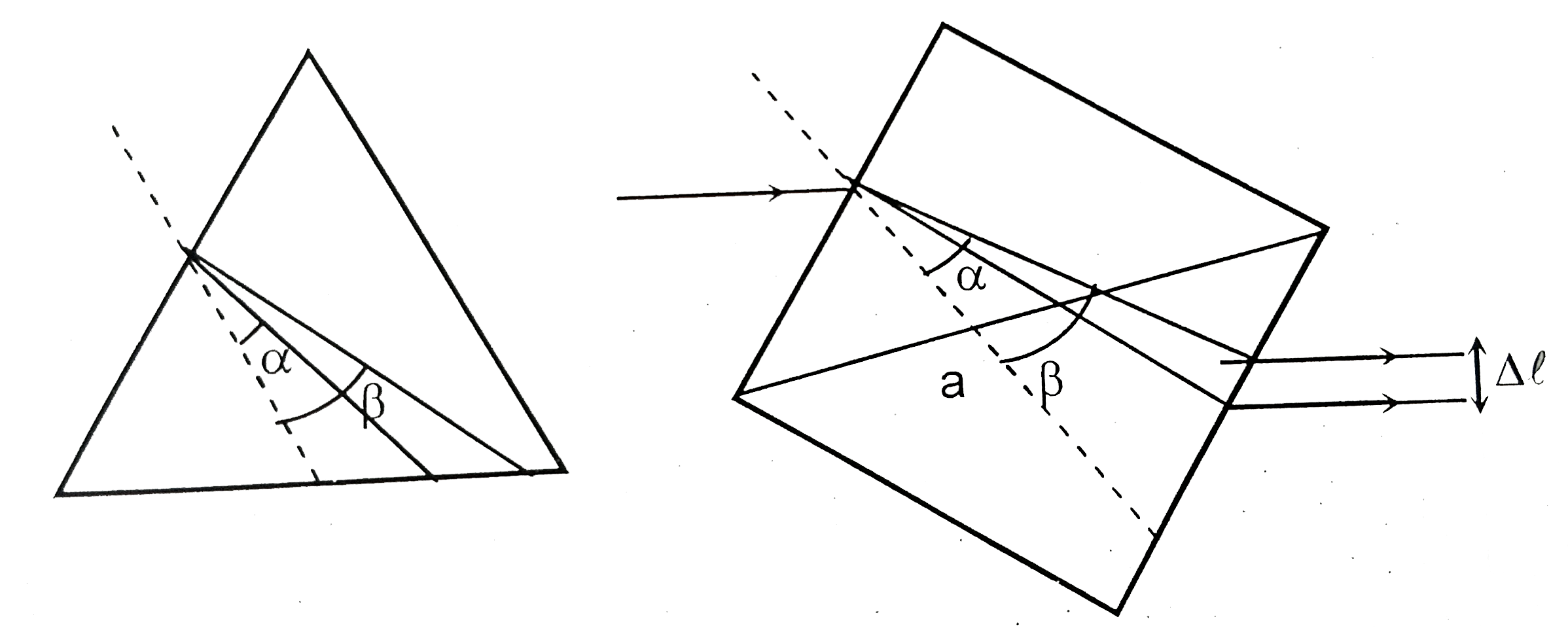
In figure II: Replace the Dove Prism, by glass cube of side as `AB`

`Deltal=(DeltaL)/(sqrt(2))`.............(2)
From geometry, we can write
`sinbeta=1/(mu_(R)sqrt(2))` and `sin (beta-Deltabeta)=1/((mu_(R)+Deltamu_(R))sqrt(2))`
`DeltaL=a tan beta-a tan (beta-Deltabeta)=1/(sqrt(2mu_(R)^(2)-1))-a/(sqrt(2(mu_(|r)+Deltamu)^(2)-1))`
`impliesDelta=a/(sqrt(2mu_(R)^(2)-1))(1-sqrt((2mu_(R)^(2)-1)/(2(mu_(R)+Deltamu)^(2)-1)))=a/(sqrt(mu_(R)^(2)-1))(1-sqrt((2mu_(R)^(2)-1)/(2(mu_(R)+Deltamu)^(2)-1)))`
`impliesDeltaL=a/(sqrt(2mu_(R)^(2)-1))(1-sqrt(2mu_(R)^(2)-1)/(2mu_(R)^(2)+4mu_(R)Deltamu+2(Deltamu)^(2)-1))`
Neglecting the value `(Deltamu)^(2)`, we have
`impliesDelta=a/(sqrt(2mu_(R)^(2)-1))(1-sqrt(1/(1+(4mu_(R)Deltamu)/(2mu_(R)^(2)-1))))-a/(sqrt(2m_(R)^(2)-1))(1-{1+(4mu_(R)Deltamu)/(2mu_(R)^(2)-1)}^(-1/2))`
Expand binomially, we have
`impliesDeltaL=(2amu_(R)Deltamu)/((2mu_(R)^(2)-1)^(3/2))`
Putting this value in equation (2), we have
`Deltal=(sqrt(2)amu_(R)Deltamu)/((2mu_(R)^(2)-1)^(3/2))`
Second method:
`DeltaL=(d/(dbeta)(a tan beta))xxDeltabeta`
`DeltaL=(asec^(2)beta)xxDeltabeta`
Also `sinbeta=1/(sqrt(2)mu_(R))`
`impliescos beta Deltabeta=1/(sqrt(2)mu_(R)^(2))Deltamu`
`impliesDeltaL=(asec^(2)betaxxDeltamu)/(sqrt(mu_(R)^(2)cosbeta`
`impliesDeltaL=(2amu_(R)Deltamu)/((2mu_(R)^(2)cosbeta)`
Third method:
`Deltal=(DeltaL)/(sqrt(2)), sin alpha = 1/ (mu_(r) sqrt(2)), sin beta=1/(mu_(v)sqrt(2))`
`DeltaL=atan alpha =a tan beta`
`=[1/(sqrt(2mu_(r)^(2)-1))-1/(sqrt(2mu_(v)^(2)-1))]`
`=a[1/2-1/(2sqrt(1+mu_(r)Deltamu))]`
`=a/2 [a-(1+mu_(r)Deltamu)^(-1//2)]`
`=a/2[1-1+1/2mu_(r)Deltamu]`
`=a/4mu_(r)Deltamu`
`Deltal=(DeltaL)/(sqrt(2))=a/(4sqrt(2)) mu_(r)Deltamu=(4cm)/(4sqrt(2))xx(sqrt(5))/(sqrt(2))xx2/100`
`=(sqrt(5))/100 cm = sqrt(5)xx10^(-4)m`
`=2.25xx10^(-4)m`
Since : `Deltal ge d`
`impliesd le 2.25xx 10^(-4)m`
`sqrt(2mu_(v)^(2)-1)=sqrt(2(mu_(r)+Deltamu)^(2)-1)`
`impliessqrt(4+4mu_(r)Deltamu)[(Deltamu)^(2)~~0]`
`=2sqrt(1+mu_(r)Deltamu)`
Promotional Banner

Topper's Solved these Questions

  • TEST PAPERS

    FIITJEE|Exercise PHYSICS|747 Videos
  • SIMPLE HARMONIC MOTION

    FIITJEE|Exercise Assignment Problems (Objective) (Level-II)|20 Videos
  • WORK, ENERGY AND POWER

    FIITJEE|Exercise COMPREHENSIONS ( Comprehension-II)|5 Videos

Similar Questions

Explore conceptually related problems

A ray of light the face AB of a glass prism of refractive index mu at an angle of incidence i . Find the value of i such that no ray emerges from the face AC of the prism. Given angle of prism is A .

A ray of light enters the face AB of a glass prism of refractive index mu at an angle of incidence i . Find the value of i such that no ray emerges from the face AC of the prism, given angle of prism is A .

A glass prism has a refractive angle of 90^(@) and a refractive index of 1.5. A ray is incident at an angle of 30^(@) . The ray emerges from an adjacent face at an angle of

Light enters an isosceles right triangular prism at normal incidence through face AB and undergoes total internal reflection at face BC as shown below. The minimum value of the refractive index of the prism is close to

An isosceles prism has one of the refracting surfaces silvered. A ray of light is incident normally on the refracting face AB. After two reflections, the ray emerges from the base of the prism perpendicular to it. Find the angle of the prism.

If a light ray incidents normally on one of the faces of the prism of refractive index 2 and the emergent ray just grazes the second face of the prism, then the angle of deviation is

FIITJEE-TEST PAPERS-PHYSICS
  1. Choose the correct statement(s).

    Text Solution

    |

  2. When a yellow light of wavelength 6000Å from a sodium lamp falls on a ...

    Text Solution

    |

  3. An electromagnetic radiation of wavelength ranging between 400nm and 1...

    Text Solution

    |

  4. A certain ideal spring stretches 20cm when m(1)=40gm mass is hung from...

    Text Solution

    |

  5. I am a verneir Calliper. I have a task to measure the length of a penc...

    Text Solution

    |

  6. A triple slit experiment is performed as shown in the figure with mono...

    Text Solution

    |

  7. One end of thin aluminium rod (cross -sectional Area =10^(-6)m^(2)) is...

    Text Solution

    |

  8. There are two cylinder shaped wooden billets, each having a mass of ma...

    Text Solution

    |

  9. Consider a wave sent down a string in the positive direction whose equ...

    Text Solution

    |

  10. Consider a wave sent down a string in the positive direction whose equ...

    Text Solution

    |

  11. ABC is an isosceles right angled triangular refecting prism of average...

    Text Solution

    |

  12. ABC is an isosceles right angled triangular refecting prism of average...

    Text Solution

    |

  13. If the dimension of a physical quantity (EB)/(mu) is M^(a)L^(b)T^(c). ...

    Text Solution

    |

  14. A 200cm length of the wire weighs 0.6 gm. If the tension in the wire c...

    Text Solution

    |

  15. A glass sphere of refractive index 1.5 forms the real image of object ...

    Text Solution

    |

  16. A large cylindrical container with open top contains a liquid upto hei...

    Text Solution

    |

  17. The figure shows a crude type of perfume atomizer. When bulb at A is c...

    Text Solution

    |

  18. A hydrogen atom in ground state, moving with speed v collides with ano...

    Text Solution

    |

  19. A soap bubble is being blown on a tube of radius 1cm. The surface tens...

    Text Solution

    |

  20. A light ray is incident on a rotating mirror, which is rotating with a...

    Text Solution

    |