Home
Class 12
PHYSICS
An electron is either released from rest...

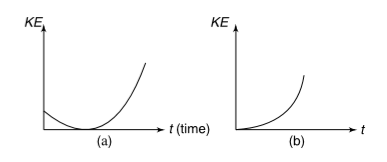
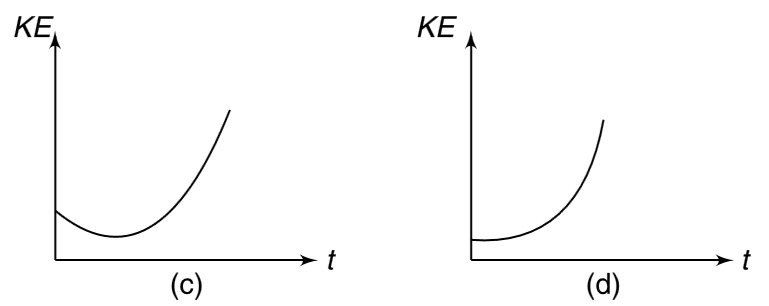
An electron is either released from rest or projected with some initial velocity in a uniform electric field. Neglect any other force on the electron apart from electrostatic force. Which of the graphs shown in fig could possibly represent the change in kinetic energy of the electron during its course of motion? Explain the situation in each case.

Text Solution

Verified by Experts

The correct Answer is:

All graphs are possible
(a). Electron has been projected in the direction of electric field
(b). Electron has been released from rest
(c). Electron has been projected making an acute angle with field
(d). Electron has been projected in a direction making an obtuse angle or right angle to the direction of field.
Promotional Banner

Topper's Solved these Questions

Similar Questions

Explore conceptually related problems

A rigid electric dipole is force to move in the electric field represented in the figure. Which one of the following phrases most accurately describes the initial motion of the dipole if it released from rest in the position shown ?

A particle of mass and charge is released from rest in a uniform electric field. If there is no other force on the particle, the dependence of its kinetic energy on the distance travelled by it is correctly given by (graphs are schematic and not drawn to scale)

an electron is released from rest in a region of uniform electric and magnetic field acting parallel to each other. The electron will (A) move in a straight line (B) move in a circle (C) remain stationary (D) move in a helical path

A proton and an electron are released from an infinite distance apart and they get attracted towars each other. Which of the following statement about their kinetic energy is true?

The Betatron was the first important machine for producing high energy electrons. The action of the betatron depends on the same fundamental principle as that of the transformer in which an alternating current applied to a primary coil induces an altermating current usually with higher or lower voltage in the secondary coil. In the betatron secondary coil is replaced by a doughnut shaped vacuum chamber.Electron produced in the doughnut from a hot filament, are given a preliminary acceleration by the application of an electric field having potential difference of 20 kV to 70 kV , when an alternating magnetic field is applied parallel to the axis of the tube, two effects are produced (1) an electromotive force is produced in the electron orbit by the changing magnetic flux that gives an additional energy to the electrons (2) a radial force is produced by the action of magnetic field whose direction is perpendicular to the electron velocity. Which keeps the electron moving in a circular path. Conditions are arranged such that the increasing magnetic field keeps the electron in a circular orbit of constant radius. The mathematical relation between the betatron parameters to ensure the above condition is called BETATRON condition. If the orbit radius of the circular path traced by the electron is R , magnetic field is B , speed of the electron is v , mass of the electron is m , charge on the electron is e and phi is the flux within the orbit of radius R . Then answer the following questions based on the above comprehension. What is the value of (d(m|vecv|))/(dt) ?

Read the following text and answer the following questions on the basis of the same: Band theory of solid: Consider that the Si or Ge crystal contains N atoms. Electrons of each atom will have discrete energies in different orbits. The electron energy will be same if all the atoms are isolated, i.e., separated from each other by a large distance. However, in a crystal, the atoms are close to each other (2 Å to 3 Å) and therefore the electrons interact with each other and also with the neighbouring atomic cores. The overlap (or interaction) will be more felt by the electrons in the outermost orbit while the inner orbit or core electron energies may remain unaffected. Therefore, for understanding electron energies in Si or Ge crystal, we need to consider the changes in the energies of the electrons in the outermost orbit only. For Si, the outermost orbit is the third orbit (n = 3), while for Ge it is the fourth orbit (n = 4). The number of electrons in the outermost orbit is 4 (2s and 2p electrons). Hence, the total number of outer electrons in the crystal is 4N. The maximum possible number of outer electrons in the orbit is 8 (2s + 6p electrons). So, out of the 4N electrons, 2N electrons are in the 2N s-states (orbital quantum number l = 0) and 2N electrons are in the available 6N p-states. Obviously, some p-electron states are empty. This is the case of well separated or isolated atoms. The maximum possible electrons in an orbit is:

Read the following text and answer the following questions on the basis of the same: Band theory of solid: Consider that the Si or Ge crystal contains N atoms. Electrons of each atom will have discrete energies in different orbits. The electron energy will be same if all the atoms are isolated, i.e., separated from each other by a large distance. However, in a crystal, the atoms are close to each other (2 Å to 3 Å) and therefore the electrons interact with each other and also with the neighbouring atomic cores. The overlap (or interaction) will be more felt by the electrons in the outermost orbit while the inner orbit or core electron energies may remain unaffected. Therefore, for understanding electron energies in Si or Ge crystal, we need to consider the changes in the energies of the electrons in the outermost orbit only. For Si, the outermost orbit is the third orbit (n = 3), while for Ge it is the fourth orbit (n = 4). The number of electrons in the outermost orbit is 4 (2s and 2p electrons). Hence, the total number of outer electrons in the crystal is 4N. The maximum possible number of outer electrons in the orbit is 8 (2s + 6p electrons). So, out of the 4N electrons, 2N electrons are in the 2N s-states (orbital quantum number l = 0) and 2N electrons are in the available 6N p-states. Obviously, some p-electron states are empty. This is the case of well separated or isolated atoms. The energy of electrons of atoms of a substance will be same if:

Read the following text and answer the following questions on the basis of the same: Band theory of solid: Consider that the Si or Ge crystal contains N atoms. Electrons of each atom will have discrete energies in different orbits. The electron energy will be same if all the atoms are isolated, i.e., separated from each other by a large distance. However, in a crystal, the atoms are close to each other (2 Å to 3 Å) and therefore the electrons interact with each other and also with the neighbouring atomic cores. The overlap (or interaction) will be more felt by the electrons in the outermost orbit while the inner orbit or core electron energies may remain unaffected. Therefore, for understanding electron energies in Si or Ge crystal, we need to consider the changes in the energies of the electrons in the outermost orbit only. For Si, the outermost orbit is the third orbit (n = 3), while for Ge it is the fourth orbit (n = 4). The number of electrons in the outermost orbit is 4 (2s and 2p electrons). Hence, the total number of outer electrons in the crystal is 4N. The maximum possible number of outer electrons in the orbit is 8 (2s + 6p electrons). So, out of the 4N electrons, 2N electrons are in the 2N s-states (orbital quantum number l = 0) and 2N electrons are in the available 6N p-states. Obviously, some p-electron states are empty. This is the case of well separated or isolated atoms. The overlap (or interaction) will be more felt by the electrons when they are:

ARIHANT-ELECTROSTATICS-Level 3
  1. An electron is either released from rest or projected with some initia...

    Text Solution

    |

  2. Three small equally charged identical conducting balls are suspended f...

    Text Solution

    |

  3. Two charged particle of equal mass are constrained to move along X and...

    Text Solution

    |

  4. Consider a uniformly charged spherical shell. Two cones having same se...

    Text Solution

    |

  5. Two point charges +q(1) and -q(2) are placed at A and B respectvely. A...

    Text Solution

    |

  6. There is a semi-infinite hollow cylindrical pipe (i.e. one end extends...

    Text Solution

    |

  7. Two equal insulating threads are placed parallel to each other. Separa...

    Text Solution

    |

  8. If coulomb's law were F=K(qQ)/(r^(3)), calculate the electric field du...

    Text Solution

    |

  9. A sermicircular ring of radius R carries a uniform linear charge of la...

    Text Solution

    |

  10. A small charged ball is in state of equilibrium at a height h above a ...

    Text Solution

    |

  11. In a certain region of space the electrostatic field depends only on t...

    Text Solution

    |

  12. A solid sphere of radius R has total charge Q. The charge is distribut...

    Text Solution

    |

  13. A ball of radius R carries a positive charge whose volume charge depe...

    Text Solution

    |

  14. A frustum is cut from a right circular cone. The two circular faces ha...

    Text Solution

    |

  15. The electric field in a region of space varies as E=(xhati+2yhatj)+3zh...

    Text Solution

    |

  16. A ball of radius R has a uniformly distributed charge Q. The surroundi...

    Text Solution

    |

  17. A uniform semicircular ring of radius R is in yz plane with its centre...

    Text Solution

    |

  18. A charge – Q is placed at some distance from a neutral conductor. Char...

    Text Solution

    |

  19. A soap bubble of radius R = 1 cm is charged with the maximum charge fo...

    Text Solution

    |

  20. A conducting sphere of radius R is cut into two equal halves which are...

    Text Solution

    |

  21. Surface tension of a soap solution is T. There is a soap bubble of rad...

    Text Solution

    |
