Home
Class 12
PHYSICS
A fuse F(1) is connected across a source...

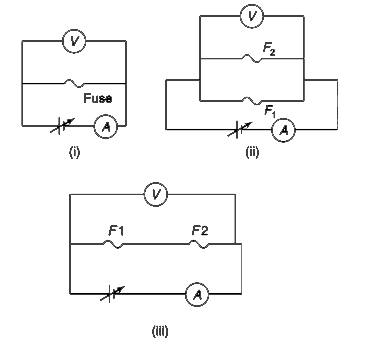
A fuse `F_(1)` is connected across a source of variable voltage and the voltage is increased gradually. The fuse blows out just when the reading of the voltmeter and ammeter reaches `1.0 V and 1.0 A` respectively (see figure (i)). The experiment is repeated with another fuse `F_(2)` and the reading of the voltmeter and ammeter when it blows out is `2.4 V and 1.2 A` respectively.
(a) The two fuses are connected in parallel as shown in figure (ii). Voltage is increased gradually. find the reading of the ammeter when any one of the fuses blows out.
(b) The two fuses are connected in series as shown in figure (iii). find the reading of the voltmeter at the point one of the fuses blows out.

Text Solution

Verified by Experts

The correct Answer is:

(a) 1.5 A
(b) 3.0 V
Promotional Banner

Topper's Solved these Questions

  • CAPACITOR

    ARIHANT|Exercise Capacitor|50 Videos
  • ELECTROMAGNETIC INDUCTION

    ARIHANT|Exercise Level 3|12 Videos

Similar Questions

Explore conceptually related problems

In the given circuit the readings of the voltmeter V_(1) and the ammeter A are .

The reading of ammeter and voltmeter in the following circuit are respectively

If the resistance R_(1) is increased how will the reading of the ammeter and voltmeter change

If the resistance R_(1) is increased (see figure), how will the reading of the ammeter and voltmeter change ?

In the given circuit the reading of voltmeters V_1 andV_2 are 300 volt each . The reading of the voltmeter V_3 and ammeter A are respectively

In the circuit shown in figure neglecting source resistance the voltmeter and ammeter reading will respectively, will be

In a circuit shown in figure. What will be the readings of a voltmeter and ammeter, if AC source of 220 V and 100 Hz is connected ?

An ammeter A, a voltmeter V and a resistance R are connected as shown in the figure. If the voltmeter reading is 1.6V and the ammeter reading is 0.4 A, then R is

ARIHANT-CURRENT ELECTRICITY-Current Electricity
  1. An infinite network of resistances has been made as shown in the figur...

    Text Solution

    |

  2. Find equivalent resistance between points A and B in the figure. Each ...

    Text Solution

    |

  3. A fuse F(1) is connected across a source of variable voltage and the v...

    Text Solution

    |

  4. In the circuit shown in the figure. find I(1) and I(2).

    Text Solution

    |

  5. In the network shown calculate current through the cell (I1) and the c...

    Text Solution

    |

  6. In the circuit shown, R=2 Omega and V = 20 volt. With switch S open th...

    Text Solution

    |

  7. The box shown in the figure has a device which ensures that I(C) = 0.9...

    Text Solution

    |

  8. In the circuit shown in figure find the equivalent resistance across p...

    Text Solution

    |

  9. Find the percentage change in power supplied by the cell after the swi...

    Text Solution

    |

  10. A and B are two identical bulbs of 40 W connected to a V = 12 volt cel...

    Text Solution

    |

  11. Find equivalent resistance between points A and B in the circuit shown...

    Text Solution

    |

  12. Find current through the cell and potential difference between A and D...

    Text Solution

    |

  13. Eight identical 1 volt cells are connected to make a ring as shown in ...

    Text Solution

    |

  14. A battery of 120 V and internal resistance r = 0.5 Omega is used to ch...

    Text Solution

    |

  15. A voltmeter of resistance R(V) and an ammeter of resistance R(A) are c...

    Text Solution

    |

  16. In the circuit shown in the figure, cell is ideal and R(2) = 100 Omega...

    Text Solution

    |

  17. In the circuit shown, an ideal cell of emf E is connected in series to...

    Text Solution

    |

  18. In the circuit shown, which way would you move the sliding contact, to...

    Text Solution

    |

  19. In the circuit shown in figure. AB is a uniform wire of length L and r...

    Text Solution

    |

  20. A rotary potentiometer has a circular resistance (C) and a conducting ...

    Text Solution

    |
