Home
Class 11
CHEMISTRY
A tripeptide on complete hydrolysis give...

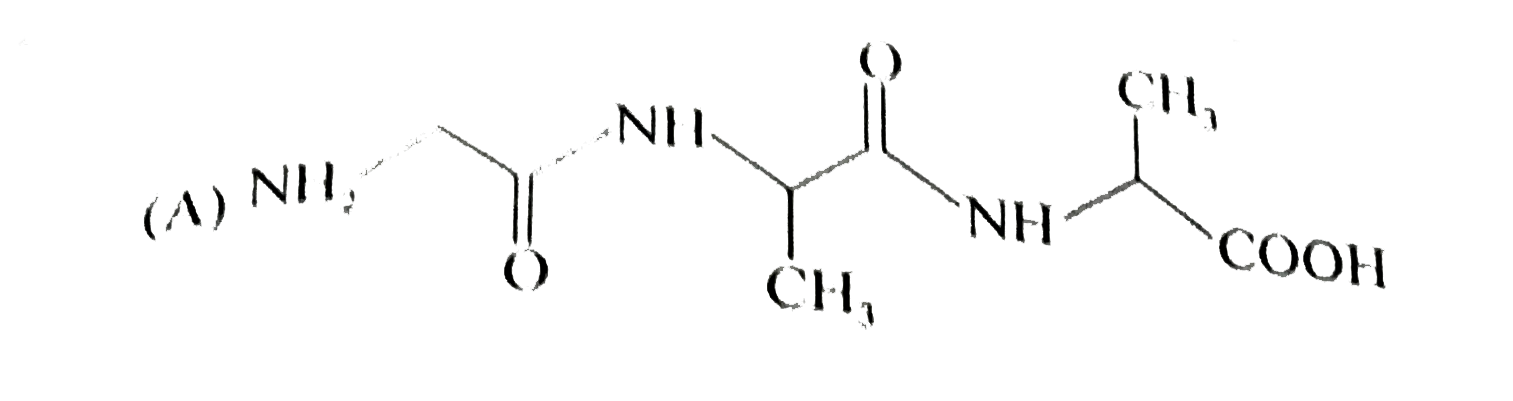
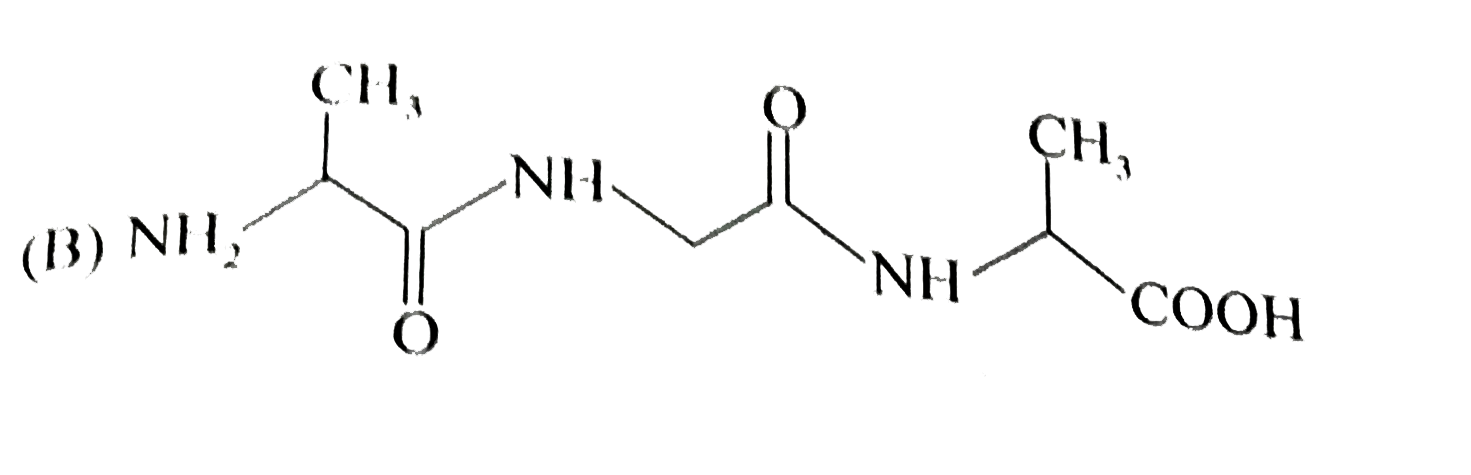
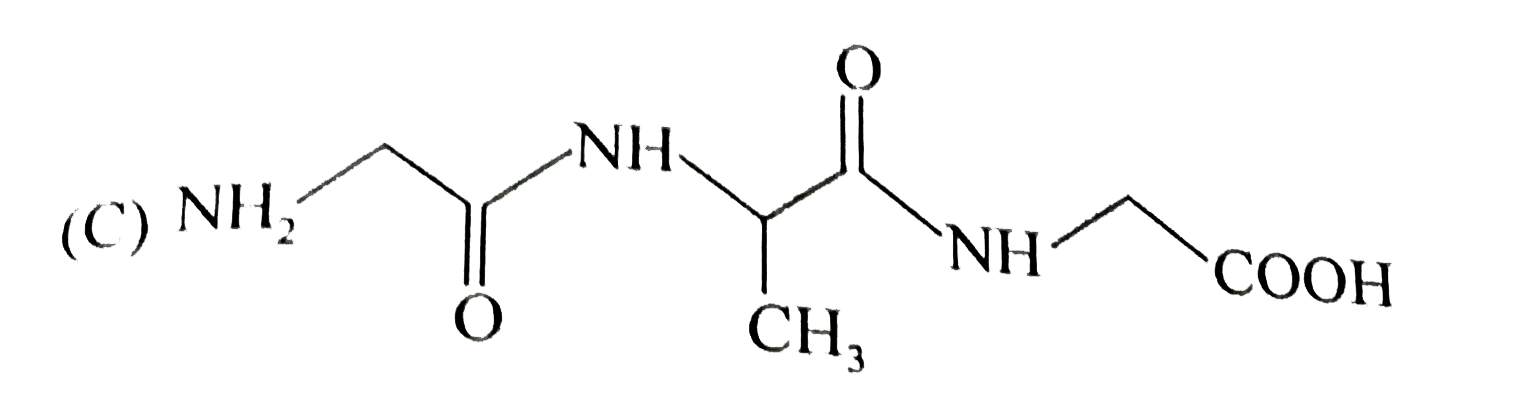
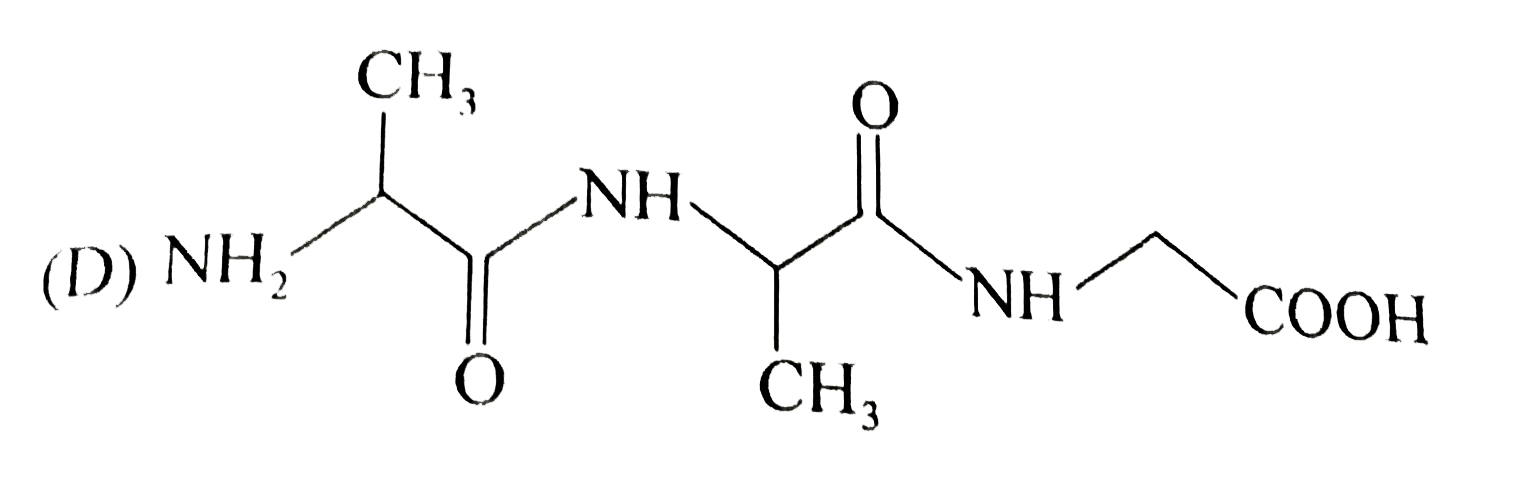
A tripeptide on complete hydrolysis gives glycine, alanine, and phenylanine,using three-letter symbols write down the possible sequences of the tripeptide.

A

B

C

D

Text Solution

Verified by Experts

The correct Answer is:
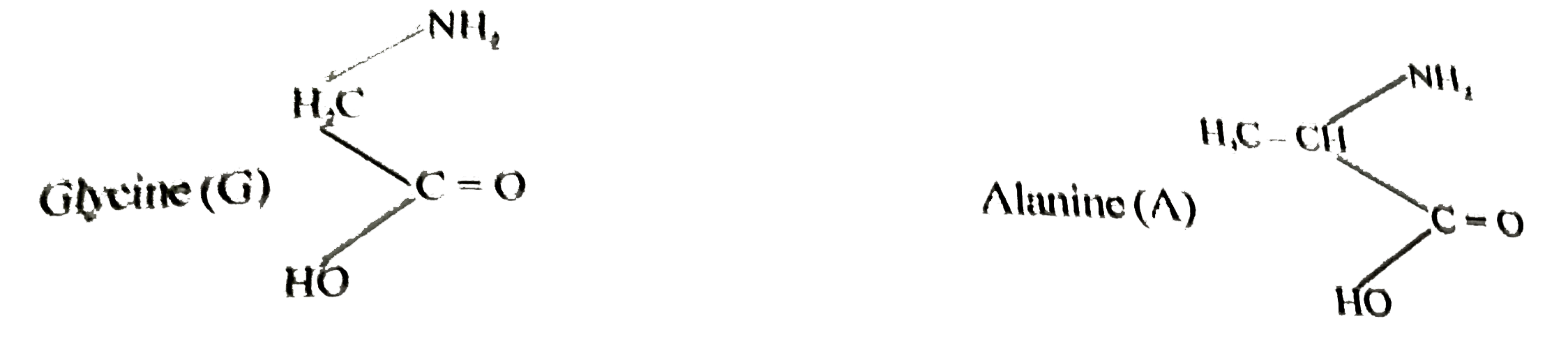
C

Trace the units
Promotional Banner

Topper's Solved these Questions

  • GENERAL ORGANIC CHEMISTRY

    BANSAL|Exercise Exercise 2|39 Videos
  • GENERAL ORGANIC CHEMISTRY

    BANSAL|Exercise Exercise 3|9 Videos
  • GENERAL ORGANIC CHEMISTRY

    BANSAL|Exercise Exercise 3|9 Videos
  • ATOMIC STRUCTURE

    BANSAL|Exercise Exercise.3|35 Videos
  • HYDROCARBONS

    BANSAL|Exercise Exercise 3|12 Videos

Similar Questions

Explore conceptually related problems

A tripeptide oon complete hydrolysis gives glycine, alanine, and phenylanine,using three-letter symbols write down the possible sequences of the tripeptide.

A decapeptide (Mol. Wt. 769) on complete hydrolysis gives glycine (Mol. Wt. 75), alanine and phenylalanine. Glycine contributes 47.0 % to the total weight of the hydrolysed products. The number of glycine units. Present in the decapeptide is.

A decapeptide (Molecular weight 796) on complete hydrolysis gives glycine (Molecular weight 75), alanine and phenylanine. Glycine contributes 47.0 % to the total weight of the hydrolysed products. The number of glycine units present in the decapeptide is

A tripeptide contains glycine, alanine and serine. How many different sequences are possible ?

Tetrapeptide is made of naturally occuring alanine , serine, glycine and valine . If the C-terminal amino acid is alanine and the N-terminal amino acid is chiral , the number of possible sequences of the tetrapeptide is

Knowledge Check

  • A decapiptide (Mol. Wt. 796) on complete hydrolysis gives glycine (Mol. Wt. 75), alanine and phenylalanine. Glycine contributes 47.0% to the total weight of the hydrolysed product. The number of glycine units present in the decapeptide is

    A
    6
    B
    5
    C
    4
    D
    3
  • A tripeptide contains glycine, alanine and serine. How many different sequences are possible ?

    A
    27
    B
    8
    C
    6
    D
    9
  • A tripeptide is written as Glycine -Alanine -Glycine .

    A
    B
    C
    D
  • BANSAL-GENERAL ORGANIC CHEMISTRY-Exercise 1
    1. A tripeptide on complete hydrolysis gives glycine, alanine, and phenyl...

      Text Solution

      |

    2. Which compound can exist in a dipolar (zwitter ion) state

      Text Solution

      |

    3. Which of the following statement is incorrect for maltose.

      Text Solution

      |

    4. Identify the correct statement about lactose.

      Text Solution

      |

    5. Naturally occuring (+)- sucrose

      Text Solution

      |

    6. D-Ribose when treated with dilute HNO(3) forms.

      Text Solution

      |

    7. Consider the given process. And identify the incorrect statement

      Text Solution

      |

    8. Glucose underset((ii)P//KI)overset((i)HCN//H(3)O^(o+))toP P is

      Text Solution

      |

    9. The configuration fo the C - 2 epimer of D - glucose is

      Text Solution

      |

    10. Mutarotation involves

      Text Solution

      |

    11. Same osazone derivative is obtained in case of D-golucose, D-Mannose a...

      Text Solution

      |

    12. Which of the following compounds will not show maturotation:

      Text Solution

      |

    13. Amylose and cellulose both are linear polymers of glucose. The differe...

      Text Solution

      |

    14. Glycogen on hydrolysis gives:

      Text Solution

      |

    15. Hydrolysis of d-sucrose results in change of optical rotation because

      Text Solution

      |

    16. The colour of the precipitate formed when a reducing sugar is heated w...

      Text Solution

      |

    17. Osazone formation involves only 2 carbon atoms of glucose because of

      Text Solution

      |

    18. alpha-D (+)-glucose and beta-D(+)-glucose are:

      Text Solution

      |

    19. Hydrolysis of lactose with dilute acid yields:

      Text Solution

      |

    20. Cellulose is a straight-chain polysaccharide conposed of only:

      Text Solution

      |

