Home
Class 11
PHYSICS
A block of mass m compresses a spring io...

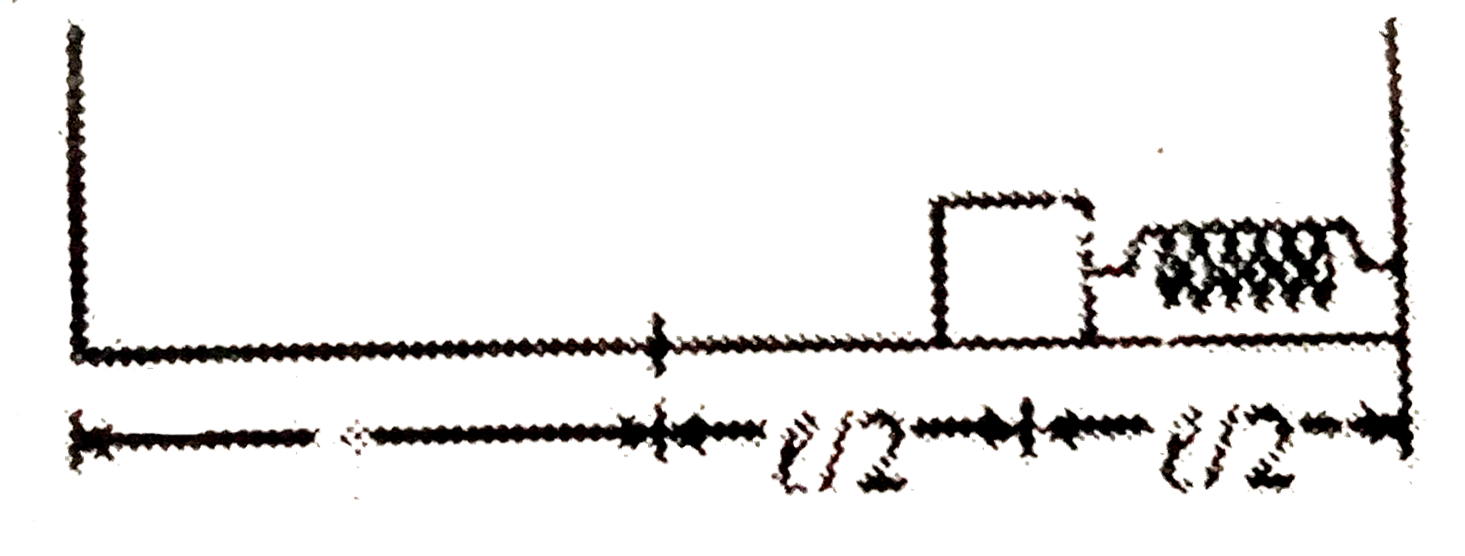
A block of mass m compresses a spring iof stifffness k through a distacne `l//2` as shown in the figure .If the block is not fixed to the spring the period of motion of the block is

A

`2pisqrt((m)/(k))`

B

`(pi+4)sqrt((m)/(k))`

C

`(1+pi)sqrt((m)/(k))`

D

None of these

Text Solution

Verified by Experts

The period of oscillation `=2pisqrt((m)/(k))`
`rArr ` The period of motion till the block is in contact with the spring is
`t=(T)/(2)=pisqrt((m)/(k))` then it leaves the spring with a speed `v=omegaA`
`v=(sqrt((k)/(m)))((l)/(2))`
Then it moves with constant velocity `v` for a distance `D=l+l=2l`
`rArr` The corresponding time of motion `=t_(2)=2l//v`
`rArr t_(2)=(2l)/((l)/(2)sqrt((k)/(m)))=4sqrt((m)/(k))`
`:. ` The time period of motion `=t=t_(1)+t_(2)=pisqrt((m)/(k))+4sqrt((m)/(k))`
`=sqrt((m)/(k))[pi+4]`.
Promotional Banner

Topper's Solved these Questions

  • ROTATIONAL MECHANICS

    FIITJEE|Exercise Example|17 Videos
  • WORK, ENERGY & POWER

    FIITJEE|Exercise Example|18 Videos

Similar Questions

Explore conceptually related problems

A block of mass m is at rest on an another block of same as shown in figure lower block is atteched to the spring than the maximum amplitude of motion as than both the block will remain as mat both the block will remain in contact is

A block of mass m moving at a speed v_0 compresses a spring of spring constant k as shown in the figure. Find (a) the maximum compression of spring and (b) speed of the block when the spring is compressed to half of maximum compression.

A block of mass m is released from rest onto a spring. A having stiffness k_A=mg//2h as shown in figure. If the block compresses spring B through a distance h, find the: a. stiffness of the spring B b. equilibrium position of the block c. maximum velocity of the block d. maximum acceleration of the block

A block of mass m, lying on a smooth horizontal surface, is attached to a spring (of negligible mass) of spring constant k. The other end of the spring is fixed, as shown in the figure. The block is initally at rest in its equilibrium position. If now the block is pulled withe a constant force F, the maximum speed of the block is :

Two springs are in a series combination and are attached to a block of mass 'm' which is in equilibrium. The spring constants and extension in the springs are as shown in the figure. Then the force exerted by the spring on the block is :

A block of mass m moving with a velocity v_(0) on a smooth horizontal surface strikes and compresses a spring ofstiffuess k till mass coines to rest as shown in the figure. This phenomenon is observed by two observers : (a) Standing on the horizontal surface (b) standing on the block To an observer B, when the block is compressing the spring :

A block of mass m held touching the upper end of a light spring of force constant K as shown in figure. Find the maximum potential energy stored in the spring if the block is released suddenly on the spring.

Two blocks of masses m_(1) and m_(2) are kept on a smooth horizontal table as shown in figure. Block of mass m_(1) (but not m_(2) is fastened to the spring. If now both the blocks are pushed to the left so that the spring is compressed a distance d. The amplitude of oscillatin of block of mass m_(1) after the system is released is

