Home
Class 11
PHYSICS
S(1)S(2) are two coherent cources (havin...

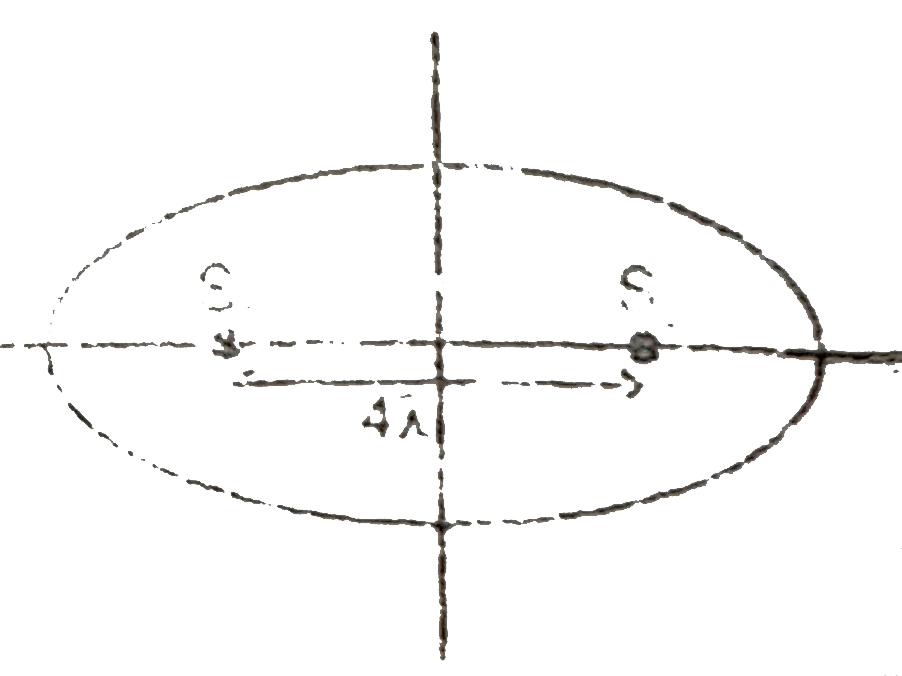
`S_(1)S_(2)` are two coherent cources (having initial phase difference zero) of sound located along`x`-axis separated by `4 lambda` where `lambda` is wavelength of sound emitted by them. Number of maxima located on the ellopical boundry around it will be.

A

`16`

B

`12`

C

`8`

D

`4`

Text Solution

Verified by Experts

The correct Answer is:
A


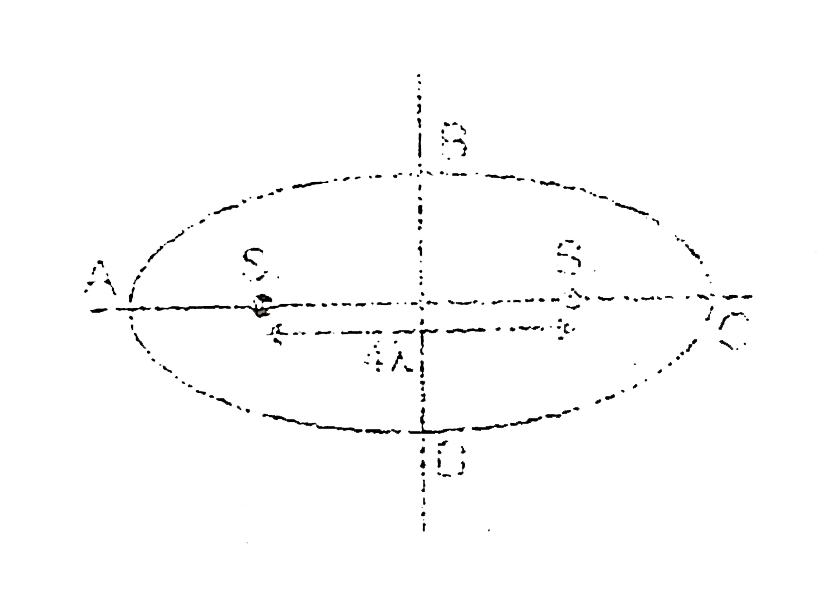
AT `B` Path difference is `O` and at `A` path difference is `4lambda`. From `nlambda` there are `3` maxima position between `A` & `B`. So total maxima in ellipse `= 16`
Note `rarr` if there were circle, rectangle, square instead of ellipse answer is same.
Promotional Banner

Topper's Solved these Questions

  • SOUND WAVES

    RESONANCE|Exercise Exercise- 2 PART - II|20 Videos
  • SOUND WAVES

    RESONANCE|Exercise Exercise- 2 PART - III|21 Videos
  • SOUND WAVES

    RESONANCE|Exercise Exercise- 1 PART - II|30 Videos
  • SIMPLE HARMONIC MOTION

    RESONANCE|Exercise Exercise|28 Videos
  • STRING WAVES

    RESONANCE|Exercise Exercise|32 Videos

Similar Questions

Explore conceptually related problems

S_(1), S_(2) are two choerent sources of sound located along x-axis separated by 4gamma where gamma is wavelength of sond emitted by them. Number of maximum located on the elliptical boundary around it will be :-

two sound sources S_(1) and S_(2) are kept symmetrically about the centre of a circle as shown. The circle is divided is 4 parts. Both the sources are separated by a 8lamda//3 distance. Where lamda is wavelength of sound emitted by the sources. A detector is moving around the circle. How many times it will detect a minima in II part if S_(1) is leading S_(2) by phase of 2pi//3 ?

An inteference is observed due to two coherent sources A and B separated by a distance 4lambda along Y-axis, where lambda is the wavelength of light. A detector 'D' is moved alog the positive X-axis. Find the totla number of maxima observe on the X-axis excluding the points x =0 and x = oo ?

S_1 and S_2 are two coherent sources of sound having no initial phase difference. The velocity of sound is 330m//s . No minimal will be formed on the line passing through S_2 and perpendicular to the line jouning S_1 and S_2 . If the frequency of both the sources is:

S_(1) and S_(2) are two coherent sources of sound having no intial phase difference. The velocity of sound is 330 m//s . No maximum will be formed on the line passing through S_(2) and prependicular to the line joining S_(1) and S_(2) . If the frequency of both the sources is

S_1 and S_2 are two coherent sources of radiations separated by distance 100.25 lambda , where lambda is the wave length of radiation. S_1 leads S_2 in phase by pi//2 .A and B are two points on the line joining S_1 and S_2 as shown in figure.The ratio of amplitudes of component waves from source S_1 and S_2 at A and B are in ratio 1:2. The ratio of intensity at A to that of B (I_A/I_B) is

An interference is observed due to two coherent sources separated by a distance 5lambda along Y-axis, where lambda is the wavelength of light A detector D is moved along the positive X -axis The number of point on the X-axis excluding the points x=0 and x=infty at which resultant intensity will be maximum are

Two coherent sources S_(f) and S_(2) (in phase with ech other) are placed at a distance of 2lambda as shown where lambda is wavelength of sound. A detector moves on line A B parrallel to S_(1)S_(2) . If detector detects maximum intensity at finite distance from O at theta = +- ((pi)/(n)) . Find n

S_(1) and S_(2) are two coherent sources of sound of frequency 110Hz each they have no initial phase difference. The intensity at a point P due to S_(1) is I_0 and due to S_2 is 4I_0 . If the velocity of sound is 330m//s then the resultant intensity at P is

RESONANCE-SOUND WAVES-Exercise- 2 PART - I
  1. When we clap our hands, the sound produced is best described by Here p...

    Text Solution

    |

  2. A light pointer fixed to one prong of a tuning fork touches gnetly a s...

    Text Solution

    |

  3. S(1)S(2) are two coherent cources (having initial phase difference zer...

    Text Solution

    |

  4. Two speakers A and B, placed 1m apart, each produce sound waves of fre...

    Text Solution

    |

  5. In a large room , a person receives direct sound waves from a source 1...

    Text Solution

    |

  6. The displacement of the medium in a sound wave is given by the equatio...

    Text Solution

    |

  7. The ratio of the speed of sound in nitrogen gas to that in helium gas,...

    Text Solution

    |

  8. Two monoatomic ideal gases 1 and 2 of molecular masses m(1) and m(2) r...

    Text Solution

    |

  9. A closed pipe resonates at its fundmental frequency of 300 Hz. Which o...

    Text Solution

    |

  10. A closed organ pipe and an open organ pipe have their first overtones ...

    Text Solution

    |

  11. An open pipe is suddenly closed at one end with the result that the fr...

    Text Solution

    |

  12. There is a set of four tuning forks , one with the lowest frequency vi...

    Text Solution

    |

  13. Two second sources produce progressive waves given by y(1) = 12 cos 10...

    Text Solution

    |

  14. A fixed source of sound emitting a certain frequency appears as f(a) w...

    Text Solution

    |

  15. When a train approaches a stationary observer, the apparent frequency ...

    Text Solution

    |

  16. A police car moving at 22 m/s, chases a motorcylist. The police man so...

    Text Solution

    |

  17. A siren placed at a railway platform is emitting sound of frequency 5 ...

    Text Solution

    |

  18. A train moves towards a stationary observer with speed 34 m//s. The tr...

    Text Solution

    |

  19. A train blowing its whistle moves with a constant velocity v away from...

    Text Solution

    |

  20. In the case of sound waves, wind a blowing from source to reciver with...

    Text Solution

    |

