Home
Class 11
PHYSICS
The vectors vec(a), vec(b) and vec(c) a...

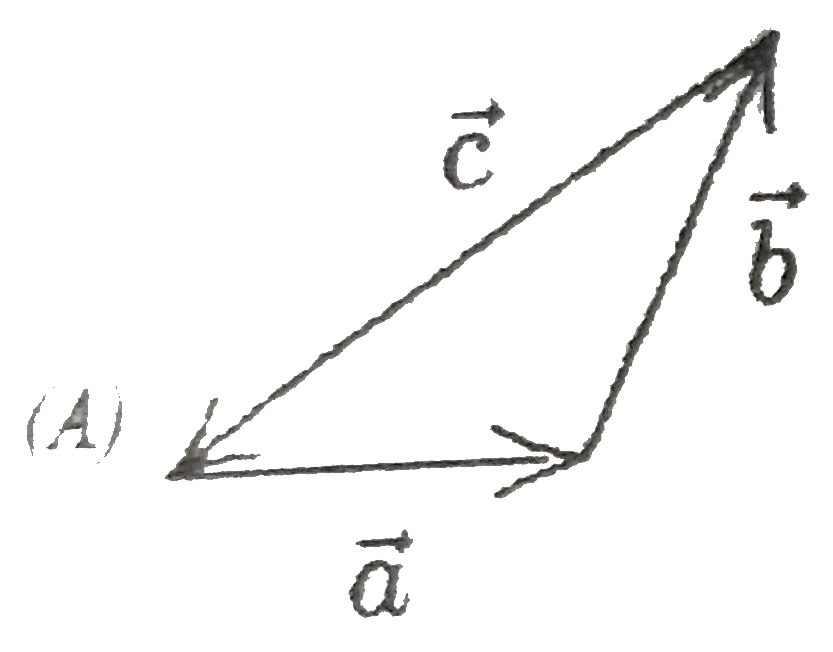
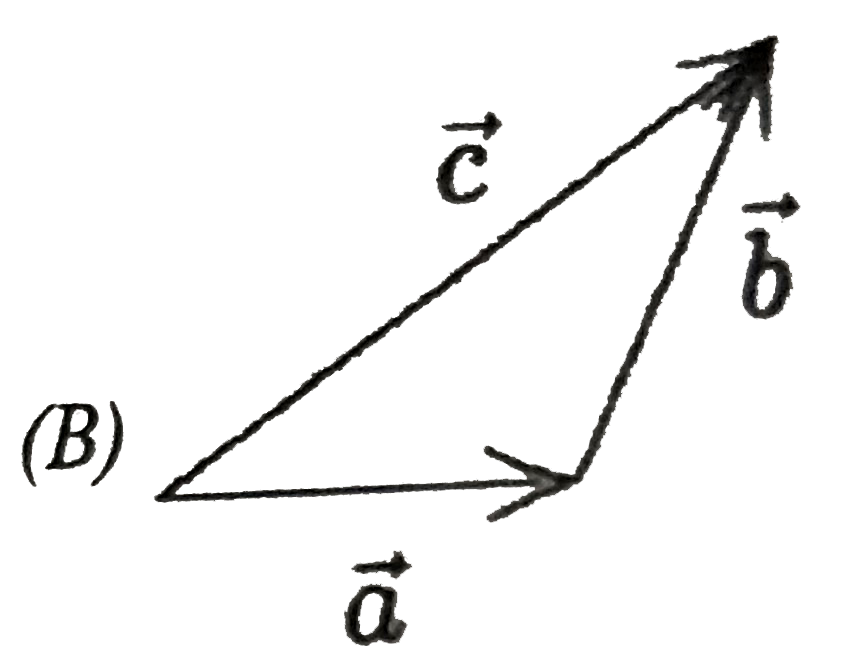
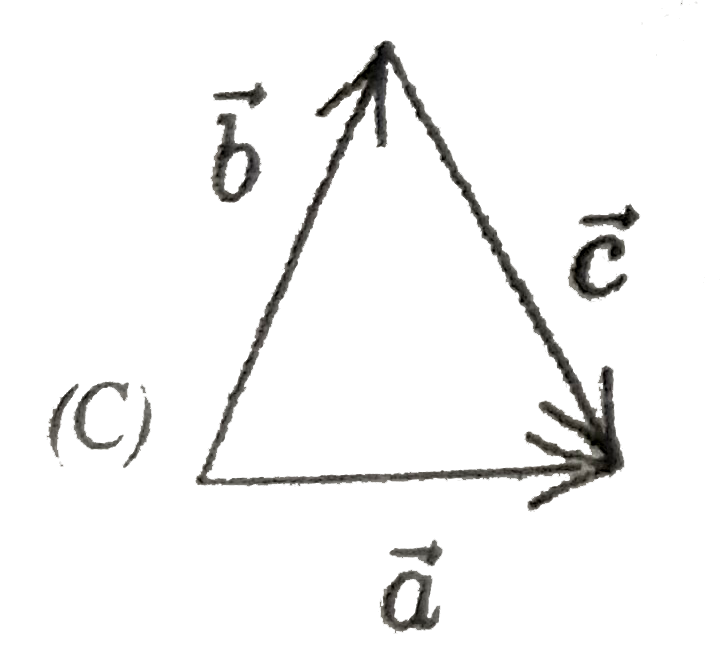
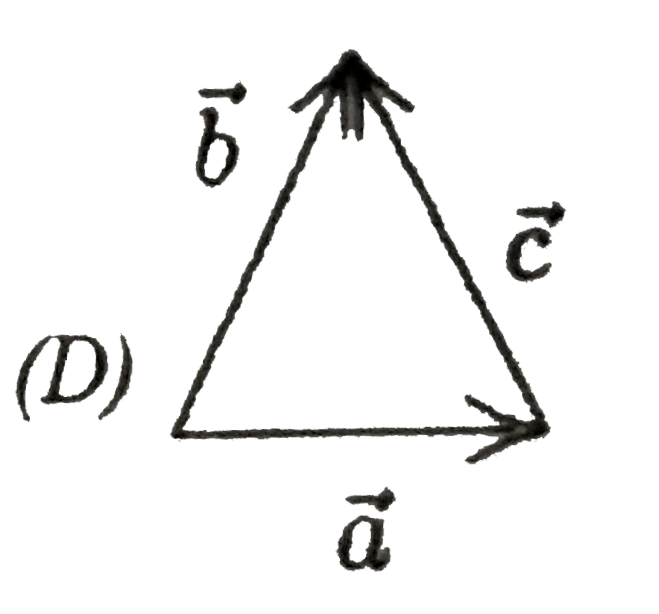
The vectors `vec(a), vec(b) and vec(c) ` are related by `vec(c) = vec(a) + vec(b)` . Which diagram below illustrates this relationship ?

A

B

C

D

Text Solution

AI Generated Solution

The correct Answer is:

To solve the problem, we need to analyze the relationship given by the equation \( \vec{c} = \vec{a} + \vec{b} \) and determine which diagram correctly represents this vector relationship. ### Step-by-Step Solution: 1. **Understanding the Vector Addition**: - The equation \( \vec{c} = \vec{a} + \vec{b} \) indicates that vector \( \vec{c} \) is the resultant of adding vectors \( \vec{a} \) and \( \vec{b} \). - In vector addition, the tail of the second vector (in this case, \( \vec{b} \)) should start from the head of the first vector (here, \( \vec{a} \)). 2. **Analyzing Diagram A**: - In Diagram A, if we start from the tail of \( \vec{a} \), it appears that \( \vec{b} \) starts from the head of \( \vec{a} \), but the resultant \( \vec{c} \) does not start from the head of \( \vec{b} \). - This does not satisfy the relationship \( \vec{c} = \vec{a} + \vec{b} \). - **Conclusion**: Diagram A is incorrect. 3. **Analyzing Diagram B**: - In Diagram B, starting from the tail of \( \vec{a} \), we see that \( \vec{b} \) starts from the head of \( \vec{a} \). - The head of \( \vec{b} \) then represents the head of \( \vec{c} \). - This correctly illustrates that \( \vec{c} \) is the resultant of \( \vec{a} \) and \( \vec{b} \). - **Conclusion**: Diagram B is correct. 4. **Analyzing Diagram C**: - In Diagram C, if we start from the tail of \( \vec{b} \) and then move to \( \vec{c} \), we find that this configuration implies \( \vec{a} \) is not correctly represented as the sum of \( \vec{b} \) and \( \vec{c} \). - This does not satisfy the relationship \( \vec{c} = \vec{a} + \vec{b} \). - **Conclusion**: Diagram C is incorrect. 5. **Analyzing Diagram D**: - In Diagram D, similar to Diagram C, the arrangement does not show \( \vec{c} \) as the resultant of \( \vec{a} \) and \( \vec{b} \). - This also does not satisfy the relationship \( \vec{c} = \vec{a} + \vec{b} \). - **Conclusion**: Diagram D is incorrect. ### Final Answer: The correct diagram that illustrates the relationship \( \vec{c} = \vec{a} + \vec{b} \) is **Diagram B**.

To solve the problem, we need to analyze the relationship given by the equation \( \vec{c} = \vec{a} + \vec{b} \) and determine which diagram correctly represents this vector relationship. ### Step-by-Step Solution: 1. **Understanding the Vector Addition**: - The equation \( \vec{c} = \vec{a} + \vec{b} \) indicates that vector \( \vec{c} \) is the resultant of adding vectors \( \vec{a} \) and \( \vec{b} \). - In vector addition, the tail of the second vector (in this case, \( \vec{b} \)) should start from the head of the first vector (here, \( \vec{a} \)). ...
Promotional Banner

Topper's Solved these Questions

  • UNIT DIMENSION, VECTOR & BASIC MATHS

    BANSAL|Exercise Solved Example|17 Videos
  • UNIT DIMENSION, VECTOR & BASIC MATHS

    BANSAL|Exercise PRACTICE EXERCISE|4 Videos
  • KINETIC THEORY OF GASES

    BANSAL|Exercise Section-B|13 Videos

Similar Questions

Explore conceptually related problems

The non-zero vectors are vec a,vec b and vec c are related by vec a=8vec b and vec c=-7vec b. Then the angle between vec a and vec c is

The non-zero vectors vec a,vec b,vec c are related by vec a=8vec b and vec c=-7vec b then the angle between vec a&vec c

Let three vectors vec(a), vec(b) and vec(c ) be such that vec(a) xx vec(b) = vec(c), vec(b) xx vec(c) = vec(a) and |vec(a)| = 2 . Then which one of the following is not true ?

Three vector vec(A) , vec(B) , vec(C ) satisfy the relation vec(A)*vec(B)=0 and vec(A).vec(C )=0 . The vector vec(A) is parallel to

[vec(a)vec(b)vec(c )]=[vec(b)vec(c )vec(a)]=[vec(c )vec(a)vec(b)] .

Three vectors vec A,vec B and vec C are related as vec A+vec B=vec C .If vector vec C is perpendicular to vector vec A and the magnitude of vec C is equal to the magnitude of vec A, what will be the angle between vectors vec A and vec B .

The vectors vec(a), vec(b), vec(c ) and vec(d) are such that vec(a) xx vec(b) = vec(c ) xx vec(d) and vec(a) xx vec(c )= vec(b) xx vec(d) . Which of the following is/are correct? 1. (vec(a)- vec(d)) xx (vec(b) - vec(c ))= vec(0) 2. (vec(a) xx vec(b))xx (vec(c ) xx vec(d))= vec(0) Select the correct answer using the codes given below

If vec(A), vec(B) and vec(C ) are three vectors, then the wrong relation is :

Show that the vectors vec a,vec b and vec c are coplanar if vec a+vec b,vec b+vec c and vec c+vec a are coplanar.

Show that the vectors vec a,vec b and vec c are coplanar if vec a+vec b,vec b+vec c and vec c+vec a are coplanar.
