Home
Class 11
PHYSICS
It is given that vec(A) + vec(B) =vec(C)...

It is given that `vec(A) + vec(B) =vec(C)` with `vec(A) _|_^(ar) vec(B) ` and
`|vec(A)|=10, |vec(C)|=20`.
Find `|vec(B)|` and angle of `vec(c)` with `vec(A)`

Text Solution

Verified by Experts
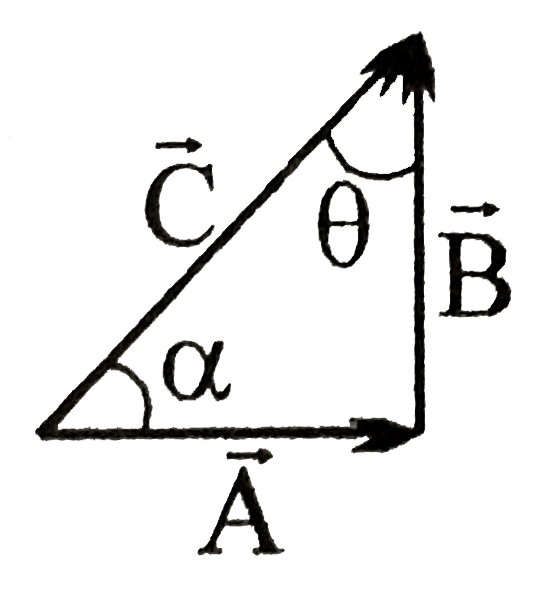
`cos alpha =(|vec(A)|)/(|vec(C)|)`
`alpha=60^(@) and theta=30^(@)`
`vec(A)+vec(B)=vec(C)`
`|vec(C)|^(2)=|vec(A)|^(2)+|vec(B)|^(2)`
`|vec(B)|=10sqrt(3)`
Promotional Banner

Topper's Solved these Questions

  • UNIT DIMENSION, VECTOR & BASIC MATHS

    BANSAL|Exercise Solved Example|17 Videos
  • UNIT DIMENSION, VECTOR & BASIC MATHS

    BANSAL|Exercise PRACTICE EXERCISE|4 Videos
  • KINETIC THEORY OF GASES

    BANSAL|Exercise Section-B|13 Videos

Similar Questions

Explore conceptually related problems

Given that vec(A)+vec(B)=vec(C ) . If |vec(A)|=4, |vec(B)|=5 and |vec(C )|=sqrt(61) , the angle between vec(A) and vec(B) is

Given that vec(A)+vec(B)=vec(C ) and that vec(C ) is perpendicular to vec(A) Further if |vec(A)|=|vec(C )| , then what is the angle between vec(A) and vec(B)

Let vec(a), vec(b) and vec(c) be three vectors such that vec(a) + vec(b) + vec(c) = 0 and |vec(a)|=10, |vec(b)|=6 and |vec(c) |=14 . What is the angle between vec(a) and vec(b) ?

If vec(a)=vec(b)+vec(c ) , then |vec(a)|=|vec(b)+vec(c )| .

Let vec(a), vec(b) and vec(c) be three vectors such that vec(a) + vec(b) + vec(c) = 0 and |vec(a)|=10, |vec(b)|=6 and |vec(c) |=14 . What is vec(a). vec(b) + vec(b).vec(c)+ vec(c). vec(a) . equal to ?

If vec(a) , vec(b) and vec(c ) be three vectors such that vec(a) + vec(b) + vec(c )=0 and |vec(a)|=3, |vec(b)|=5,|vec(C )|=7 , find the angle between vec(a) and vec(b) .

If vec(a),vec(b) and vec(c ) are three vectors such that vec(a)+vec(b)+vec(c )=vec(0) and |vec(a)|=2,|vec(b)|=3 and |vec(c )|=5 , then the value of vec(a)*vec(b)+vec(b)*vec(c)+vec(c)*vec(a) is

If the vectors vec(a), vec(b) and vec(c ) satisfy the condition vec(a)+vec(b)+vec(c )=vec(0) and |vec(a)|=3, |vec(b)| =4 and |vec(c )|=5 , then show that vec(a).vec(b)+vec(b).vec(c )+vec(c ). vec(a)=-25 .

The vector vec(A),vec(B) and vec( C ) are such that |vec(A)|=|vec(B)|,|vec( C )| = sqrt2|vec(A)| and vec(A) + vec(B) + vec( C ) =0. The angles between vec(A) and vec(B), vec(B) and vec( C ) respectively are

If [vec(a) vec(b) vec(c)]=4 then [vec(a)times vec(b) vec(b)times vec(c)vec(c) times vec(a)] =

