Text Solution
Verified by Experts



Topper's Solved these Questions
Similar Questions
Explore conceptually related problems
BANSAL-UNIT DIMENSION, VECTOR & BASIC MATHS-Exercise
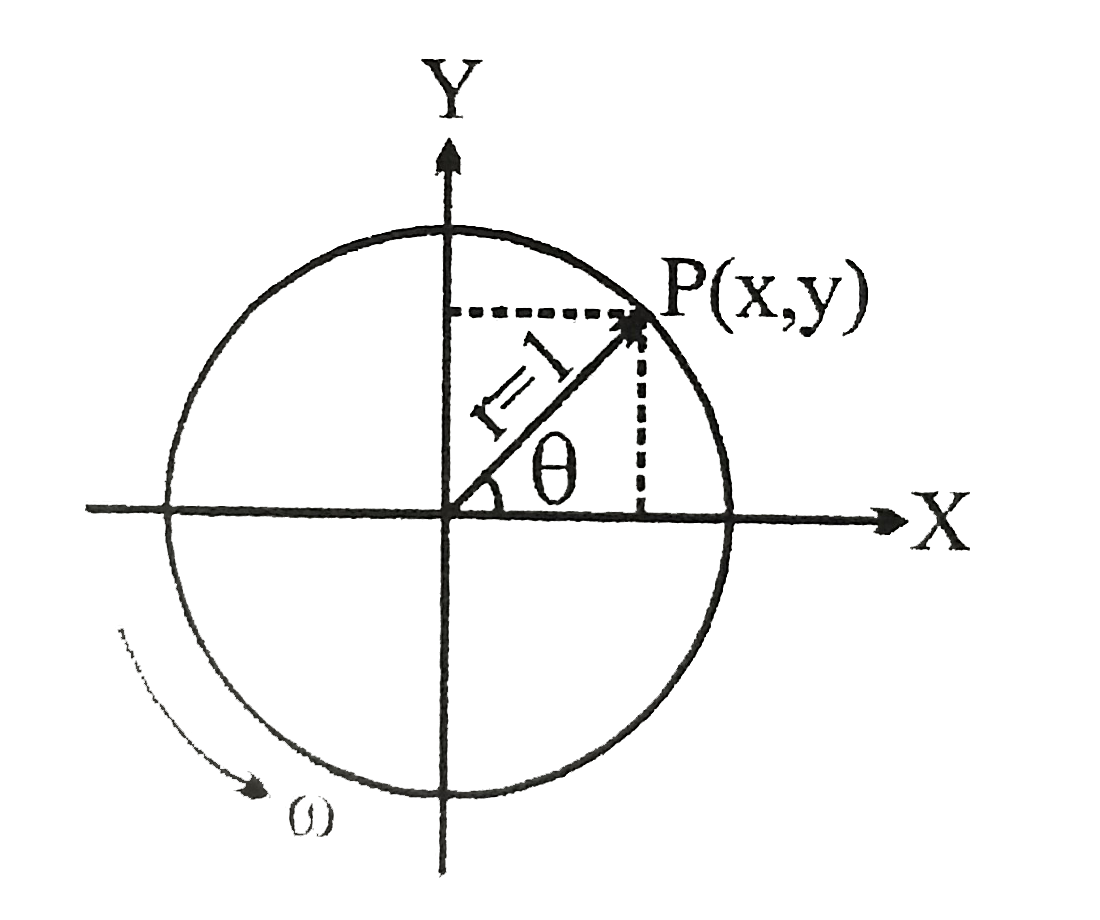
- Find the equation of trajectory for the particle moving in circular pa...
Text Solution
|
- Find (dx)/(dt) (derivative) of w.r.t. t). (i) x=(t^(2)+1)^(3) (ii) ...
Text Solution
|
- If a body is rotating such that its angle from a fixed location is giv...
Text Solution
|
- The charge flowing through a conducting wire with time t is given by t...
Text Solution
|
- A particle moves along the space curve vec(r)=(t^(2)+t)hat(i)+(3t-2)ha...
Text Solution
|
- Find the following integrals: (i)int(1)^(9)(dx)/(sqrt(x))" " (ii) in...
Text Solution
|
- Find the following integrals: (i)int(1)^(9)(dx)/(sqrt(x))" " (i...
Text Solution
|
- If velocity of a particle is given by v=3t^(2)-6t +4. Find its displac...
Text Solution
|
- The velocity-time graph of a linear motion is shown below. Find the (a...
Text Solution
|
- The position vector of a particle moving in x-y plane is given by vec(...
Text Solution
|
- Find value of sqrt(101)
Text Solution
|