Home
Class 11
CHEMISTRY
The gas A(2) in the left flask allowed t...


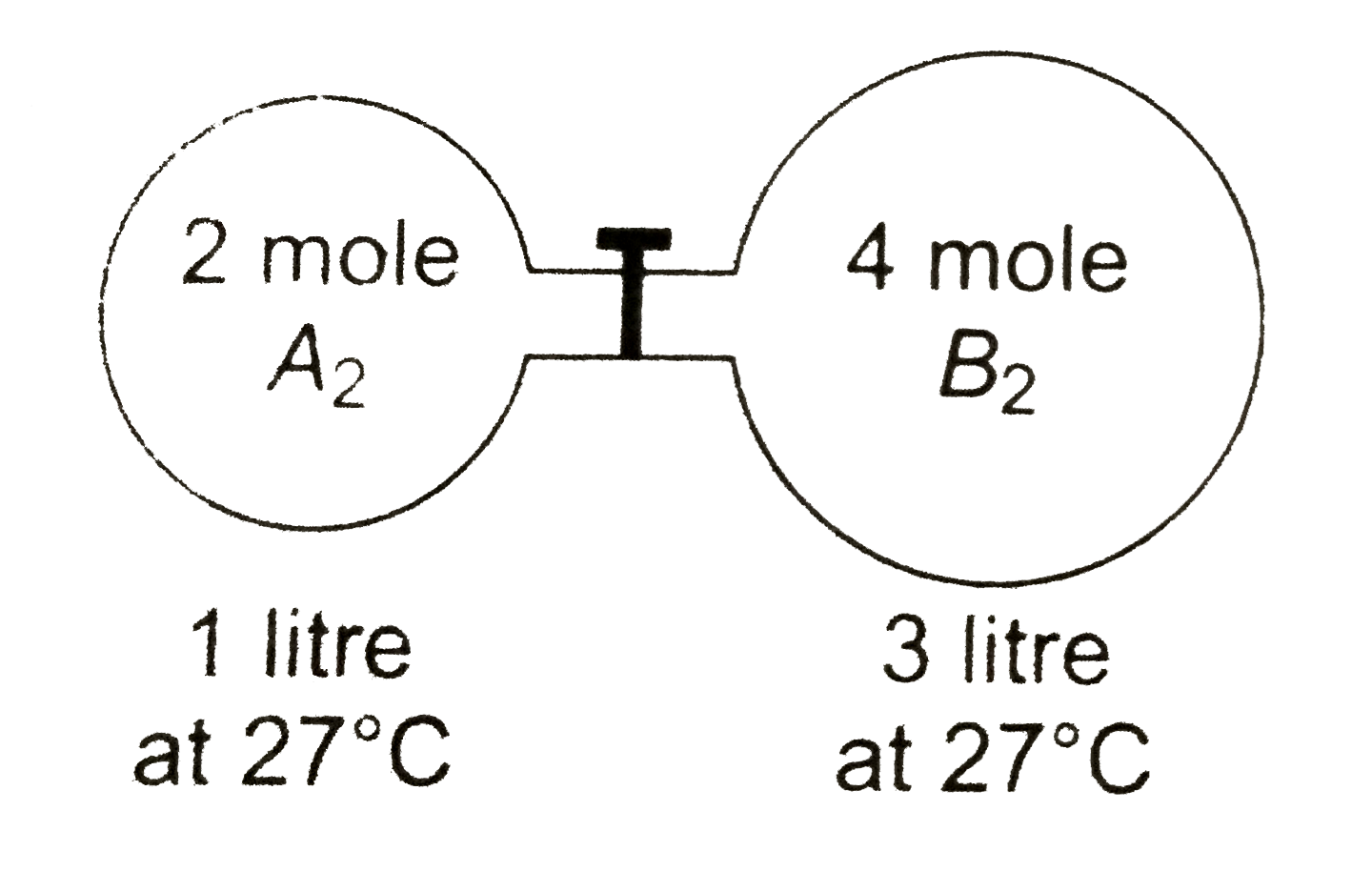
The gas `A_(2)` in the left flask allowed to react with gas `B_(2)` present in right flask as `A_(2)(g)+B_(2)(g)hArr2AB(g),K_(c)=4` at `27^(@)C.` What is the concentration of AB when equilibrium is established ?

A

1.33 M

B

0.66 M

C

0.33 M

D

2.66 M

Text Solution

Verified by Experts

The correct Answer is:

D
Promotional Banner

Topper's Solved these Questions

  • CHEMICAL EQUILIBRIUM

    GRB PUBLICATION|Exercise Reaction Quotient|10 Videos
  • CHEMICAL EQUILIBRIUM

    GRB PUBLICATION|Exercise Degree of Dissociation|39 Videos
  • ATOMIC STRUCTURE

    GRB PUBLICATION|Exercise Subjective Type|55 Videos
  • GASEOUS STATE

    GRB PUBLICATION|Exercise Exercise|530 Videos

Similar Questions

Explore conceptually related problems

The gas A_(2) in the left flask allowed to react with gas B_(2) present in right flask as A_(2)(g)+B_(2)(g)hArr2AB(g),K_(c)=4 at 27^(@)C. What is the concentrartion of AB when equilibrium is established ?

In a reaction A_(2)(g)+4B_(2)(g) hArr 2AB_(4)(g), DeltaH lt 0 . The formation of AB_(4) is not favoured by

When A_(2) and B_(2) are allowed to react, the equilibrium constant of the reaction at 27^(@)C is found (K_(C)=4).A_(2)(g)+B_(2)(g)hArr 2AB(g) What will be the equilibrium concentration of AB?

1 mol of H_(2), 2 mol of I_(2) and 3 mol of HI were taken in a 1-L flask. If the value of K_(c) for the equation H_(2)(g)+I_(2)(g) hArr 2HI(g) is 50 at 440^(@)C , what will be the concentration of each specie at equilibrium?

In the reaction A_(2)(g) + 4B_(2)(g)hArr2AB_(4)(g) , Delta H lt 0 . The decomposition of AB_(4) (g) will be favoured at

For the reaction A_((s)) + 2B_((g)) ƒhArr 3C_((g)) . At constant pressure on addition of inert gas, the equilibrium state

The factor which changes equilibrium constant of the reaction A_(2)(g)+B_(2)(g) rarr 2AB(g) is

GRB PUBLICATION-CHEMICAL EQUILIBRIUM-D.Le Chateliera principle
  1. The gas A(2) in the left flask allowed to react with gas B(2) present ...

    Text Solution

    |

  2. For the reaction CO(g)+H2O(g) hArr CO2(g)+H2(g) at a given temperature...

    Text Solution

    |

  3. Given the following reaction at equilibium. N2(g) +3H2(g)hArr 2NH3(g...

    Text Solution

    |

  4. For an equilibrium H2O(s) hArr H2O(l)which of the following statements...

    Text Solution

    |

  5. When a bottle of cold drink is opened, the gas comes out with a fizzle...

    Text Solution

    |

  6. The equilibrium , SO2Cl2(g) hArr SO2(g)+Cl(2)(g) is attained at 25^@C ...

    Text Solution

    |

  7. An equilibrium mixture in a vessel of capacity 100 litre contains 1 mo...

    Text Solution

    |

  8. The following two reactions: i. PCl(5)(g) hArr PCl(3)(g)+Cl(2)(g) ...

    Text Solution

    |

  9. For the reaction, 4NH(3)(g) + 5O(2)(g)hArr4NO(g) + 6 H(2)O(l), Delt...

    Text Solution

    |

  10. For the reaction H(2)(g)+I(2)(g) hArr 2HI(g) The equilibrium const...

    Text Solution

    |

  11. To the system, LaCl(3)(s)+H(2)O(g) hArr LaClO(s)+2HCL(g)-"Heat" alre...

    Text Solution

    |

  12. In the Haber process for the industrial manufacturing of ammonia invol...

    Text Solution

    |

  13. For the reaction CaCO3(s)hArr CaO(s)+CO2(g) , the pressure of CO2 (g) ...

    Text Solution

    |

  14. Which of the following will not shift the equilibrium , N2+3H2 hArr 2N...

    Text Solution

    |

  15. One mole of helium (He) gas is added to the equilibrium N2O4(g) hArr 2...

    Text Solution

    |

  16. Some quantity of water is contained in a container as shown in figure....

    Text Solution

    |

  17. For the equilibrium CuSO(4)xx5H(2)O(s)hArrCuSO(4)xx3H(2)O(s) + 2H(2)O(...

    Text Solution

    |
