Home
Class 12
MATHS
Let P,Q,R and S be the feet of the perpe...

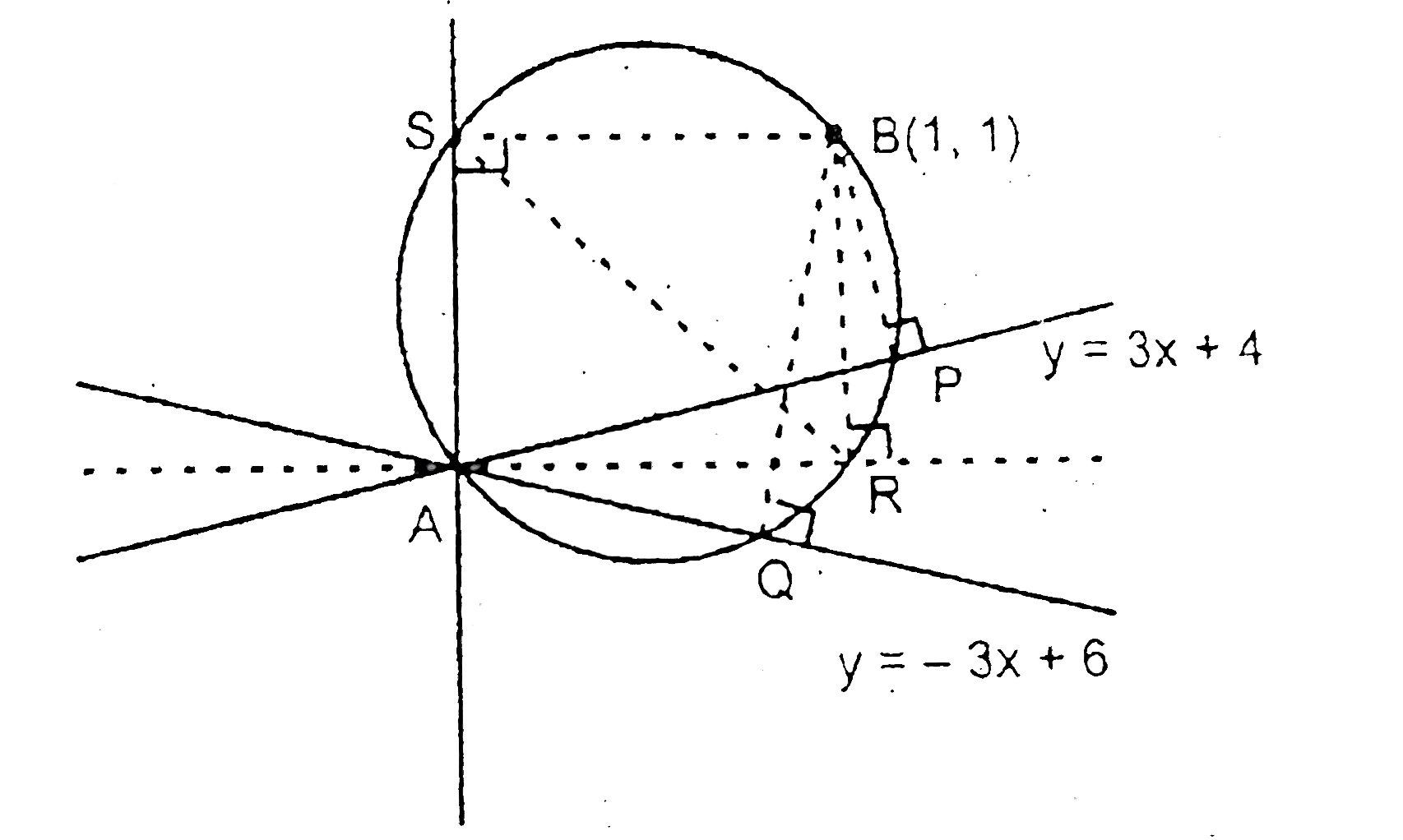
Let `P,Q,R` and `S` be the feet of the perpendiculars drawn from point `(1,1)` upon the lines `y=3x+4,y=-3x+6` and their angle bisectors respectively. Then equation of the circle whose extremities of a diameter are `R` and `S` is

A

`3x^(2)+3y^(2)+104x-110=0`

B

`x^(2)+y^(2)+104x-110=0`

C

`x^(2)+y^(2)-18x-4y+16=0`

D

`3x^(2)+3y^(2)-4x-18y+16=0`

Text Solution

Verified by Experts

The correct Answer is:
D


`/_RBS=/_RAS=90^(@)`
so, equation of circle with `RS` as diameter is same circle with `AB` as diameter
So, point of intersection of two given lines
`y=3x+4`
and `y=-3x+6` is `y=6,x=1/3`
Equation of circle is
`(x-1)(x-1/3)+(y-1)(y-5)=0`
`implies3x^(2)+3y^(2)-4x-18y+16=0`
Promotional Banner

Topper's Solved these Questions

Similar Questions

Explore conceptually related problems

Let P, Q, R, S be the feet of the perpendiculars drawn from a point (1, 1) upon the lines x+4y=12, x-4y+4=0 and their angle bisectors respectively, then equation of the circle which passes through Q, R, S is :

Find the length of perpendicular drawn from point (2,-1) to the line 3x+4y-11=0 .

Find the length of the perpendicular drawn from the point (4,5) upon the straight line 3x+4y=10

What will be the length of the perpendicular drawn from the point (4, 5) upon the straight line 3x + 4y = 10?

The length of the perpendicular drawn from orgin upon the straight line x/3 - y/4 =1 is

Find the equation of the perpendicular drawn from (2,4,-1) to the line (x+5)/1=(y+3)/4=(z-6)/3 .

The feet of the perpendicular drawn from focus upon any tangent to the parabola,y=x^(2)-2x-3 lies on

Let the perpendiculars from any point on the line 7x+56y=0 upon 3x+4y=0 and 5x-12y=0 be p&p', then

Obtain the co-ordinates of the feet of perpendiculars drawn from the origin upon the lines 3x-5y+2=0 and 4x-3y+5=0 and show that the equation of the st. Line joining these feet is 26x+53y=11 .

RESONANCE-TEST PAPERS-MATHEMATICS
  1. The equation (x)^(2)=[x]^(2)+2x where [x] and (x) are the integers jus...

    Text Solution

    |

  2. Let x^2+y^2+x y+1geqa(x+y)AAx ,y in R , then the number of possible i...

    Text Solution

    |

  3. Let P,Q,R and S be the feet of the perpendiculars drawn from point (1,...

    Text Solution

    |

  4. Let [.] denote G.I.F. and tge0 and S={(x,y):(x-T)^(2)+y^(2)leT^(2) whe...

    Text Solution

    |

  5. A function is defined as f(x)=lim(x->oo)[cos^(2n) x , if x<0) , ...

    Text Solution

    |

  6. If [.] denotes the greatest integer function and x,yepsilonRr,"n" epsi...

    Text Solution

    |

  7. The number of solutions to |e^(|x|)-3|=K is

    Text Solution

    |

  8. Let f(x)={(x+1, -1lexle0),(-x,0ltxle1):} then

    Text Solution

    |

  9. Angle bisector of angles subtended by the chord of a circle in the sam...

    Text Solution

    |

  10. Let f(x)={(xsin((pi)/x), "at" xgt0),(0,"at"x=0):}

    Text Solution

    |

  11. Which of the following is True?

    Text Solution

    |

  12. lim(xrarrc)f(x) does not exist for wher [.] represent greatest integ...

    Text Solution

    |

  13. f(x)is defined for xge0 & has a continuous derivative. It satisfies f(...

    Text Solution

    |

  14. Let A*B=A^(T)B^(-1) where A^(T) represents transpose of matrix A and B...

    Text Solution

    |

  15. Let A*B=A^(T)B^(-1) where A^(T) represents transpose of matrix A and B...

    Text Solution

    |

  16. A curve is represented parametrically by the equations x = e^t cos t a...

    Text Solution

    |

  17. A curve is represented paramtrically by the equations x=e^(t)cost and ...

    Text Solution

    |

  18. Find the locus of the point of intersection of the perpendicular ta...

    Text Solution

    |

  19. If the points (2-x, 2, 2), (2, 2-y, 2) and (2, 2, 2-z) are coplanar th...

    Text Solution

    |

  20. cot^(-1)(-1/2)+cot^(-1)(-1/3) is equal to

    Text Solution

    |

