Text Solution
Verified by Experts
The correct Answer is:



Topper's Solved these Questions
Similar Questions
Explore conceptually related problems
RESONANCE-TEST PAPERS-MATHEMATICS
- Given lim(n->oo)((3nCn)/(2nCn))^(1/n) =a/b where a and b are relativel...
Text Solution
|
- lim(nrarroo)(1/(n+1)+1/(n+2)+…….+1/(6n))=kln6, then find the value of ...
Text Solution
|
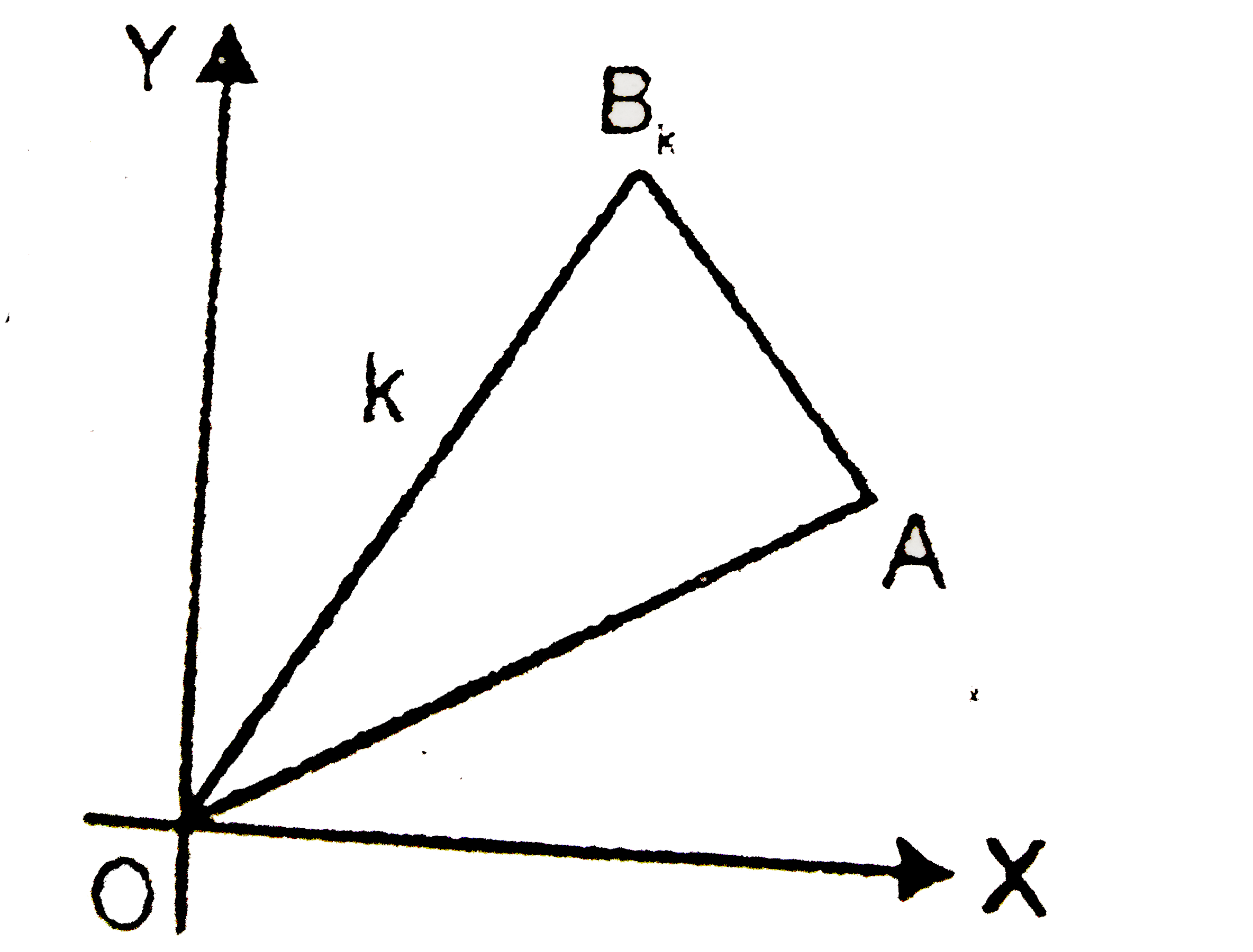
- For positive integers k=1,2,3,....n,, let Sk denotes the area of trian...
Text Solution
|
- Number of solutions of the equation sec^(-1)((2)/((1)/(x)+x))+picospix...
Text Solution
|
- If lim(xrarr0)((cotx)(e^(x)-1)-cos^(2)x)/(sinx)=K,Kepsilonr then find ...
Text Solution
|
- the derivative of y=(1-x)(2-x)..........(n-x) at x=1 is equal to
Text Solution
|
- If f(x)=|sinx-|cosx||, then the value of f^(')(x) at x=(7pi)/6 is
Text Solution
|
- The global maximum value of f(x0=(log)(10)(4x^3-12 x^2+11 x-3),x in [2...
Text Solution
|
- If 3(a+2c)=4(b+3d), then the equation a x^3+b x^2+c x+d=0 will have no...
Text Solution
|
- If 3f(cosx)+2f(sinx)=5x, then f^(')(cosx) is equal to (where f^(') den...
Text Solution
|
- If y=(x^x)^x then (dy)/(dx) is
Text Solution
|
- If f(x)=(4+x)^(n),"n" epsilonN and f^(r)(0) represents the r^(th) deri...
Text Solution
|
- Let f(x)=x/(1+x^2) and g(x)=(e^(-x))/(1+[x]) (where [.] denote greates...
Text Solution
|
- If the derivative of an odd cubic polynomial vanishes at two different...
Text Solution
|
- If f(x) = { 3 + |x-k|, x leq k; a^2 -2 + sin(x-k)/(x-k), xgtk} has min...
Text Solution
|
- Find the critical (stationary ) points of the function f(X)=(x^(5))/(2...
Text Solution
|
- If curve y = 1 - ax^2 and y = x^2 intersect orthogonally then the valu...
Text Solution
|
- If ST and SN are the lengths of subtangents and subnormals respectivel...
Text Solution
|
- Find the point on the curve y=x^3-11 x+5 at which the tangent is y"...
Text Solution
|
- The tangents from (1, 2sqrt2) to the hyperbola 16x^2-25y^2 = 400 inclu...
Text Solution
|