Home
Class 12
PHYSICS
In the electric field of a point chargde...

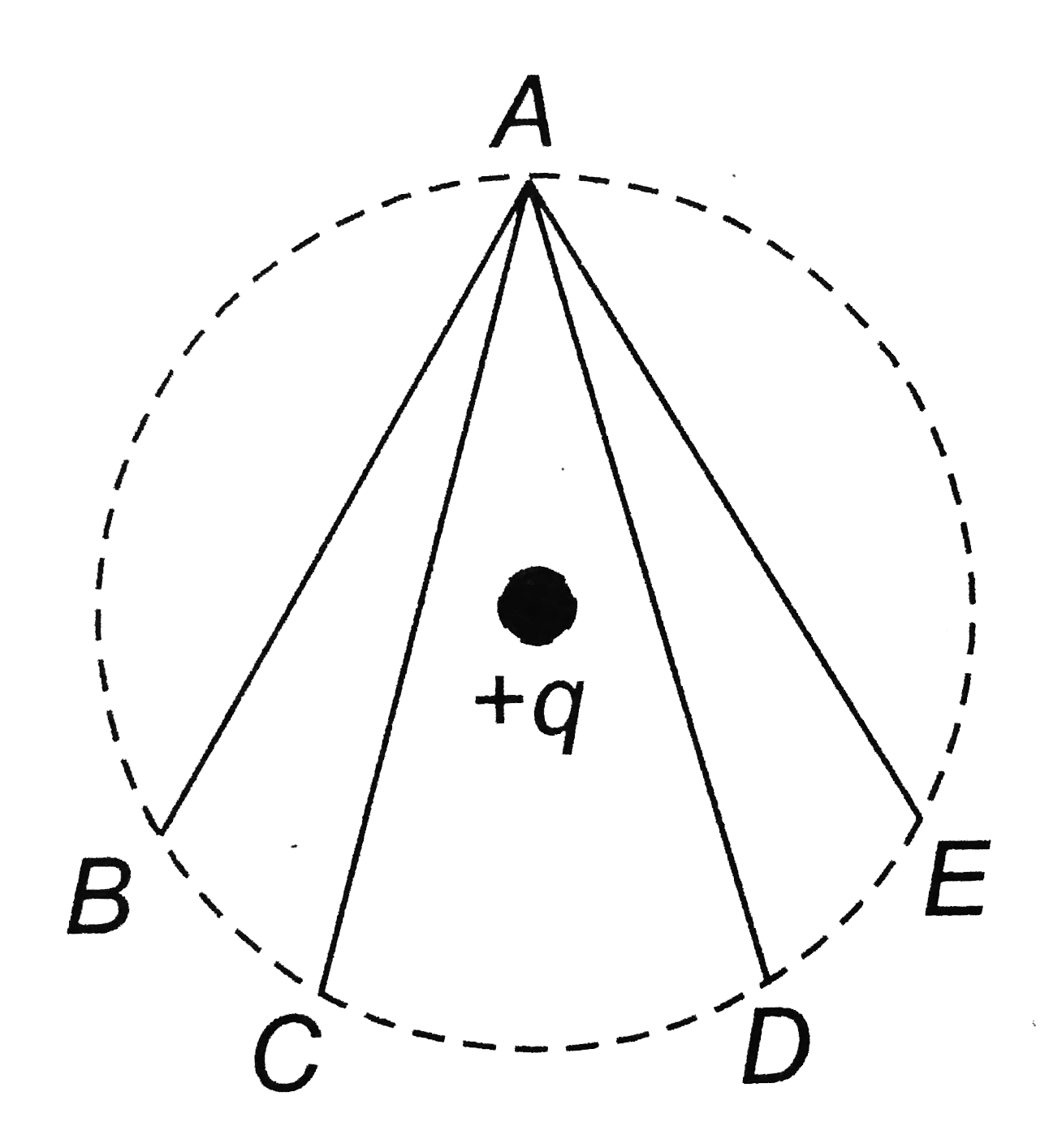
In the electric field of a point chargde `q`, a cetrain charge is carried from point `A` to `B, C, D` and `E`. Then the ork done

A

is least along the path AB

B

is least along the path AD

C

is zero along all the paths AB,AC,AD and AE

D

is least along AE

Text Solution

Verified by Experts

The correct Answer is:

C
Promotional Banner

Topper's Solved these Questions

  • ELECTRIC POTENTIAL

    CENGAGE PHYSICS|Exercise DPP 3.4|15 Videos
  • ELECTRIC POTENTIAL

    CENGAGE PHYSICS|Exercise DPP 3.5|14 Videos
  • ELECTRIC POTENTIAL

    CENGAGE PHYSICS|Exercise DPP 3.2|15 Videos
  • ELECTRIC FLUX AND GAUSS LAW

    CENGAGE PHYSICS|Exercise MCQ s|38 Videos
  • ELECTRICAL MEASURING INSTRUMENTS

    CENGAGE PHYSICS|Exercise M.C.Q|2 Videos

Similar Questions

Explore conceptually related problems

In the electric field of charge Q, another charge is carried from A to B, A to C, A to D and A to E, then work done will be :

In the electric field of a point charge ( + q) , placed at the centre of a circle , a certain test charge is carried from point A to B, C,D and E Least amount of work is done along the path

" Electric field intensity due to a point charge " "q" ' at a distance 'r' from it is "

A positive point charge q is carried from a point B to a point A in the electric field of a point charge +Q at O. If the permittivity of free space is epsi_0 , the work done in the process is given by (where a = OA and b = OB ) -

A charge is moved in an electric field of a fixed charge distribution from point A to another point B slowly. The work done by external agent in doing so is 100J . What is the change in potential energy of the charge as it moves from A to B ? What is the work done by the electric field of the charge distribution as the charge moves from A to B ?

Which of the following statement(s) is/are correct? If the electric field due to a point charge varies as r^(-2.5) instead of r^(-2),then the Gauss law will still be valid. The Gauss law can be used to calculate the field distribution around an electric dipole. If he electric field between two point charges is zero somewhere,then the sign of the two charges is the same. The work done by the external force is moving a unit positive charge from point A at potential "V_(A)" to point B at potential "V_(B)" is,(V_(B)-V_(A))

In an uniform electric field of strength E, a charge particle Q moves point A to point B in the direction of the field and back from B to A. Calculate the ratio of the work done by the electric field in taking the charge particle from A to B and from B to A.

CENGAGE PHYSICS-ELECTRIC POTENTIAL-DPP 3.3
  1. Two metal spheres, one fo radius R and the other of radius 2R, both ...

    Text Solution

    |

  2. Two charges q(1) and q(2) are placed at (0,0d) and (0,0-d) respectivel...

    Text Solution

    |

  3. Equipotentials at a great distance from a collection of charges whose ...

    Text Solution

    |

  4. Figure shows some equipotential lines distributed in space. A charge...

    Text Solution

    |

  5. In the electric field of a point chargde q, a cetrain charge is carrie...

    Text Solution

    |

  6. Eluipotential surfcaces are shown in figure. Then the electric field s...

    Text Solution

    |

  7. In moving from A to B along an electric field line, the work done by t...

    Text Solution

    |

  8. Electric lines of force are as shown in the figure. Then potential at ...

    Text Solution

    |

  9. Two infinitely large charged planes having uniform suface charge densi...

    Text Solution

    |

  10. Equipotential surfaces

    Text Solution

    |

  11. Consider a uniform electric field in the hat (z) direction. The potent...

    Text Solution

    |

  12. Across the surface of a charged conductor, the electric

    Text Solution

    |

  13. Mark the correct statements :

    Text Solution

    |

  14. A conducting sphere of radius r has a charge . Then .

    Text Solution

    |

  15. Consider two conducting spheres of radii R(1) and R(2) with R(1) gt R(...

    Text Solution

    |

  16. Free electrons travel to region of higher potential or lower potential...

    Text Solution

    |

  17. Can there be a potential difference between two adjacent conductors c...

    Text Solution

    |

  18. A test charge q is made to move in the electric field of a point cha...

    Text Solution

    |

  19. Prove that a closed equipotenitial surface with no charge within itsel...

    Text Solution

    |

  20. Prove that, if an insulated, uncharged conductor is placed near a ch...

    Text Solution

    |
