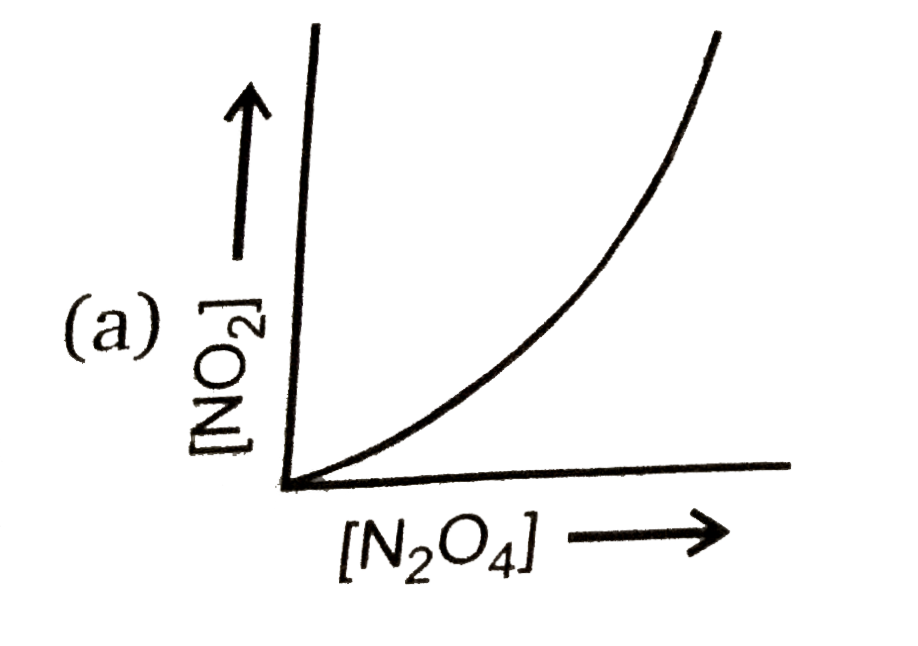
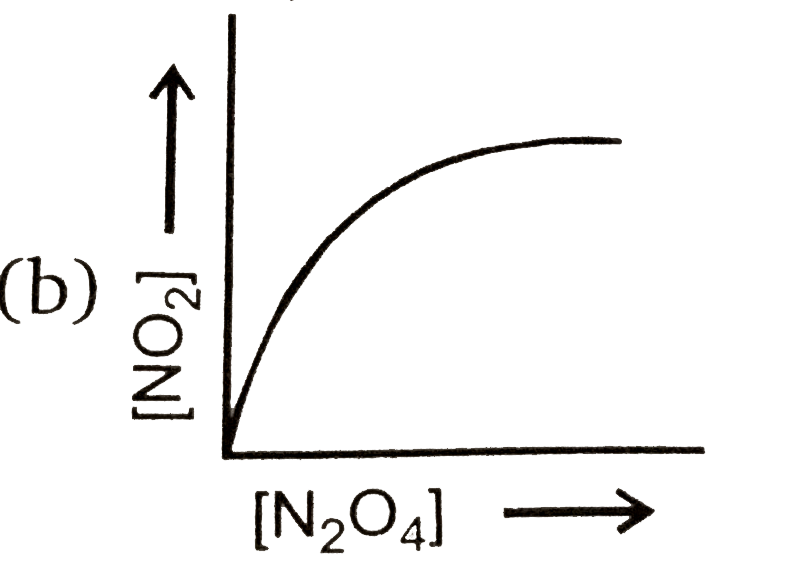
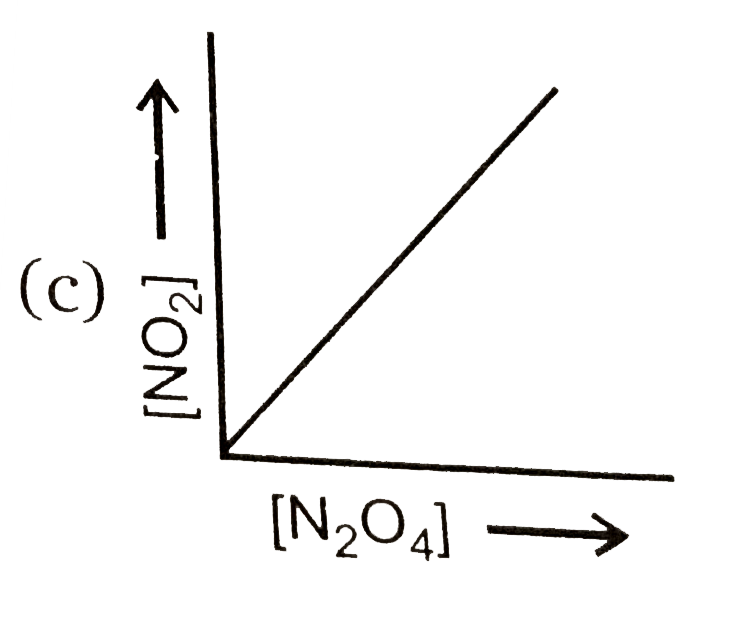
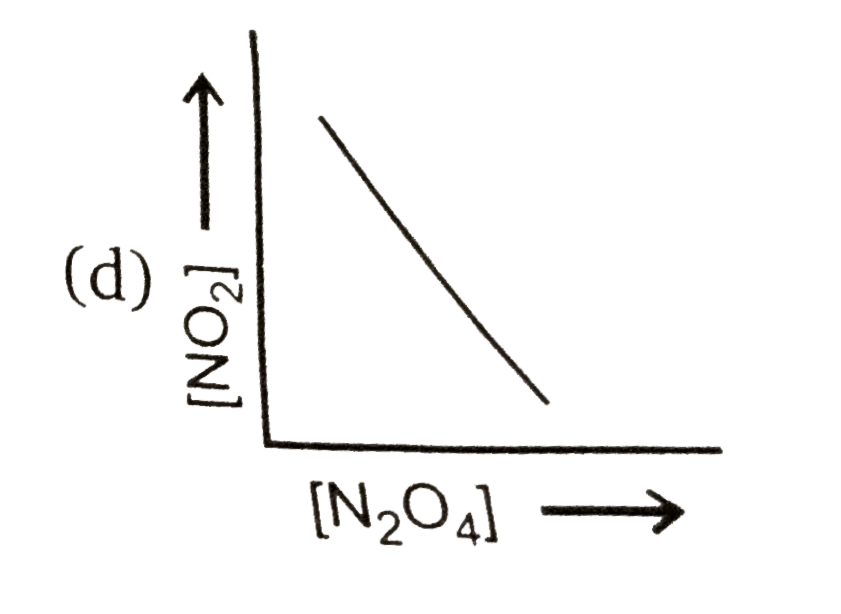
Consider the following equilibrium `N_(2)O_(4)(g)hArr2NO_(2)(g)` Then the select the correct graph , which shows the variation in concentratins of `N_(2)O_(4)` Against concentrations of `N_(2)`O_(4)`:
A
B
C
D
Text Solution
AI Generated Solution
The correct Answer is:
To solve the problem, we need to analyze the equilibrium reaction given:
\[ N_2O_4(g) \rightleftharpoons 2NO_2(g) \]
We are tasked with determining the correct graph that shows the variation in concentrations of \( N_2O_4 \) against the concentrations of \( NO_2 \).
### Step-by-Step Solution:
1. **Understanding the Reaction**:
- The reaction shows that one mole of \( N_2O_4 \) dissociates to form two moles of \( NO_2 \).
- This implies that as the concentration of \( N_2O_4 \) decreases, the concentration of \( NO_2 \) increases.
2. **Setting Up the Equilibrium Expression**:
- The equilibrium constant \( K_c \) for the reaction can be expressed as:
\[
K_c = \frac{[NO_2]^2}{[N_2O_4]}
\]
- Rearranging this gives:
\[
[NO_2]^2 = K_c \cdot [N_2O_4]
\]
3. **Graphing the Relationship**:
- In the equation \( [NO_2]^2 = K_c \cdot [N_2O_4] \), we can see that if we let \( y = [NO_2] \) and \( x = [N_2O_4] \), we can rewrite it as:
\[
y^2 = K_c \cdot x
\]
- This is a quadratic equation in terms of \( y \), which indicates that the graph will be a parabola.
4. **Determining the Orientation of the Parabola**:
- The equation \( y^2 = K_c \cdot x \) suggests that as \( x \) (the concentration of \( N_2O_4 \)) increases, \( y^2 \) (the square of the concentration of \( NO_2 \)) also increases.
- Therefore, the graph opens upwards, indicating that \( y \) increases as \( x \) increases.
5. **Identifying the Correct Graph**:
- Since we are looking for a graph that represents a parabolic relationship where \( y^2 \) is proportional to \( x \), and it opens upwards, we can eliminate options that show a downward-opening parabola.
- The correct graph will show a curve that starts at the origin and rises as \( [N_2O_4] \) increases.
### Conclusion:
The correct graph is the one that represents a parabolic curve opening upwards, indicating that as the concentration of \( N_2O_4 \) increases, the concentration of \( NO_2 \) also increases.
Topper's Solved these Questions
CHEMICAL EQUILIBRIUM
NARENDRA AWASTHI|Exercise Level 1 (Q.93 To Q.122)|1 Videos
CHEMICAL EQUILIBRIUM
NARENDRA AWASTHI|Exercise Level 2|1 Videos
ATOMIC STUCTURE
NARENDRA AWASTHI|Exercise Exercise|273 Videos
DILUTE SOLUTION
NARENDRA AWASTHI|Exercise Level 3 - Match The Column|1 Videos
Similar Questions
Explore conceptually related problems
For the following equilibrium N_(2)O_(4)(g)hArr 2NO_(2)(g) K_(p) is found to be equal to K_(c) . This is attained when :
For the following gases equilibrium, N_(2)O_(4)(g)hArr2NO_(2)(g) K_(p) is found to be equal to K_(P) . This is attained when:
The reaction , N_2O_4(g)rarr2NO_2(g) , is first order reaction , which of the following best describes the variation of concentration of N_2O_4 with time ?
At the equilibrium of the reaction , N_(2)O_(4)(g)rArr2NO_(2)(g) , the observed molar mass of N_(2)O_(4) is 77.70 g . The percentage dissociation of N_(2)O_(4) is :-
For the following equilibrium in gaseous phase, N_(2)O_(4)hArr 2NO_(2) NO_(2) is 50% of the total volume, when equilibrium is set up. Hence, percent dissociation of N_(2)O_(4) is :
For the equilibrium reaction 2NO_2(g) hArr N_2O_4(g) + 60.0 kJ the increase in temperature
9.2 grams of N_(2)O_(4(g)) is taken in a closed one litre vessel and heated till the following equilibrium is reached N_(2)O_(4(g))hArr2NO_(2(g)) . At equilibrium, 50% N_(2)O_(4(g)) is dissociated. What is the equilibrium constant (in mol litre^(-1) ) (Moleculatr weight of N_(2)O_(4) = 92 ) ?
9.2gm of N_(2)O_(4) (g) is taken is a closed one litre vessel and heated till the following equilibrium is reached N_(2)O_(4) (g) harr 2 NO_(2) (g) . At equilibrium 50% of N_(2)O_(4)(g) is dissociated. What is the equilibrium constant (in mole lit^(-1) ) ?.(M.wt.of N_(2)O_(4) is 92)