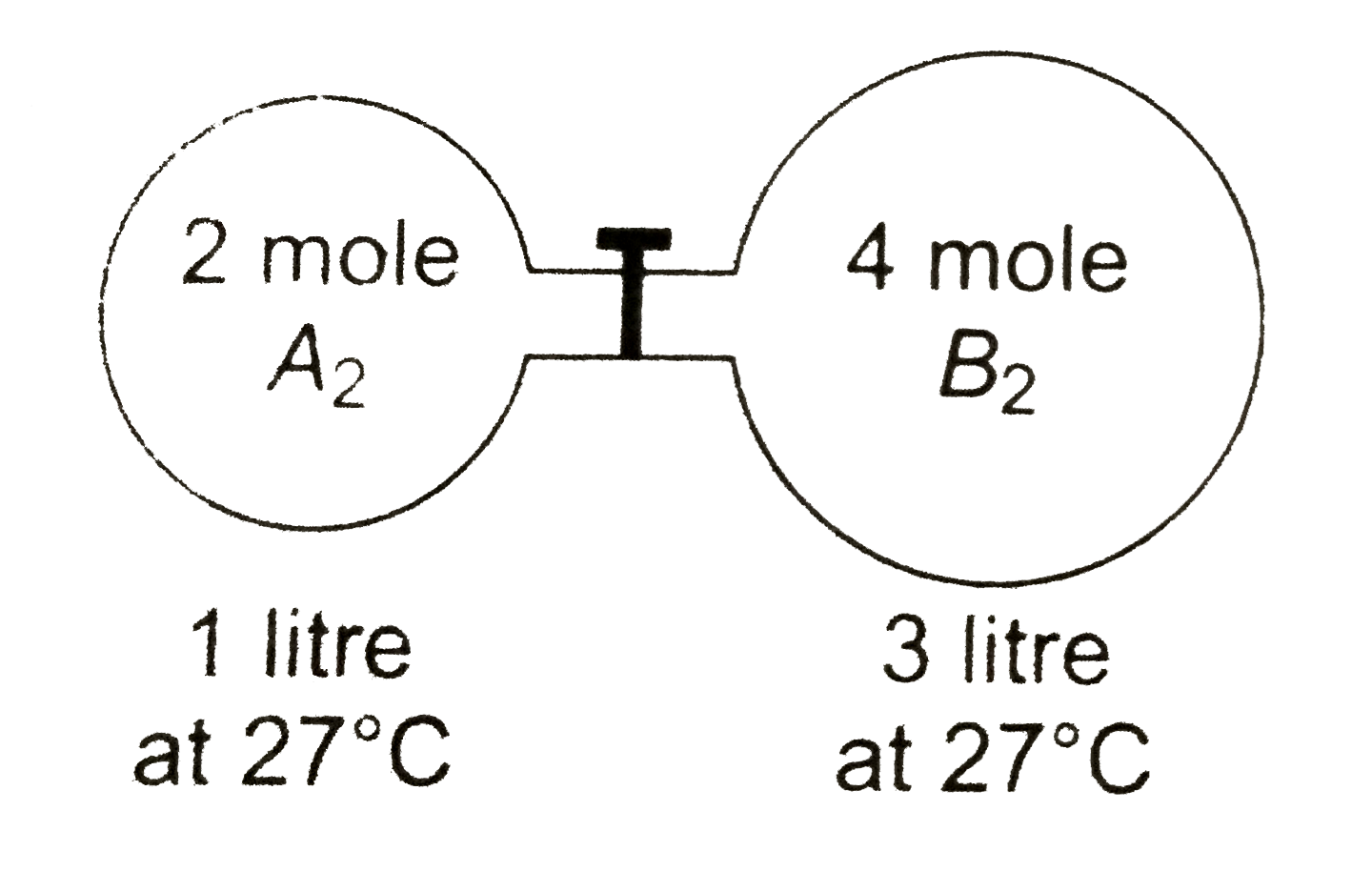
The gas `A_(2)` in the left flask allowed to react with gas `B_(2)` present in right flask as `A_(2)(g)+B_(2)(g)hArr2AB(g),K_(c)=4` at `27^(@)C.` What is the concentrartion of AB when equilibrium is established ?
A
`1.33` M
B
`2.66` M
C
`0.66` M
D
`0.33` M
Text Solution
Verified by Experts
The correct Answer is:
C
Topper's Solved these Questions
CHEMICAL EQUILIBRIUM
NARENDRA AWASTHI|Exercise Level 1 (Q.93 To Q.122)|1 Videos
CHEMICAL EQUILIBRIUM
NARENDRA AWASTHI|Exercise Level 2|1 Videos
ATOMIC STUCTURE
NARENDRA AWASTHI|Exercise Exercise|273 Videos
DILUTE SOLUTION
NARENDRA AWASTHI|Exercise Level 3 - Match The Column|1 Videos
Similar Questions
Explore conceptually related problems
In a reaction A_(2)(g)+4B_(2)(g) hArr 2AB_(4)(g), DeltaH lt 0 . The formation of AB_(4) is not favoured by
When A_(2) and B_(2) are allowed to react, the equilibrium constant of the reaction at 27^(@)C is found (K_(C)=4).A_(2)(g)+B_(2)(g)hArr 2AB(g) What will be the equilibrium concentration of AB?
In the reaction A_(2)(g) + 4B_(2)(g)hArr2AB_(4)(g) , Delta H lt 0 . The decomposition of AB_(4) (g) will be favoured at
For the reaction A_((s)) + 2B_((g)) hArr 3C_((g)) . At constant pressure on addition of inert gas, the equilibrium state
The factor which changes equilibrium constant of the reaction A_(2)(g)+B_(2)(g) rarr 2AB(g) is
Two moles of each reactant A and B are taken in a reaction flask. They react in the following manner, A(g)+B(g)hArr C(g)+D(g) At equilibrium, it was found that the concentration of C is triple to that of B the equilibrium constant for the reaction is
A flask containing 0.5 atm pressure of A_(2)(g,) some solid AB added into flask which undergoes dissociation according to 2AB(s)hArrA_(2)(g)+B_(2)(g),K_(p)=0.06atm^(2) The total pressure (in atm) at equilibrium is :