

Home
Class 11
PHYSICS
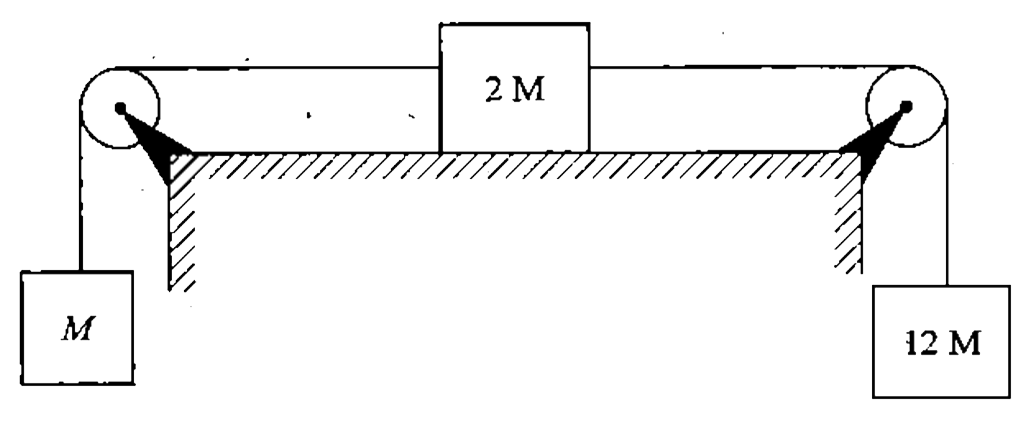
The three blocks in figure-2.25 are rele...

The three blocks in figure-2.25 are released from rest and accelerate at the rate of `5m//s^(2)`. If M = 4kg, what is the magnitude of the frictional force on the block that slides horizontally?

[140 N]

Promotional Banner

Topper's Solved these Questions

  • NEWTONS LAWS OF MOTION

    PHYSICS GALAXY - ASHISH ARORA|Exercise Practice Exercise|23 Videos
  • NEWTONS LAWS OF MOTION

    PHYSICS GALAXY - ASHISH ARORA|Exercise Practice Exercise 2.2|1 Videos
  • NEWTONS LAWS OF MOTION

    PHYSICS GALAXY - ASHISH ARORA|Exercise Practice Exerice 2.1|1 Videos
  • LINEAR MOMENTUM & ITS CONSERVATION

    PHYSICS GALAXY - ASHISH ARORA|Exercise exercise 1.3|3 Videos
  • RIGID BODIES AND ROTATIONAL MOTION

    PHYSICS GALAXY - ASHISH ARORA|Exercise Unsolved Numerical|63 Videos

Similar Questions

Explore conceptually related problems

When the three blocks of masses M, 2M and 2M in the system are released from rest, they accelerate with a magnitude of 1 m/ s^(2) . What is the coefficient of kinetic friction between block on the table and the table top? (neglect the force of friction in the pulleys and take g =10 m/ s^(2) )

On the horizontal surface of a truck (mu=0.6) a block of mass 1 kg is placed. If the truck is accelerating at the rate of 5m//sec^(2) then friction force on the block will be

When the three blocks in Fig. 6-45 are released from rest, they accelerate with a magnitude of 0.500 m/s2 Block 1 has mass M, block 2 has 2M, and block 3 has 2M. What is the coefficient of kinetic friction between block 2 and the table?

Two forces act on a 4.5 kg block resting on a frictionless surface as shown in the given figure. What is the magnitude of the horizontal acceleration of the block ?

A 2.5 kg block is initially at rest on a horizontal surface. A horizontal force vecF of magnitude 6.0 N and a vertical force vecP are then applied to the block (Fig. 6-31). The coefficients of friction for the block and surface are mu = 0.40 and mu = 0.25 . Determine the magnitude of the frictional force acting on the block if the magnitude of vecP is (a) 8.0 N. (b) 10 N, and (c) 12 N

A 3.5 kg block is pushed along a horizontal floor by a force vecF of magnitude 15 N at an angle theta = 40^(@) with the horizontal (Fig. 6-33). The coefficient of kinetic friction between the block and the floor is 0.25. Calculate the magnitudes of (a) the frictional force on the block from the floor and (b) the block's acceleration.

The elevator shown in figure is descending with an acceleration of 2m/s^2 . The mass of the block A is 0.5 kg. What force is exerted by the block A on the block B?

Three blocks A , B and C , whose masses are 9kg , 9kg and 18kg respectively as shown in the figure, are released from rest. The co-efficient of friction between block A and the horizontal surface is 0.5 & the co-efficient of friction between block B and the horizontal surface is 0.5 . Find the acceleration of block C just release [Take g=10m//s^(2) ]. All strings and pulleys are ideal

A block of mass m is released from rest at a height R above a horizontal surface. The acceleration due to gravity is g. The block slides along the inside of a frictionless circular hoop of radius R. What is the magnitude of the normal force exerted on the block by the hoop when the block has reached the bottom ?

A block of mass 0.1 kg is held against a wall by applying a horizontal force of 5 N on the block. If the coefficient of friction between the block and the wall is 0.5, then the magnitude of the frictional force acting on the block is