Home
Class 11
PHYSICS
Passage III A block of mass m =1/2 kg is...

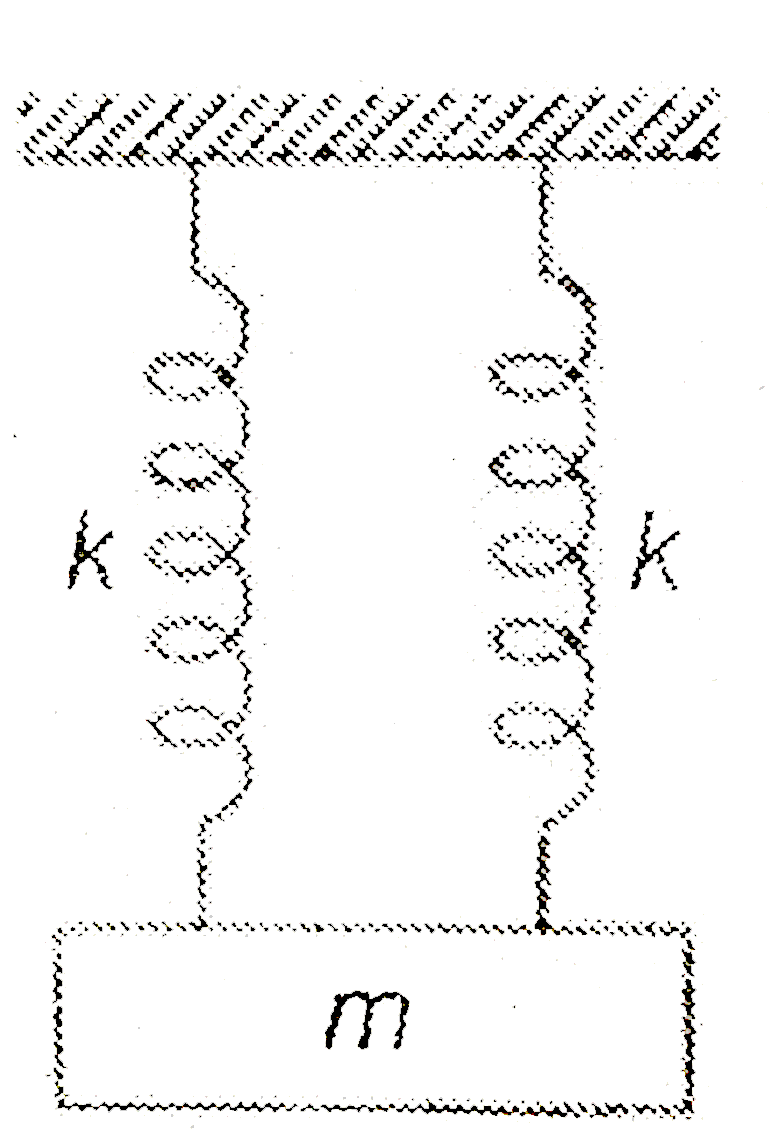
Passage III A block of mass m =1/2 kg is attached with two springs each of force contant k=10N/m as shown. The block is oscillating vertically up and down with amplitude A=25cm. When the block is at its mean position one of the spring breaks without changing momentum of block.

What is the new amplitude of osciallation of the block.

A

10.6cm

B

43.3 cm

C

25 cm

D

62.2 cm

Text Solution

Verified by Experts

The correct Answer is:

B
Promotional Banner

Topper's Solved these Questions

  • SIMPLE HARMONIC MOTION

    DC PANDEY|Exercise Matrix matching type questions|13 Videos
  • SIMPLE HARMONIC MOTION

    DC PANDEY|Exercise Integer type questions|14 Videos
  • SIMPLE HARMONIC MOTION

    DC PANDEY|Exercise More than one option is correct|50 Videos
  • SEMICONDUCTORS AND ELECTRONIC DEVICES

    DC PANDEY|Exercise More than One Option is Correct|3 Videos
  • SOLVD PAPERS 2017 NEET, AIIMS & JIPMER

    DC PANDEY|Exercise Solved paper 2018(JIPMER)|38 Videos

Similar Questions

Explore conceptually related problems

Passage III A block of mass m =1/2 kg is attached with two springs each of force contant k=10N/m as shown. The block is oscillating vertically up and down with amplitude A=25cm. When the block is at its mean position one of the spring breaks without changing momentum of block. If instead of breaking one spring m/2 mass would have fallen from the block, then what will be the new amplitude?

A block of mass m is attached to two unstretched springs of spring constant k , each as shown. The block is displaced towards right through a distance x and is released The speed of the block as it passes through the mean position will be

A block of mass 'm' is attached to the light spring of force constant K and released when it is in its natural length. Find amplitude of subsequent oscillations.

A block of mass 2 kg is connected with a spring of natural length 40 cm of force constant K=200 N//m . The cofficient of friction is mu=0.5 . When released from the given position, acceleration of block will be

A block of mass m = 2 kg is attached to two unstretched spring of force constant k_(1)=100 N//m and k_(2)=125 N//m The block is displaced towards left through a distance of 10 cm and released. Find the speed of the block as it passes through the mean position.

A block of mass m =1 kg placed on top of another block of mass M = 5 kg is attached to a horizontal spring of force constant K = 20 N/m as shown in figure. The coefficient of friction between the blocks is µ where as the lower block slides on a frictionless surface. The amplitude of oscillation is 0.4 m. What is the minimum value of µ such that the upper block does not slip over the lower block ?

A block of mass m is attached to a spring of force constant k .Charges on the block is q . A horizontal electric field E is acting in the directions as shown.Block is released with the spring in unstretched position block will execute SHM (b) time period of osciallation is 2pisqrt(m)/(k) (c) amplitude of oscillation is (qE)/(k) Block will oscillate but not simple harmonically choose the correct answer

A block of mass m is attached to two unstretched springs of spring constants k_1 and k_2 as shown in figure. The block is displaced towards right through a distance x and is released. Find the speed of the block as it psses through the mean position shown.

A horizontal spring block system ( mass m_2 spring constant k) is oscillating on a smooth surface with amplitude A. If at the mean position an identical block is kept on it so that they move together after what is the new amplitude?

DC PANDEY-SIMPLE HARMONIC MOTION-Comprehension types
  1. Passage I) In simple harmonic motion force acting on a particle is giv...

    Text Solution

    |

  2. Passage I) In simple harmonic motion force acting on a particle is giv...

    Text Solution

    |

  3. Passage I) In simple harmonic motion force acting on a particle is giv...

    Text Solution

    |

  4. Passage II) Two identicla blocks P and Q have masses m each. They are ...

    Text Solution

    |

  5. Passage II) Two identicla blocks P and Q have masses m each. They are ...

    Text Solution

    |

  6. Passage II) Two identicla blocks P and Q have masses m each. They are ...

    Text Solution

    |

  7. Passage III A block of mass m =1/2 kg is attached with two springs eac...

    Text Solution

    |

  8. Passage III A block of mass m =1/2 kg is attached with two springs eac...

    Text Solution

    |

  9. Passage IV) Angular frequency in SHM is given by omega=sqrt(k/m). Maxi...

    Text Solution

    |

  10. Passage IV) Angular frequency in SHM is given by omega=sqrt(k/m). Maxi...

    Text Solution

    |

  11. Passage V) In SHM displacement, velocity and acceleration all oscillat...

    Text Solution

    |

  12. Passage V) In SHM displacement, velocity and acceleration all oscillat...

    Text Solution

    |

  13. Passage VI Two particles collide when they are at same position at sam...

    Text Solution

    |

  14. Passage VI Two particles collide when they are at same position at sam...

    Text Solution

    |

  15. Passage VII There is a spring block system in a lift moving upwards wi...

    Text Solution

    |

  16. Passage VII There is a spring block system in a lift moving upwards wi...

    Text Solution

    |

  17. Passage VIII A disc of mass m and radius R is attached with a spring o...

    Text Solution

    |

  18. In the problem if k = 10 N/m, m=2kg, R=1m and A=2m. Find linear speed ...

    Text Solution

    |
