Home
Class 11
PHYSICS
The figure shows elliptical orbit of a p...

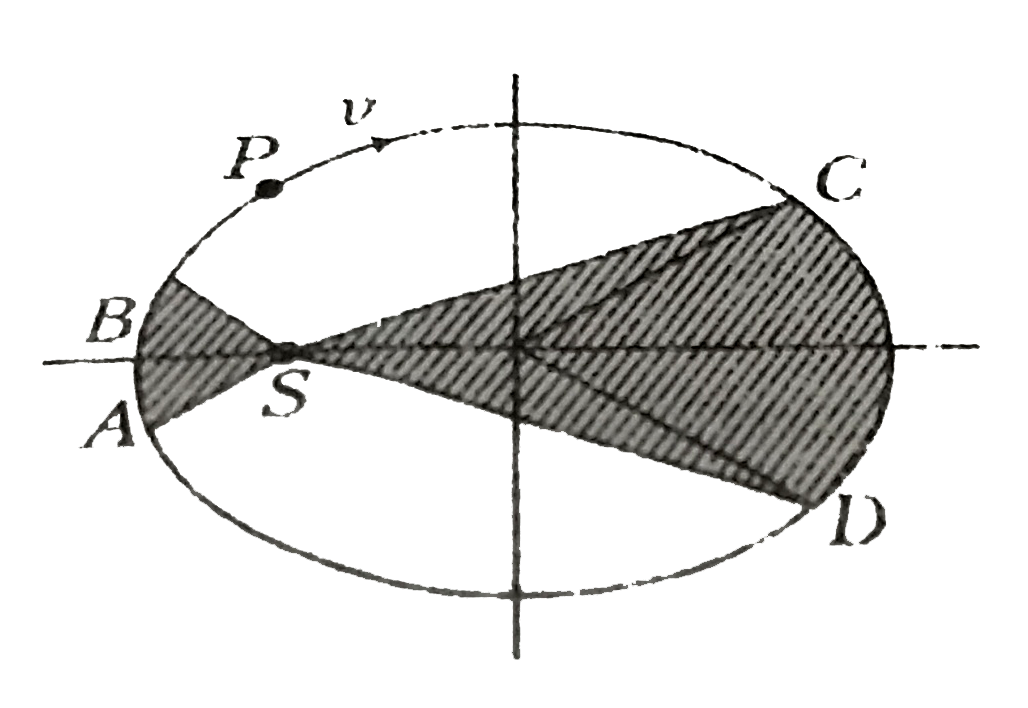
The figure shows elliptical orbit of a plant P about the sun S. The shaded area CSD is twice tha shaded area ASB. If `t_(1)` is the time taken by the planet to move from C to D and `t_(2)` is the time to move from A to B, determine the ratio `t_(1)//t_(2)`

Text Solution

Verified by Experts

According to Kepler's second law, the areal velocity of the planet remains constant
`:. (A_(1))/(t_(1))=(A_(2))/(t_(2))`
`:. (t_(1))/(t_(2))=(A_(1))/(A_(2))=("Area CSD")/("Area ASD")=2 rArr t_(1)=2t_(2)`
Promotional Banner

Topper's Solved these Questions

  • GRAVITATION

    DC PANDEY|Exercise Solved Examples|16 Videos
  • GRAVITATION

    DC PANDEY|Exercise Miscellaneous Examples|8 Videos
  • GENERAL PHYSICS

    DC PANDEY|Exercise INTEGER_TYPE|2 Videos
  • KINEMATICS

    DC PANDEY|Exercise INTEGER_TYPE|11 Videos

Similar Questions

Explore conceptually related problems

The figure shows elliptical orbit of a planet m about the sun S. the shaded area SCD is twice the shaded area SAB. If t_(1) be the time for the planet to move from C to D and t_(2) is the time to move from A to B, then:

The given figure shows the elliptical orbit of a planet m about the sun S. If t_(1) is the time taken by the planet of move from C to D and t_(2) is the time taken by the planet to move from A to B, then the relation between t_(1) and t_(2) is [Given, area SCD = 2 (area SAB)]

The figure shows the elliptical orbit of a planet about the sun S. An ellipse is the curve obtained when a cone is cut by an inclined plane. It has two focal points. The sum of the distances to the two focal points from every point on the curve is constant. F_1 " and " F_2 are the two focal points of the ellipse . The shaded area CF_1D is twice the shaded area AF_1B. t_1 is the time taken by the planet to move from C to D and t_2 is the time to move from A to B State the law regarding areas swept by the line joining the planet and the sun

The figure shows the elliptical orbit of a planet about the sun S. An ellipse is the curve obtained when a cone is cut by an inclined plane. It has two focal points. The sum of the distances to the two focal points from every point on the curve is constant. F_1 " and " F_2 are the two focal points of the ellipse . The shaded area CF_1D is twice the shaded area AF_1B. t_1 is the time taken by the planet to move from C to D and t_2 is the time to move from A to B State the law regarding the time period of revolution of a planet .

Figure shows the elipticla path of a planet about the sun. The two shaded parts have equal area. If t_1 and t_2 be the tim taken by the planet to go from a to b and from c to d respectively

The figure shows the elliptical orbit of a planet about the sun S. An ellipse is the curve obtained when a cone is cut by an inclined plane. It has two focal points. The sum of the distances to the two focal points from every point on the curve is constant. F_1 " and " F_2 are the two focal points of the ellipse . The shaded area CF_1D is twice the shaded area AF_1B. t_1 is the time taken by the planet to move from C to D and t_2 is the time to move from A to B Which laws do we understand from the above diagram and description?

Figure shows the orbit of a planet P round the sun S . AB and CD are the minor and major axed of the ellipse. If t_(1) is the time taken by the planet to travel along ACB and t_(2) the time along BDA , then

The figure shows the motion of a planet around the sun in an elliptical orbit with the sun at one focus. The shaded area SAB is twice that of SCD. If t_(1) and t_(2) are the times taken by the planet to move from A to B and C to D respectively, then

DC PANDEY-GRAVITATION-(C) Chapter Exercises
  1. The figure shows elliptical orbit of a plant P about the sun S. The sh...

    Text Solution

    |

  2. Starting from the centre of the earth having radius R, the variation o...

    Text Solution

    |

  3. A satellite of mass m is orbiting the earth (of radius R) at a height ...

    Text Solution

    |

  4. At what height from the surface of earth the gravitation potential and...

    Text Solution

    |

  5. The ratio of escape velocity at earth (v(e)) to the escape velocity at...

    Text Solution

    |

  6. Kepler's third law states that square of period revolution (T) of a pl...

    Text Solution

    |

  7. The reading of a spring balance corresponds to 100 N while situated at...

    Text Solution

    |

  8. The gravitational field due to an uniform solid sphere of mass M and r...

    Text Solution

    |

  9. What would be the value of acceleration due to gravity at a point 5 km...

    Text Solution

    |

  10. Two particles of equal mass (m) each move in a circle of radius (r) un...

    Text Solution

    |

  11. What would be the escape velocity from the moon, it the mass of the mo...

    Text Solution

    |

  12. Two spheres of masses 16 kg and 4 kg are separated by a distance 30 m ...

    Text Solution

    |

  13. Orbital velocity of an artificial satellite does not depend upon

    Text Solution

    |

  14. Gravitational potential energy of body of mass m at a height of h abov...

    Text Solution

    |

  15. According to Kepler's law of planetary motion, if T represents time pe...

    Text Solution

    |

  16. If mass of a body is M on the earth surface, then the mass of the same...

    Text Solution

    |

  17. Two spherical bodies of masses m and 5m and radii R and 2R respectivel...

    Text Solution

    |

  18. The force of gravitation is

    Text Solution

    |

  19. Dependence of intensity of gravitational field (E) of earth with dista...

    Text Solution

    |

  20. Keeping the mass of the earth as constant, if its radius is reduced to...

    Text Solution

    |

  21. A body of mass m is raised to a height 10 R from the surface of the ea...

    Text Solution

    |
