Home
Class 11
PHYSICS
Particles of masses 2M, m and M are resp...

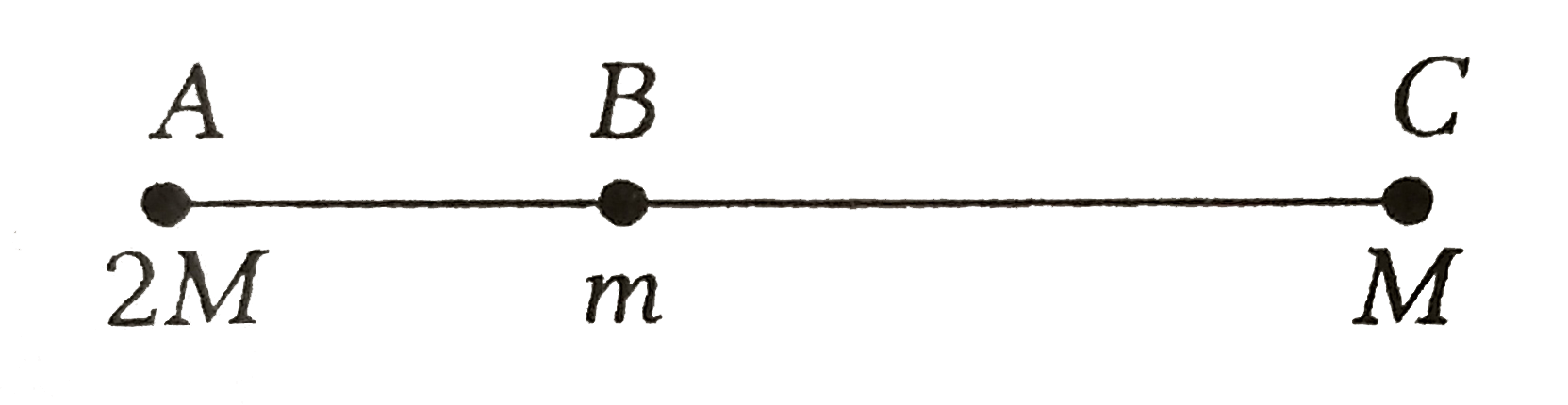
Particles of masses 2M, m and M are respectively at points A, B and C with `sqrt((GM)/(R))(sqrt(2)+1)` is much-much smaller than M and at time `t=0`, they are all at rest as given in figure

At subsequent time before any collision takes place.

A

`m` will remain at rest

B

`m` will move towards M

C

`m` will move towards 2M

D

`m` will have oscillatory motion

Text Solution

Verified by Experts

The correct Answer is:

C

Fore on B due to A `=F_(BA)=(G(2Mm))/((AB)^(2))` towards BA
Force on B due to C `= F_(BC)=(GMm)/((BC)^(2))` towards BC
As, `(BC)=2AB`
`rArr F_(BC)=(GMm)/((2AB)^(2))=(GMm)/(4(AB)^(2))lt F_(BA)`
Hence, `m` will move towards BA (i.e., 2M)
Promotional Banner

Topper's Solved these Questions

  • GRAVITATION

    DC PANDEY|Exercise (B) Chapter Exercises|31 Videos
  • GRAVITATION

    DC PANDEY|Exercise (C) Chapter Exercises|45 Videos
  • GRAVITATION

    DC PANDEY|Exercise Check Point 10.6|20 Videos
  • GENERAL PHYSICS

    DC PANDEY|Exercise INTEGER_TYPE|2 Videos
  • KINEMATICS

    DC PANDEY|Exercise INTEGER_TYPE|11 Videos

Similar Questions

Explore conceptually related problems

particles of masses 2M m and M are resectively at points A , B and C with AB = (1)/(2) (BC) m is much - much smaller than M and at time t=0 they are all at rest as given in figure . As subsequent times before any collision takes palce .

Two particle of masses m and 2m are coliding elastically as given in figure. If V_(1) and V_(2) speed of particle just after collision then

Four particles of masses m, 2m, 3m & 4m respectively are placed on the periphery of a circle of radius R as shown in the figure then CM of the system contains the particle is at

Two particles of masses 1kg and 2kg respectively are initially 10m aprt. At time t=0 , they start moving towards each other with uniform speeds 2m//s and 1m//s respectively. Find the displacement of their centre of mass at t=1s .

consider a head on collision between two particles of masses m_1 and m_2 . The initial speeds of the particles are u_1 and u_2 in the same directioin. The collision starts at t=0 and the particles interact for a time inteval /_\t. Lduring the collision the speed o the first particle varies as v(t)=u_1+t//_\(v_1-u_1) Find the speed of the second particle as as function of time during the collision.

A particle of mass m moving with a speed v hits elastically another staionary particle of mass 2m on a smooth horizontal circular tube of radius r . Find the time when the next collision will take place?

Two particles A and B are revolving with constant angular velocity on two concentric circles of radius 1m and 2m respectively as shown in figure. The positions of the particles at t = 0 are shown in figure. The positions of the particles at t=0 are shown in figure. if m_(A)=2kg, m_(B)= 1kg and vec(P)_(A) and vec(P)_(B) are linear momentum of the particle then what is the maximum value of |vec(P)_(A)+vec(P)_(B)| in kg-m/sec in subsequent motion of two particles.

A particle A of mass m initially at rest slides down a height of 1.25 m on a frictionless ramp, collides with and sticks to an identical particles B of mass m at rest as shown in the figure. Then, particles A and B together collide elastically with particle G of mass 2m at rest. The speed of particle G after the collision with combined body (A+B) would be (Take, g =10 ms^(-2))

Two blocks A and B of masses m and 2m respectively are placed on a smooth floor. They are connected by a spring. A third block C of mass m moves with a velocity v_0 along the line joing A and B and collides elastically with A, as shown in figure. At a certain instant of time t_0 after collision, it is found that the instantaneous velocities of A and B are the same. Further, at this instant the compression of the spring is found to be x_0 . Determine (i) the common velocity of A and B at time t_0 , and (ii) the spring constant.

DC PANDEY-GRAVITATION-(A) Chapter Exercises
  1. Two satellite of same mass are launched in the same orbit of radius r ...

    Text Solution

    |

  2. Compute the additional velocity required by a satellite orbiting aroun...

    Text Solution

    |

  3. Particles of masses 2M, m and M are respectively at points A, B and C ...

    Text Solution

    |

  4. Earth orbiting satellite will escape if

    Text Solution

    |

  5. Energy required in moving a body of mass m from a distance 2R to 3R fr...

    Text Solution

    |

  6. A body attains a height equal to the radius of the earth. The velocity...

    Text Solution

    |

  7. Suppose the gravitational attraction varies inversely as the distance ...

    Text Solution

    |

  8. The rotation of the earth about its axis speeds up such that a man on ...

    Text Solution

    |

  9. The rotation of the earth radius R about its axis speeds upto a value ...

    Text Solution

    |

  10. Assuming the radius of the earth to be 6.5 xx 10^(6) m. What is the ti...

    Text Solution

    |

  11. If gravitational attraction between two points masses be given by F=G(...

    Text Solution

    |

  12. Suppose the gravitational force varies inversely as the n^(th) power o...

    Text Solution

    |

  13. A body is projected vertically upwards from the surface of the earth w...

    Text Solution

    |

  14. A particle takes a time t(1) to move down a straight tunnel from the s...

    Text Solution

    |

  15. An earth satellite of mass m revolves in a circular orbit at a height ...

    Text Solution

    |

  16. A body which is initially at rest at a height R above the surface of t...

    Text Solution

    |

  17. A planet of mass m moves around the Sun of mass Min an elliptical orbi...

    Text Solution

    |

  18. A rocket is launched vertical from the surface of the earth of radius ...

    Text Solution

    |

  19. Two particles of equal mass (m) each move in a circle of radius (r) un...

    Text Solution

    |

  20. Suppose a smooth tunnel is dug along a straight line joining two point...

    Text Solution

    |
