Home
Class 11
PHYSICS
In elliptical orbit of a planet, as the ...

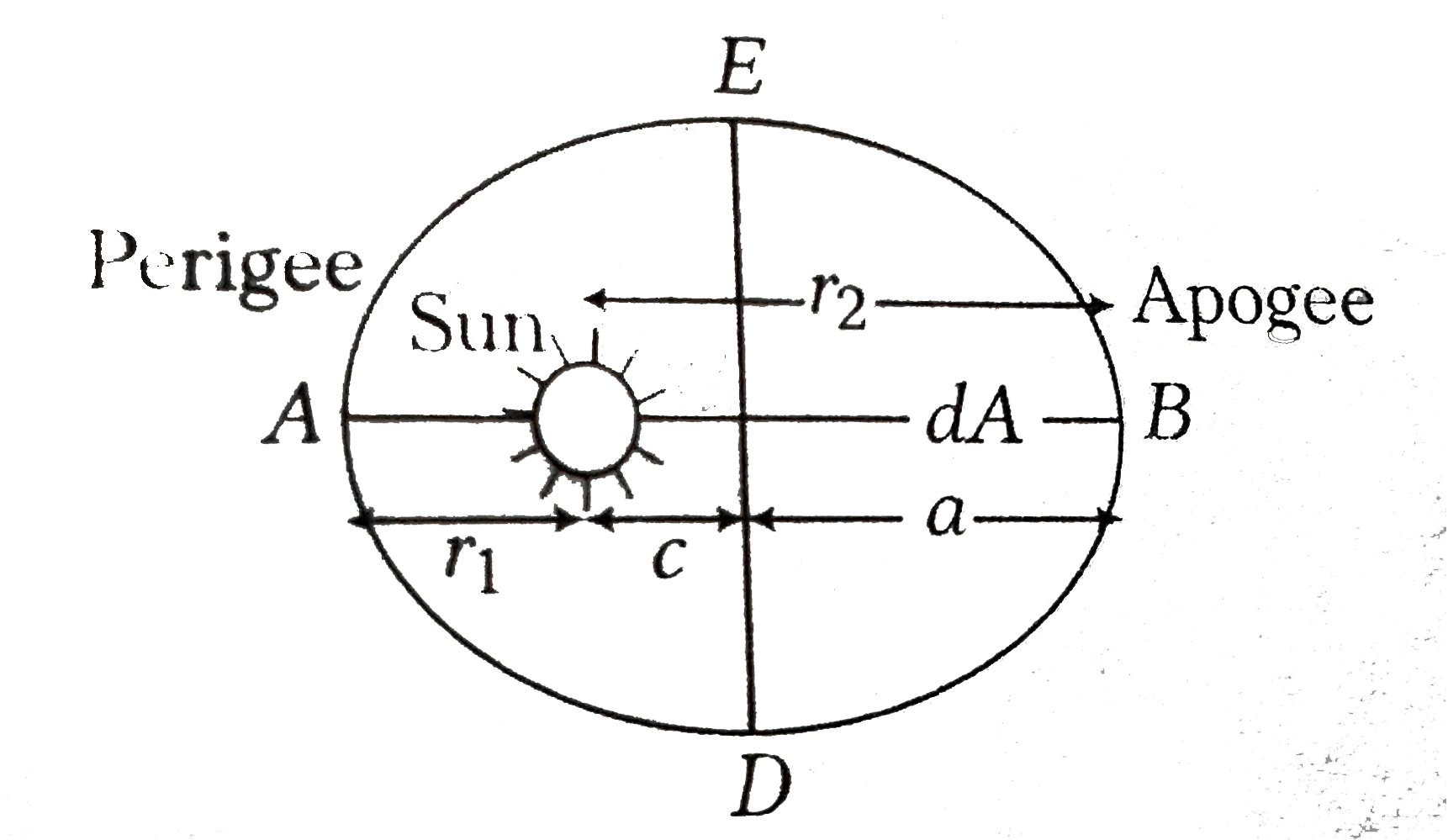
In elliptical orbit of a planet, as the planet moves from apogee position to perigee position to perigee position, match the following columns
`{:(,"Column-I",,"Column-II"),("(A)","Speed of planet","(p)","Remains same"),("(B)","Distance of planet from centre of sun","(q)","Decreases"),("(C)","Potential energy","(r)","Increase"),("(D)","Angular momentum about centre of sun","(s)","Cannot say"):}`

Text Solution

Verified by Experts

The correct Answer is:
`(A rarr r,B rarr q, C rarr q,D rarr p)`

In the figure given alongside, it can be seen that at perigee position, plant is nearest to the sun. So, in the elliptical moves, as the planet orbit from opogee position to perigee position, then speed of planet increases, distance of planet from cebtre of sun decreaes, potential energy decreases, Angular momentum about centre of sun remains the same
Promotional Banner

Topper's Solved these Questions

  • GRAVITATION

    DC PANDEY|Exercise (C) Chapter Exercises|45 Videos
  • GRAVITATION

    DC PANDEY|Exercise (A) Chapter Exercises|68 Videos
  • GENERAL PHYSICS

    DC PANDEY|Exercise INTEGER_TYPE|2 Videos
  • KINEMATICS

    DC PANDEY|Exercise INTEGER_TYPE|11 Videos

Similar Questions

Explore conceptually related problems

If earth decreases its rotational speed. Match the following columns {:(,"Column-I",,"Column-II"),("(A)","Value of g at pole","(p)","Will remain same"),("(B)","Value of g at equator","(q)","Will increase"),("(C)","Distance of geostationary","(r)","Will decrease"),("(D)","Energy of geostationary satellite","(s)","Cannot say"):}

Match the following : {:(,"Column-1",," Column-2"),("(A)","Electrostatic potential energy",,"(P) Positive"),("(B)","Gravitational potential energy",,"(Q) Negative"),("(C)","Elastic potential energy",,"(R) Zero"),("(D)","Magnetic potential energy",,"(S) Not defined"):}

Match the following columns. (for a satellite in circular orbit) {:(,"Column-I",,"Column-II"),("(A)","Kinetic energy","(p)",-(GMm)/(2r)),("(B)","Potential energy","(q)",sqrt((GM)/(r))),("(C)","Total energy","(r)",-(GMm)/(r)),("(D)","Orbital speed","(s)",(GMm)/(2r)):}

Match the following {:(,"Column-I",,"Column-II"),("(A)","Kepler's first law","(p)",T^(2)propr^(3)),("(B)","Kepler's second law","(q)","Areal velocity is constant"),("(C)","Kepler's third law","(r)","Orbit of planet is elliptical"):}

Two concentric spherical shells are as shown in figure. Match the following columns {:(,"Column-I",,"Column-II"),("(A)","Potential at A","(p)","greater than B"),("(B)","Gravitational field at A","(q)","less than B"),("(C)","As one moves from C to D","(r)","Potential remains constant"),("(D)","As one moves from D to A","(s)","Gravitational field decreases"),(,,"(t)","None"):}

Density of a planet is two times the density of earth. Radius of this planet is half. Match the following (as compared to earth) {:(,"Column-I",,"Column-II"),("(A)","Accleration due to gravity on this planet's surface","(p)","Half"),("(B)","Gravitational potential on the surface","(q)","Same"),("(C)","Gravitational potential at centre","(r)","Two times"),("(D)","Gravitational field strength at centre","(s)","Four times"):}

Match the following: {:("Column-I","Column-II"),((A)"Water clock",(p)"Sand"),((b)"Sun dial",(q)"flow of water"),((c )"Hour glass",(r )"Shadow"):}

A planet moves in elliptical around sun, at one of focal points. Match the following, for different parameters related to the planet during the motion {:(,"Column I",,"Column II"),((A),"Kinetic energy",(p),"Maximum at perigee"),((B),"Gravitational potential energy",(q),"Minimum at perigee"),((C ),"Linear momentum",(r ),"Maximum at apogee"),((D),"Area swept per second radius",(s),"Minimum at apogee"):}

DC PANDEY-GRAVITATION-(B) Chapter Exercises
  1. Assertion : If a particle is projected from the surface of earth with ...

    Text Solution

    |

  2. Assertion : On earth's satellite, we feel weightlessness. Moon is also...

    Text Solution

    |

  3. Assertion : The centre of semicircular ring of mass m and radius R is...

    Text Solution

    |

  4. Assertion : If the projuct of surface area and density is same for bot...

    Text Solution

    |

  5. Assertion : Areal velocity of a planet around of surface area and dens...

    Text Solution

    |

  6. Assertion : Mass of the rod AB is m(1) and of particle P is m(2). Dist...

    Text Solution

    |

  7. Assertion : Four point masses each of mass m are placed at points 1, 2...

    Text Solution

    |

  8. Assertion : Let W(1) be the work done in taking away a satellite from ...

    Text Solution

    |

  9. Assertion : Two spherical shells have masses m(1) and m(2). Their radi...

    Text Solution

    |

  10. Match the following {:(,"Column-I",,"Column-II"),("(A)","Kepler's fi...

    Text Solution

    |

  11. Density of a planet is two times the density of earth. Radius of this ...

    Text Solution

    |

  12. On the surface of earth acceleration due gravity is g and gravitationa...

    Text Solution

    |

  13. Let V and E denote the gravitational potential and gravitational field...

    Text Solution

    |

  14. Two concentric spherical shells are as shown in figure. Match the foll...

    Text Solution

    |

  15. Match of following columns {:(,"Column-I",,"Column-II"),("(A)",under...

    Text Solution

    |

  16. A particle is projected from the surface of earth of mass M and radius...

    Text Solution

    |

  17. In elliptical orbit of a planet, as the planet moves from apogee posit...

    Text Solution

    |

  18. Match the following columns {:(,"Column-I",,"Column-II"),("(A)",unde...

    Text Solution

    |

  19. If earth decreases its rotational speed. Match the following columns ...

    Text Solution

    |

  20. Match the following columns. (for a satellite in circular orbit) {:(...

    Text Solution

    |

