

Home
Class 12
PHYSICS
Screen S is illuminated by two point sou...

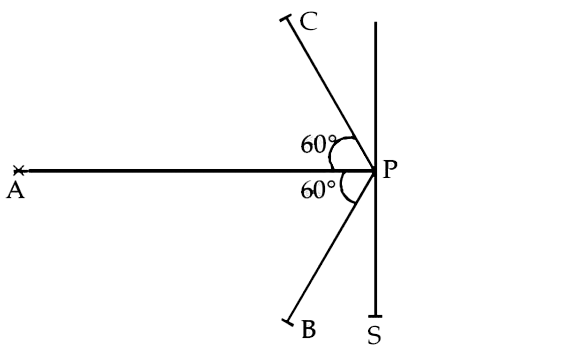
Screen S is illuminated by two point sources A and B. Another source C sends a parallel beam of light towards point P on the screen (see figure). Line AP is normal to the screen and the lines AP, BP and CP are in one plane. The distance AP, BP and CP are 3m, 1.5m and 1.5m respectively. The radiant powers of sources A and B are `90` watts and `180` watts respectively. The beam from C is of intensity `20`(watts)`/(m^2)`. Calculate the intensity at P on the screen. `

Promotional Banner

Topper's Solved these Questions

  • RAY OPTICS

    SL ARORA|Exercise TYPE A|15 Videos
  • RAY OPTICS

    SL ARORA|Exercise Problems For Self Practice|109 Videos
  • RAY OPTICS

    SL ARORA|Exercise TYPE J|11 Videos
  • OPTICAL INSTRUMENTS

    SL ARORA|Exercise Problems for self practice|35 Videos
  • SOLIDS AND SEMICONDUCTOR DEVICES

    SL ARORA|Exercise PROBLEM_TYPE|9 Videos

Similar Questions

Explore conceptually related problems

If A and B are (1,4) and (5,2) respectively, find the coordinates of P when AP/BP=3/4

A photoelectric cell is illuminated by a point source of light 1 m away . When the source is shifted to 2 m then

Two coherent point sources S_1 and S_2 are separated by a small distance d as shown. The fringes obtained on the screen will be

In the Figure AP = 2 cm, BP = 6 cm and CP = 3 cm. Find DP

If the distance between a point source and screen is doubled, then intensity of light on the screen will become

The optical path difference at a point on the screen which is equidistant from two sources is

A point source of sound is placed in a non-absorbing medium two points A and B are at the distance of 1 m and 2 m, respectively, from the source. The ratio of amplitudes of waves at A to B is

In a Fresnel's biprims experiment fringes widht 0.05 mm are observed on a screen at a distance of 1.5 m from the source. When a convex lens is placed between the source and the screen, are 0.04 mm and 0.1 mm resepectively. The wavelenght of light used is s

SL ARORA-RAY OPTICS-Problems
  1. Screen S is illuminated by two point sources A and B. Another source C...

    Text Solution

    |

  2. A motor car is fitted with a convex driving mirror of focal length 20 ...

    Text Solution

    |

  3. Glycerine (refractive index 1.4) is poured into a large jar of radiys ...

    Text Solution

    |

  4. A point source of light S is placed at the bottom of a vessel containi...

    Text Solution

    |

  5. A ray of light travelling in glass (mug=3//2) is incident on a horizon...

    Text Solution

    |

  6. A rectangular glass block of thickness 10 cm and refractive index 1.5 ...

    Text Solution

    |

  7. A ray of light travelling in air is incident at grazing angle (incide...

    Text Solution

    |

  8. A right angled prism is to be made by selecting a proper material and ...

    Text Solution

    |

  9. A right angles prism (45^(@),90^(@), 45^(@)) of refractive index n ha...

    Text Solution

    |

  10. Light is incident at an angle alpha on one planar end of a transparent...

    Text Solution

    |

  11. A rod of glass ( mu = 1.5) and of square cross section is bent into t...

    Text Solution

    |

  12. A slab of a material of refractive index 2 shown in fig. has a curved ...

    Text Solution

    |

  13. A parallel beam of light travelling in water (refractive index =4//3)...

    Text Solution

    |

  14. A glass sphere of radius 5 cm has a small bubble at a distance 2 cm fr...

    Text Solution

    |

  15. A plano-convex lens has thickness 4cm. When places on a horizontal tab...

    Text Solution

    |

  16. Two point light sources are 24 cm apart. Where should a convex lens of...

    Text Solution

    |

  17. A convex lens and a convex mirror of radius of curvature 20 cm are pla...

    Text Solution

    |

  18. Consider a coaxial system of two thin convex lenses of focal length f ...

    Text Solution

    |

  19. A thin plano-convex lens of focal length f is split into two halves. O...

    Text Solution

    |

  20. Two thin similar convex glass are joined together front to front, with...

    Text Solution

    |