Home
Class 12
PHYSICS
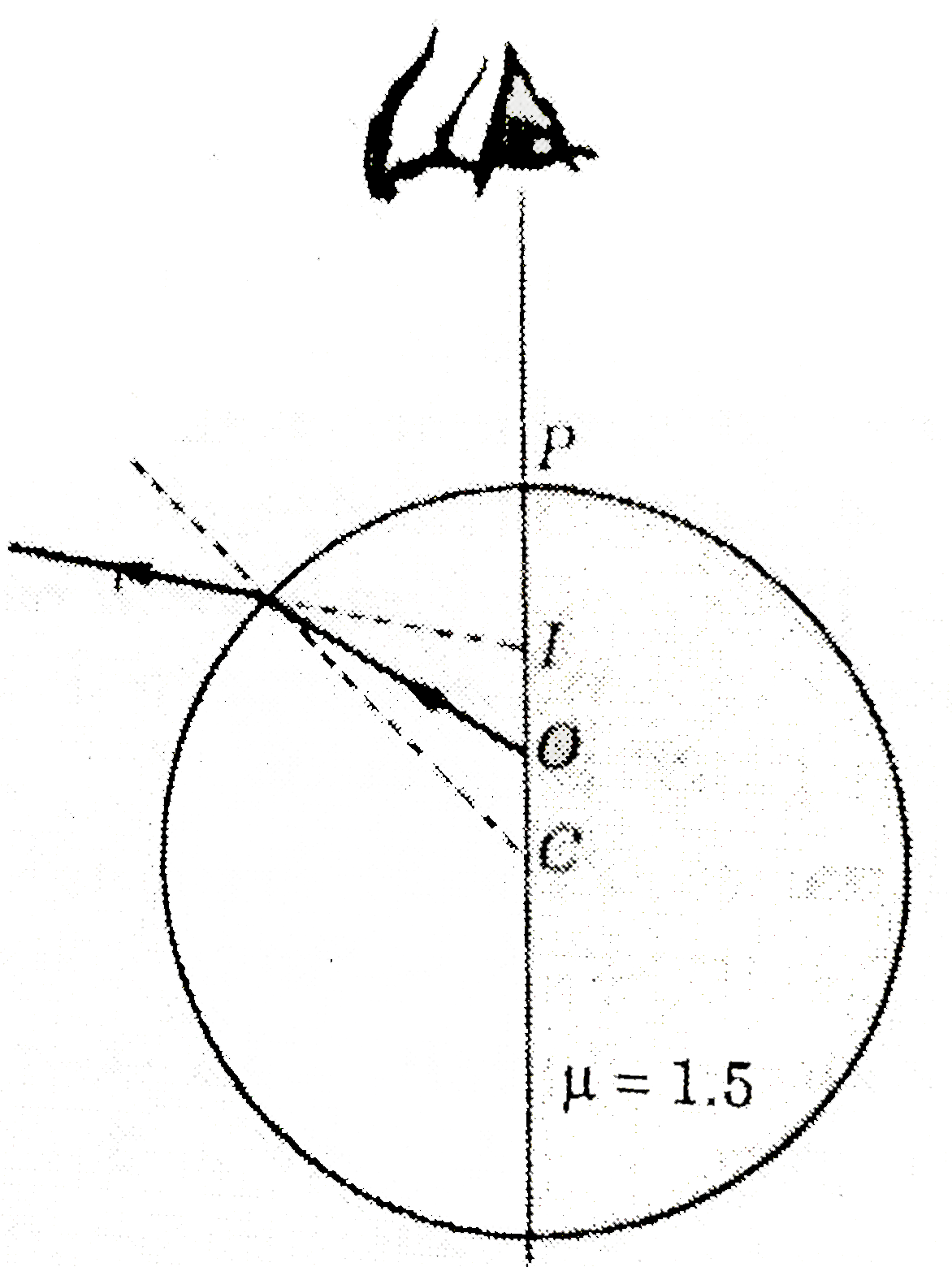
Fig shows a small air bubble inside a gl...

Fig shows a small air bubble inside a glass sphere `(mu = 1.5)` of radius 10 cm. the bubble is 4.0 cm below the surface and is viewed normally from the outside. Find the apparent depth of the bubble.

Text Solution

Verified by Experts

The correct Answer is:

3 cm below the surface
Promotional Banner

Topper's Solved these Questions

  • RAY OPTICS

    SL ARORA|Exercise TYPE F|10 Videos
  • RAY OPTICS

    SL ARORA|Exercise TYPE I|12 Videos
  • RAY OPTICS

    SL ARORA|Exercise TYPE A|15 Videos
  • OPTICAL INSTRUMENTS

    SL ARORA|Exercise Problems for self practice|35 Videos
  • SOLIDS AND SEMICONDUCTOR DEVICES

    SL ARORA|Exercise PROBLEM_TYPE|9 Videos

Similar Questions

Explore conceptually related problems

There is a small air bubble inside a glass sphere (mu=1.5) of radius 10 cm. The bubble is 4.0cm below the surface and is viewd normally from the outside. Find the apparent dipth of the bubble.

There is small air bubble inside a glass sphere (mu=1.5) of radius 10 cm. The bubble is 4.0 cm below the surface and is viewed normally from the outside figure. Find the apparent depth of the bubble

A glass sphere ( mu =1.5) of radius 20 cm has small air bubble 4 cm below its centre. The sphere is viewed from outside and along vertical line through the bubble. The apparent depth of the bubble below the surface of sphere is (in cm)

An air bubble inside a glass slab (µ=1.5) appears 6 cm when viewed from one side and 4 cm when viewed from the opposite side. The thickness of the slab is

An object lies 100 cm inside water (mu=4//3) . It is viewed from air nearly normally. Find the apparent depth of the object.

A small air bubble in a glass sphere of radius 2 cm appears to be 1 cm from the surface when looked at, along a diameter. If the refractive index of glass is 1.5 , find the true position of the air bubble. .

SL ARORA-RAY OPTICS-Problems For Self Practice
  1. A small object is 2 cm below the concave meniscus of water in a test t...

    Text Solution

    |

  2. A spherical surface of radius 30 cm separates two transparent media A ...

    Text Solution

    |

  3. Fig shows a small air bubble inside a glass sphere (mu = 1.5) of radiu...

    Text Solution

    |

  4. A double convex lens has radii 20 cm. The index of refraction of glass...

    Text Solution

    |

  5. The focal length of a double convex lens is equal to radius of curvatu...

    Text Solution

    |

  6. Fig. 6(b).54. shows a thin lens with centres of curvature C(1) and C(2...

    Text Solution

    |

  7. A plano-convex lens (mu = 1.5) has a curved surface of radiys 15 cm. w...

    Text Solution

    |

  8. The focal length of a concave-convex lens of radii of curvature 5 cm a...

    Text Solution

    |

  9. A convex lens of refractive index 1.5 is immersed in a liquid of refra...

    Text Solution

    |

  10. The two surfaces of a double concave lens are of curvature 10 cm and 4...

    Text Solution

    |

  11. The focal length of a plano-convex lens is 20 cm in air. Refractive in...

    Text Solution

    |

  12. The focal length of a convex lens of glass (mu = 1.5) in air is 30 cm....

    Text Solution

    |

  13. A lens of refractive index mu becomes a lens of focal length f' when i...

    Text Solution

    |

  14. The radii of curvature of each surface of a convex lens is 20 cm and t...

    Text Solution

    |

  15. The radii of curvatureof double convex lens of glass (mu = 1.5) are in...

    Text Solution

    |

  16. Where should an object be placed from a converging lens of focal lengt...

    Text Solution

    |

  17. At what distance should an object be placed from a convex lens of foca...

    Text Solution

    |

  18. A convex lens is placed on an optical bench and is moved till it gives...

    Text Solution

    |

  19. A convex lens of focal length 30 cm is placed between a screen and a s...

    Text Solution

    |

  20. An object is 60 cm in front of a thin lens, the image being 300 cm on ...

    Text Solution

    |
