Home
Class 12
PHYSICS
In the following ray diagram are given t...

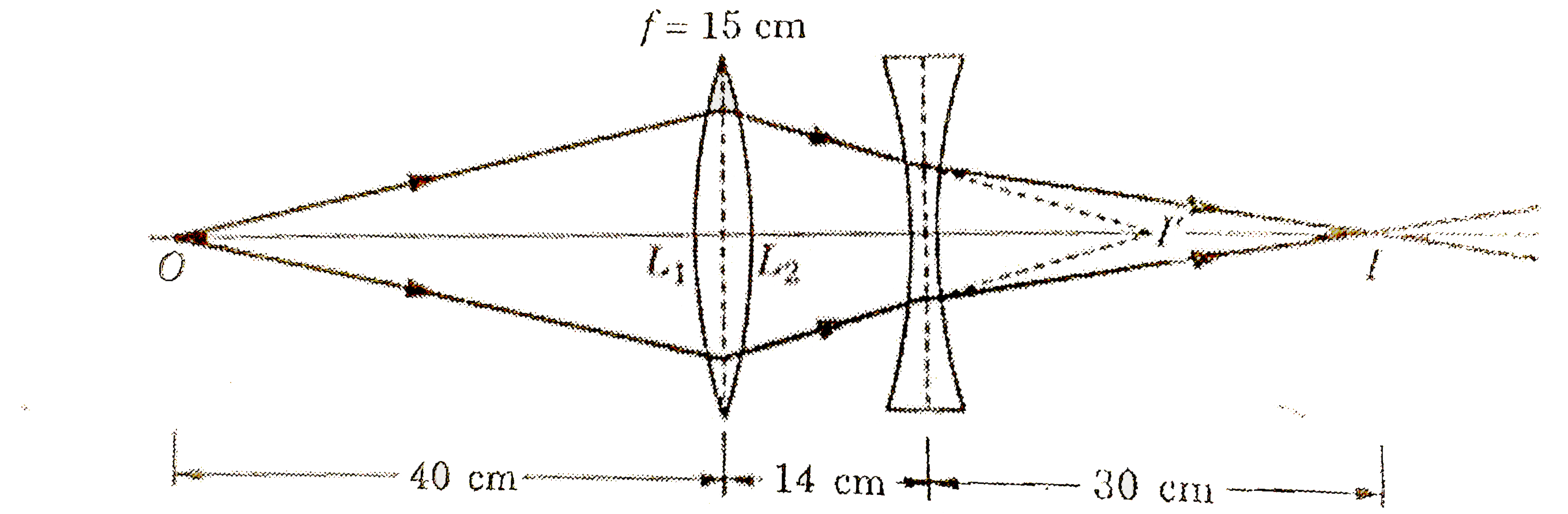
In the following ray diagram are given the position of an object O, image I and two lenses `L_(1)` and `L_(2)`. The focal length of `L_(1)` is also given. Find the focal length of `L_(2)`.

Text Solution

Verified by Experts

The correct Answer is:

20 cm
Promotional Banner

Topper's Solved these Questions

  • RAY OPTICS

    SL ARORA|Exercise TYPE F|10 Videos
  • RAY OPTICS

    SL ARORA|Exercise TYPE I|12 Videos
  • RAY OPTICS

    SL ARORA|Exercise TYPE A|15 Videos
  • OPTICAL INSTRUMENTS

    SL ARORA|Exercise Problems for self practice|35 Videos
  • SOLIDS AND SEMICONDUCTOR DEVICES

    SL ARORA|Exercise PROBLEM_TYPE|9 Videos

Similar Questions

Explore conceptually related problems

In the following ray diagram the positions of an object O, image I and two lenses L_(1) and L_(2) and a mirror M are given. The focal length of L_(1) is 10 cm. Find the focal length of L_(2) .

In the following diagram are shown the position of an object O, image I and two lenses. The focal length of one lens is also given. Determine the focal length of the other lens.

Use the following ray diagram, Fig. to calculate focal length of lens L_2 . .

In Fig., there are two convex lenses L_(1) and L_(2) having focal lengths F_(1) and F_(2) respectively. The distance between L_(1) and L_(2) will be :

In the figure shown, there are two convex lenses L_(1) and L_(2) having focal. Lengths f_(1) and f_(2) respectively. The distance between L_(1) and L_(2) will be

Use the following ray diagram, Fig. 6(b).56 to calculate focal length of lens L_(2) .

The length of a metal wire is l_(1) when the tension in it is F_(1) and l_(2) when the tension becomes F_(2) . Find the natural length of wire.

Under the action of load F_(1), the length of a string is L_(1) and that under F_(2), is L_(2). The original length of the wire is

In Fig., there are two convex lenses L_1 and L_2 having focal lengths F_1 and F_2 respectively. The distance between L_1 and L_2 will be : .

SL ARORA-RAY OPTICS-Problems For Self Practice
  1. When a slide is placed 15 cm behind the lens in a projector, an image ...

    Text Solution

    |

  2. In the diagram shows below rays are coming from infinity and after pas...

    Text Solution

    |

  3. In the following ray diagram are given the position of an object O, im...

    Text Solution

    |

  4. In the following diagram are shown the position of an object O, image ...

    Text Solution

    |

  5. A compound lens has been formed by joinined a convex and a concave len...

    Text Solution

    |

  6. Two thin lenses of power + 3 D and - 1 D are held contact with each ot...

    Text Solution

    |

  7. A what distance must an object be placed from convex lens of power 4D ...

    Text Solution

    |

  8. Find the focal length and power of a convex lens, which when placed in...

    Text Solution

    |

  9. The power of a thin convex lens of glass is 5 dioptre. When it is imme...

    Text Solution

    |

  10. A concave lens is kept in contact with a convex lens of focal length 2...

    Text Solution

    |

  11. A compound lens is made of two lenses having powers +15.5 D and -5.5D....

    Text Solution

    |

  12. Ray coming from an object situated at infinity, fall on a convex lens ...

    Text Solution

    |

  13. A ray of light is incident at an angle of 60^(@) on one face of a pris...

    Text Solution

    |

  14. The refracting angle of a glass prism is 60^(@). The value of minium d...

    Text Solution

    |

  15. The refractive index of the material of a prism of 60^(@) angle for ye...

    Text Solution

    |

  16. A ray of light incident at 49^(@) on the face of an equilateral prism ...

    Text Solution

    |

  17. A glass prism has a refracting angle of 60^@. The angle of minimum dev...

    Text Solution

    |

  18. A ray incident normally on one face of a right-angled isosceles glass ...

    Text Solution

    |

  19. As shown in Fig. PQ is a ray incident on prism ABC. Show the correspon...

    Text Solution

    |

  20. Show that a light ray will pass through an equilateral glass prism (mu...

    Text Solution

    |
