Home
Class 11
PHYSICS
A steel rod with a cross-sectional area ...

A steel rod with a cross-sectional area of `150 mm^(2)` is stretched between two fixed points. The tensile load at `20^(@)C` is `5000N`.
`(a)` What will be the stress at `-20^(@)C` ?
`(b)` At what temperature will the stress be zero ?
(Assume `alpha=11.7mu m//m^(@)C` and `Y=200GN//m^(2)`)

A

`12.7 xx 10^(6)N//m^(2)`

B

`1.27 xx 10^(6)N//m^(2)`

C

`127 xx 10^(6)N//m^(2)`

D

`0.127 xx 10^(6)N//m^(2)`

Text Solution

Verified by Experts

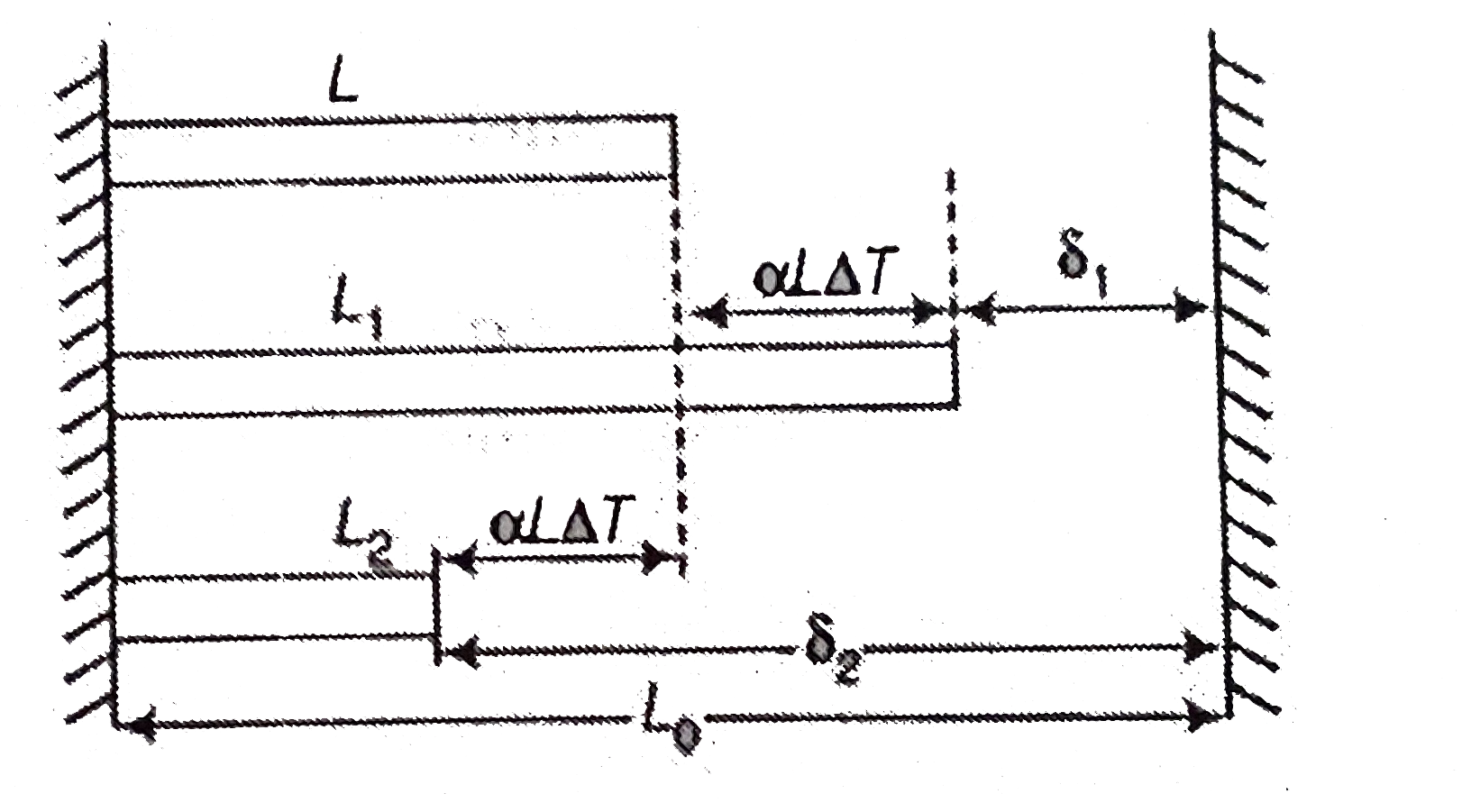
c) Let L = free length at `0^(@)`C
`L_(0)`=Final stretched length in each case.
`L_(1)` and `L_(2)` are free lengths at `+20^(@)`C and `-20^(@)`C, respectively.
We know, Here `s_(1)` and `s_(2)` are load deformation
`(F_(2)L)/(AY) = (F_(1)L)/(AY) + 2alphaLDeltaT`
`rArr sigma_(2) = (F_(2)/A =(F_(1))/A + 2alphaDeltaTY`
`=(5000)/(150 xx 10^(-6)) + (2)(11.7 xx 10^(-6)(20)(2 xx 10^(11))`
`(127 xx 10^(6)N//m^(2)`)
Promotional Banner

Topper's Solved these Questions

  • HEAT, TEMPERATURE AND CALORIMETRY

    BITSAT GUIDE|Exercise Bitsat archives|9 Videos
  • GRAVITATION

    BITSAT GUIDE|Exercise BITSAT Archives|15 Videos
  • LAWS OF THERMODYNAMICS

    BITSAT GUIDE|Exercise 40|1 Videos

Similar Questions

Explore conceptually related problems

A wire of cross sectional area 3mm^(2) is just stretched between two fixed points at a temperature of 20^(@) . Determine the tension when the temperature falls to 20^(@) C . Coefficient of linear of expansion alpha = 10^(-5)//"^(@)C and Y = 2 xx 10^(11)N//m^(2) .

A wire of cross-sectional area 3 mm^(2) is first stretched between two fixed points at a temperature of 20^(@)C . Determine the tension when the temperature falls to 10^(@)C Coefficient of linear expansion alpha=10^(-5).^(@)C^(-1) and Y =2 xx10^(11) N//m^(2)

The steel wire of cross-sectional area =2 mm^2 [Y= 200GPa, alpha= 10^(-5) /.^@C] is stretched and tied firmly between two rigid supports, at a tempeture =20^@C . At this moment, the tension in the wire is 200N. At what temperature will the tension become zero?

A wire of cross sectional area 3 mm^(2) is just stretched between two fixed points at a temperature of 20^(@)C . Then the tension in the wire when the temperature falls to 10^(@)C is, (alpha =1.2 xx 10^(-5) //""^(@)C, Y=2xx10^(11) N//m^(2))

A steel wire 2 mm is diameter is just stretched between two fixed points at a temperature of 20^(@)C . If the temperature falls to 10^(@)C , then the tension in the wire is (Coefficient of linear expansion of steel (alpha) is 11xx10^(-6)//""^(@)C and Y_(s)=2.1xx10^(11)N//m^(2) )

A steel wire 2 mm in diameter is just stretched between two fixed points at a temperature of 20^(@)C. If the temperature falls to 10^(@)C, then the tension in the wire is (The coefficient of linear expansion of steel = 11xx10^(-6)//^(@)C and Y for steel 2.1 xx10^(11)N//m^(2))

A stell wire of cross-sectional area 0.5mm^2 is held between teo fixed supports. If the wire is just taut at 20^C , determine the tension when the temperature falls to 0^C . Coefficient of linear expansion of steel is 1.2 xx 10^(-5) 0^C(-1) and its Young's modulus is 2.0 xx 10^11 N m^(-2).

A uniform steel wire of cross-sectional area 0.20mm^(2) is held fixed by clamping its two ends. If wire is cooled from 100^(@)C to 0^(@)C , find (a) temperature strain (b) temperature stress (c) extra force exerted by each clamp on the wire. Young's modulus of steel =2xx10^(11)N//m^(2) , coefficient of linear expansion of steel =1.2xx10^(-5)//^(@)C .

A steel rod of cross-sectional area 1m^(2) is acted upon by forces as shown in the Fig. Determine the total elongation of the bar. Take Y = 2.0xx10^(11) N//m^(2)