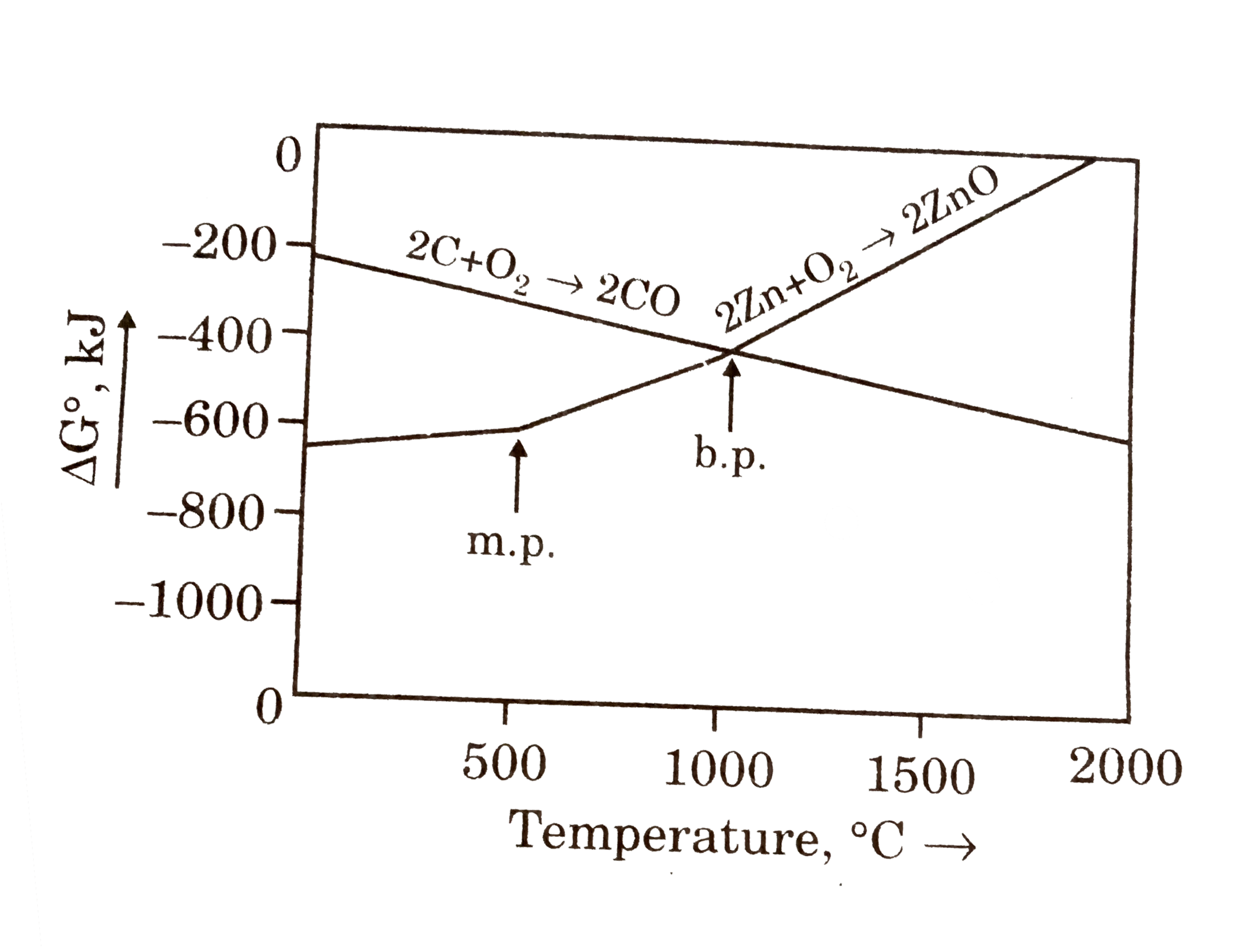
Question given below are based on the given diagram of extractive metallurgy. The point noted by arrow are the melting and boiling points of the metals zinc and magnesium. `DeltaG^(@)` as a function of temperature for some reaction of extractive metallurgy. At what temperature, zinc and carbon have equal affinity for oxygen?
A
`1000^(@)`C
B
`1500^(@)`C
C
`500^(@)C`
D
`1200^(@)C`
Text Solution
Verified by Experts
The correct Answer is:
b
Topper's Solved these Questions
METTALURGY
NARAYNA|Exercise Passage-III|2 Videos
METTALURGY
NARAYNA|Exercise Passage-IV|2 Videos
METTALURGY
NARAYNA|Exercise Comprehension type question Passage-I|2 Videos
METALLURGY
NARAYNA|Exercise STATEMENT TYPE QUESTOINS|20 Videos
NUCLEAR CHEMISTRY
NARAYNA|Exercise INTEGER|28 Videos
Similar Questions
Explore conceptually related problems
Question given below are based on the given diagram of extractive metallurgy. The point noted by arrow are the melting and boiling points of the metals zinc and magnesium. DeltaG^(@) as a function of temperature for some reaction of extractive metallurgy. At this temperature DeltaG^(@) of the reaction is: ZnO+C to Zn+CO
Question given below are based on the given diagram of extractive metallurgy. The point noted by arrow are the melting and boiling points of the metals zinc and magnesium. DeltaG^(@) as a function of temperature for some reaction of extractive metallurgy. To make the following reduction process spontaneous, temperature should be: ZnO+C to Zn+CO
Questions given below are based on the given diagram for extractive metallurgy. (v) This method is known as :
Questions given below are based on the given diagram for extractive metallurgy. (i) At what approximate temperature, zinc and carbon have equal affinity for oxygen ?
Questions given below are based on the given diagram for extractive metallurgy. (iv) At 1100^@C , which reaction is spontaneous to a maximum extent ?