A
B
C
D
Text Solution
Verified by Experts
The correct Answer is:



Topper's Solved these Questions
GRAVITATION
MOTION|Exercise Exercise - 3 | level - 1 (Subjective | JEE Advanced)|13 VideosGRAVITATION
MOTION|Exercise Exercise - 3 | Level - II (Subjective | JEE Advanced)|10 VideosGRAVITATION
MOTION|Exercise Exercise - 2 (Level - I) (Objective Problems | Jee Main|13 VideosGEOMETRICAL OPTICS
MOTION|Exercise Exercise - 4 | Level-II|55 VideosHEAT - 1
MOTION|Exercise EXERCISE -4 (Level - II) Previous Year | JEE Advanced|22 Videos
Similar Questions
Explore conceptually related problems
MOTION-GRAVITATION-Exercise - 2 (Level - II) Multiple choice | JEE Advanced
- Two masses m(1) and m(2) (m(1) lt m(2)) are released from rest from a ...
Text Solution
|
- In side a hollow spherical shell
Text Solution
|
- The magnitude of the gravitational field at distance r(1) and r(2) fro...
Text Solution
|
- Three mass ‘m’ each are kept at corner of a equilateral triangle and a...
Text Solution
|
- The gravitational potential changes uniformly from -20 j/kg to -40 J/k...
Text Solution
|
- A tunnel is dug along a chord of the earth at a perpendicular distance...
Text Solution
|
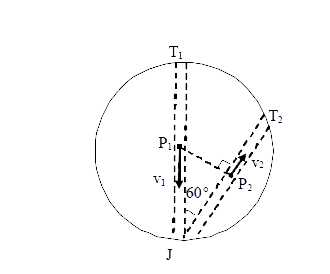
- Two tunnels are dug across the earth as shown in figure. Two particles...
Text Solution
|
- If a satellite orbits as close to the earth's surface as possible,
Text Solution
|
- When a satellite in a circular orbit around the earth enters the atmos...
Text Solution
|
- A communications Earth satellite
Text Solution
|
- A geostationary satellite is at a height h above the surface of earth....
Text Solution
|
- For a satellite to orbit around the earth, which of the following must...
Text Solution
|