Home
Class 12
CHEMISTRY
Identify X,Y and Z respectively in the...

Identify X,Y and Z respectively in the following reaction sequence
Acetic acid `underset((3)C_6H_5SO_2 Cl, "Pyridine/343 K")overset((1)NH_3, (2) Delta)to` X+Y+Z

A

`C_(6)H_(5)SO_(3)H, CH_(3)NC, HCl`

B

`{:(" O"),(" ||"),(CH_(3)CONH-S-C_(6)H_(5)"," H_(2)O"," HCl),(" ||"),(" O"):}`

C

`C_(6)H_(5)SO_(3)H, CH_(3)CN, HCl`

D

`C_(6)H_(5)SO_(2)Cl, CH_(3)(NC, H_(2)O`

Text Solution

Verified by Experts

The correct Answer is:
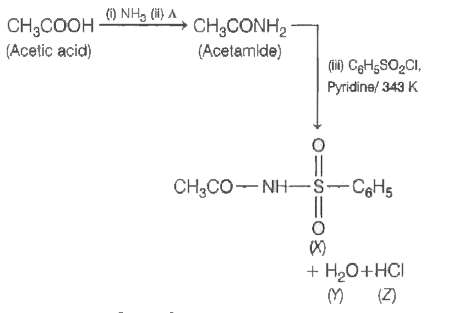
B


Hence answer (B) is correct option.
Promotional Banner

Topper's Solved these Questions

  • TS EAMCET 2018 (7 MAY SHIFT 1)

    TS EAMCET PREVIOUS YEAR PAPERS|Exercise CHEMISTRY|40 Videos
  • TS EAMCET 2019 (3 MAY SHIFT 2)

    TS EAMCET PREVIOUS YEAR PAPERS|Exercise CHEMISTRY|40 Videos

Similar Questions

Explore conceptually related problems

identify X, Y,and Z in the following reaction 2CH_(3)Cl+X overset(Y)underset(570k) rarr Z

Identify X and Y in the following reaction sequence X overset(Zn)(to) underset(Zn.H_(2)O)overset(O_(3))(To) [CH_(3)]_(2) CO + CH_(2)O

Identify the structure of Z in the following reaction sequence Phthalic acid +NH_(3)hArrXoverset(Delta)toYunderset("heating")overset("strong")toZ

Identify C in the following reaction : C_2 H_2 overset("Chromic acid")to A overset(NH_3)to B underset(-H_2 O)overset(Delta)to C

What are the structures of X, Y and Z in the following reaction sequence ? C_(6)H_(5)NH_(2)underset("Pyridine")overset((CH_(3)CO)_(2)O)toXunderset(288 K)overset(HNO_(3)//H_(2)SO_(4))toY

Identify Z in the following sequence of reactions Ethanol overset( PBr_3)to X overset( Alc. KOH) to Y underset( (ii) H_2O , "heat") overset( (i) Conc, H_2SO_4) to Z CH_3COONH_4 overset(Delta )to X overset(P_2O_5) to Y overset(H_2O //H^(+)) to Z

Identify (z) in the following reaction series Ethanol overset(PBr_2)(to)X overset(alc. KOH)(to) Y underset(H_2O, "heat")overset(H_2SO_4, "room temp")(to) Z

Identify the product Z in the following sequence of reactions "phenol" overset(NaOH)to X underset(4-7 atm, 410 K)overset(CO_(2))to Y overset(H_(3)O^(+))to Z

TS EAMCET PREVIOUS YEAR PAPERS-TS EAMCET 2019 (3 MAY SHIFT 1)-Chemistry
  1. Which of the following are not aromatic ?

    Text Solution

    |

  2. How many of the following compounds show ferrimagnetism ? Fe(3)O(4),...

    Text Solution

    |

  3. The molality (in mol kg^(-1) ) of 1 mole of solute in 50 g of solve...

    Text Solution

    |

  4. The freezing point of solution containing 10 mL of non-volatile and...

    Text Solution

    |

  5. A current of 19296 C is passed through an aqueous solution of cop...

    Text Solution

    |

  6. For a zero order reaction , the correct expression for rate constant ...

    Text Solution

    |

  7. Which one of the following is used as an eye lotion ?

    Text Solution

    |

  8. Identify A and B respectively in the following reactions : 4Au(s)+8C...

    Text Solution

    |

  9. Statement(A): Sulphur vapour is paramagnetic . Statement (B): Reacti...

    Text Solution

    |

  10. The reason for the noble gases to have low boiling and low melting po...

    Text Solution

    |

  11. Match the following : {:(,"List I",,"List II"),((A),Co^(2+),(I),"Yel...

    Text Solution

    |

  12. Which one of the following complex has the highest magnitude of Crys...

    Text Solution

    |

  13. A polymer contains 50 molecules with molecular mass 5000, 100 molecul...

    Text Solution

    |

  14. Which of the following are reducing sugars ? {:("Sucrose","Maltose"...

    Text Solution

    |

  15. Idenify opiates from the following {:("Codeine","Thymine","Epinehrin...

    Text Solution

    |

  16. Match the following {:(,"List I",,"List II"),(,,,"(Major"),(,,,"Prod...

    Text Solution

    |

  17. Find the suitable product for the following reaction . R-CO2H under...

    Text Solution

    |

  18. What is the product E in the following reaction?

    Text Solution

    |

  19. The decreasing order of acidic strength for following acids is (a...

    Text Solution

    |

  20. Identify X,Y and Z respectively in the following reaction sequence...

    Text Solution

    |

