Home
Class 12
CHEMISTRY
Arrange the following compounds in the i...

Arrange the following compounds in the increasing order of their property as indicated:
i. Acetaldehyde, acetone, di-tert-butyl ketone, methyl tert-butyl ketone (reactivity towards HCN).
ii. `CH_(3)CH_(2)CH(Br)COOH, CH_(3)CH(Br)CH_(2)COOH, (CH_(3))_(2)CHCOOH, CH_(3)CH_(2)CH_(2)COOH` (acidic strength).
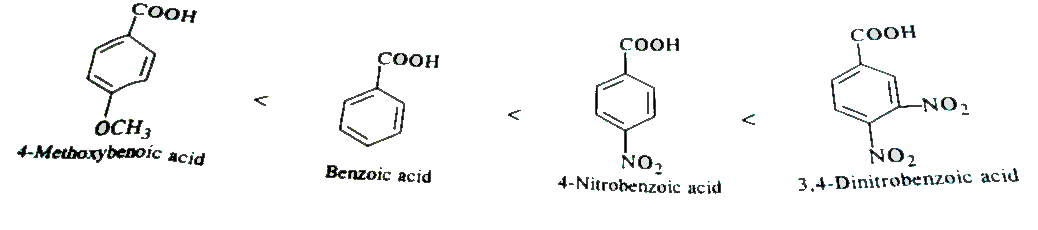
iii. Benzoic acid, 4-nitrobenzoic acid, 3,4-dinitro-benzoic acid, 4-methoxybenzoic acid (acidic strength).

Text Solution

Verified by Experts

(i) Cyanohydrin derivatives are formed as a result of the reaction in which the nucleophile`(CN^(-) ion)` attacks the carbon atom of the carbonyl group. The order of reactivity
decreases with increase in+1 effect of the alkyl group.
decreases with increase in steric hindrance due to the size as well as number of the alkyl groups.
In the light of the above information, the decreasing order of reactivity is :
(ii) We know that alkyl group with +1 effect decreases the acidic strength. The +1 effect of isopropyl group is more than that of n-propyl group. Similarly, bromine (Br) with -I effect increases the acidic strength. Closer its position in the carbon atom chain w.r.t., carboxyl (COOH) group, more will be its-I effect and stronger will be the acid. In the light of this, the increasing order of acidic strength is : `(CH_(3))_(2)CHCOOHltCH_(3)CH_(2)CH_(2)COOHltCH_(3)CH(Br)CH_(2)COOHltCH_(3)CH_(2)CH(Br)COOH`
(iii) We have learnt that the electron donating group `(OCH_(3))` decreases the acidic strength of the benzoic acid. At the same time, the electron withdrawing group `(NO_(2))` increases the same. Keeping this in mind, the increasing order of acidic strength is :
Promotional Banner

Topper's Solved these Questions

  • CARBOXYLIC ACIDS

    DINESH PUBLICATION|Exercise SHORT ANSWER TYPE QUESTIONS|19 Videos
  • CARBOXYLIC ACIDS

    DINESH PUBLICATION|Exercise LONG ANSWER TYPE QUESTIONS|4 Videos
  • CARBOXYLIC ACIDS

    DINESH PUBLICATION|Exercise N.C.E.R.T. IN-TEXT QUESTIONS|8 Videos
  • BIOMOLECULES

    DINESH PUBLICATION|Exercise MATRIX - MATCH TYPE|8 Videos
  • CHEMICAL BONDING AND MOLECULAR STRUCTURE

    DINESH PUBLICATION|Exercise Unit Test - 1|20 Videos

Similar Questions

Explore conceptually related problems

Arrange the following compounds in decreasing order of acidity : CH_(3)CH_(2)OH H_(2)C=CH_(2)

Give chemical tests to distinguish between (i) Propanal and propanone (ii) Benzaldehyde and acetophenone (b) Arrange the following compounds in an increasing order of their property as indicated : (i) Acetaldehyde, Acetone , Methyl tert-butyl ketone (reactivity towards HCN) (ii) Benzoic acid ,3,4-Dinitrobenzoic acid , 4-Metthoxybenzoic acid (acid strength) (iii) CH_(3)CH_(2)CH(Br)(COOH), CH_(3)CH(Br)CH_(2)COOH, (CH_(3))_(2)CH COOH (acid strength)

Arrange the following compounds in increasing order of their property as indicated : (i) underset("(reactivity toward nucleophilic addition reaction)")underset()(CH_(3)COCH_(3),C_(6)H_(5)COCH_(3),CH_(3)CHO ) (ii) Cl-CH_(2)-COOH, F-CH_(2)-COOH,CH_(3)-COOH ( acidic character)

Arrange the following compounds in the increasing of their acid strength : (I ) (a) CH_3 CH_2 CH (Br ) COOH (b ) CH_3 CH (Br) CH_2 COOH ( c ) (CH_3)_2 CHCOOH , (d) CH_3CH_2 COOH (ii ) (a) Benzonic acid ( b ) p-nitrobenzonic acid ( c ) 3,4- dinitrobenzoic acid ( d ) 4- methoxybenzoic acid

(a) Arrange the following in an increasing order of their indicated property. (i) Benzoic acid ,4- Nitrobenzoc acid ,3,4 - Dinitrobenzoic acid, 4- Methoxybenzoic acid (acid strength) (ii) CH_(3)CH_(2)CH(Br)COOH,CH_(3)CH(Br)CH_(2)COOH , (CH_(3))_(2)CHCOOH,CH_(3)CH_(2)CH_(2)COOH (acid strength) (b) How would you bring about the following conversions : (i) Propanone to propene (ii) Benzoic acid to Benzaldehyde (iii) Bromobenzene to 1- phenylethanol

Arrange the following in order of decreasing of acid strenth indicated ? (i) Benzoic acid, 3, 4-Dinitrobenzoic acid, 4-Methylbenzoic acid ltbgt (ii) CH_(3)CH_(2)CH(Br)COOH,CH_(3)CH(Br)CH_(2)COOH,(CH_(3))_(2)CHCOOH

Arrange the following in increasing order of acid strength : (i) CH_(3)CH_(2)CH(Br)COOH , (ii) CH_(3)CH(Br)CH_(2)COOH , (iii) CH_(3)COOH

DINESH PUBLICATION-CARBOXYLIC ACIDS -N.C.E.R.T. EXERCISE
  1. What is meant by the following terms ? Give an example of the reaction...

    Text Solution

    |

  2. Name the following compounds according to the IUPAC system of nomencla...

    Text Solution

    |

  3. Draw the structures of following compound: i. 3-Methylbutanal ii. ...

    Text Solution

    |

  4. Write the IUPAC names of following ketones and aldehydes. Wherever pos...

    Text Solution

    |

  5. Draw the structure of following derivatives: i. 2,4-Dinitrophylhydra...

    Text Solution

    |

  6. Predict the products formed when cyclohexane carbaldehyde reacts with ...

    Text Solution

    |

  7. Which of the following compounds would undergo aldol condensation or t...

    Text Solution

    |

  8. How will you convert ethnal into the following compounds ? i. Butane...

    Text Solution

    |

  9. Write structure formulae and names of four possible aldol condensation...

    Text Solution

    |

  10. An organic compound with the molecular folmula C(9)H(10)O form 2,4-DNP...

    Text Solution

    |

  11. An organic compound (A) (molecular formula C(8)H(16)O(2)) was hydrolys...

    Text Solution

    |

  12. Arrange the following compounds in the increasing order of their prope...

    Text Solution

    |

  13. Give simple chemical test to distinguish between the following pairs o...

    Text Solution

    |

  14. How will you prapare the following compounds from benzene ? You may us...

    Text Solution

    |

  15. How will you bring about the following conversions in not more than tw...

    Text Solution

    |

  16. Complete each synthesis by giving missing starting material, reagent o...

    Text Solution

    |

  17. Giving plausible explanation for each of the following: i. Cyclohexa...

    Text Solution

    |

  18. An organic compound contains 69.77% carbon, 11.63% hydrogen, and rest ...

    Text Solution

    |

  19. Although phenoxide ion has more number of resonating structures than c...

    Text Solution

    |