Home
Class 11
PHYSICS
A door is hinged at one and is free to r...

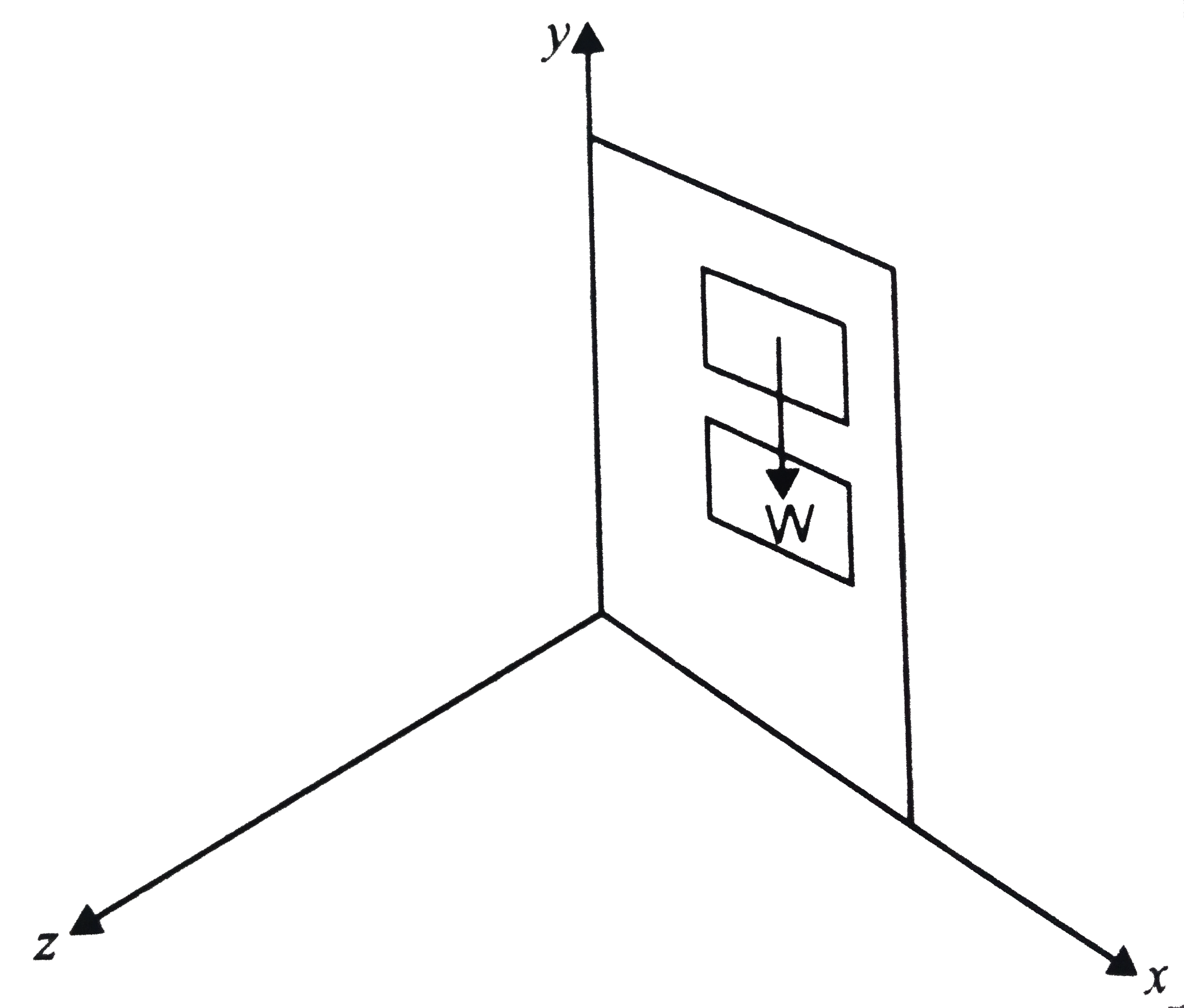
A door is hinged at one and is free to rotate about a vertical axis [Fig.] Does its weight cause any torque the axis ? Given reason for you answer.

Text Solution

Verified by Experts
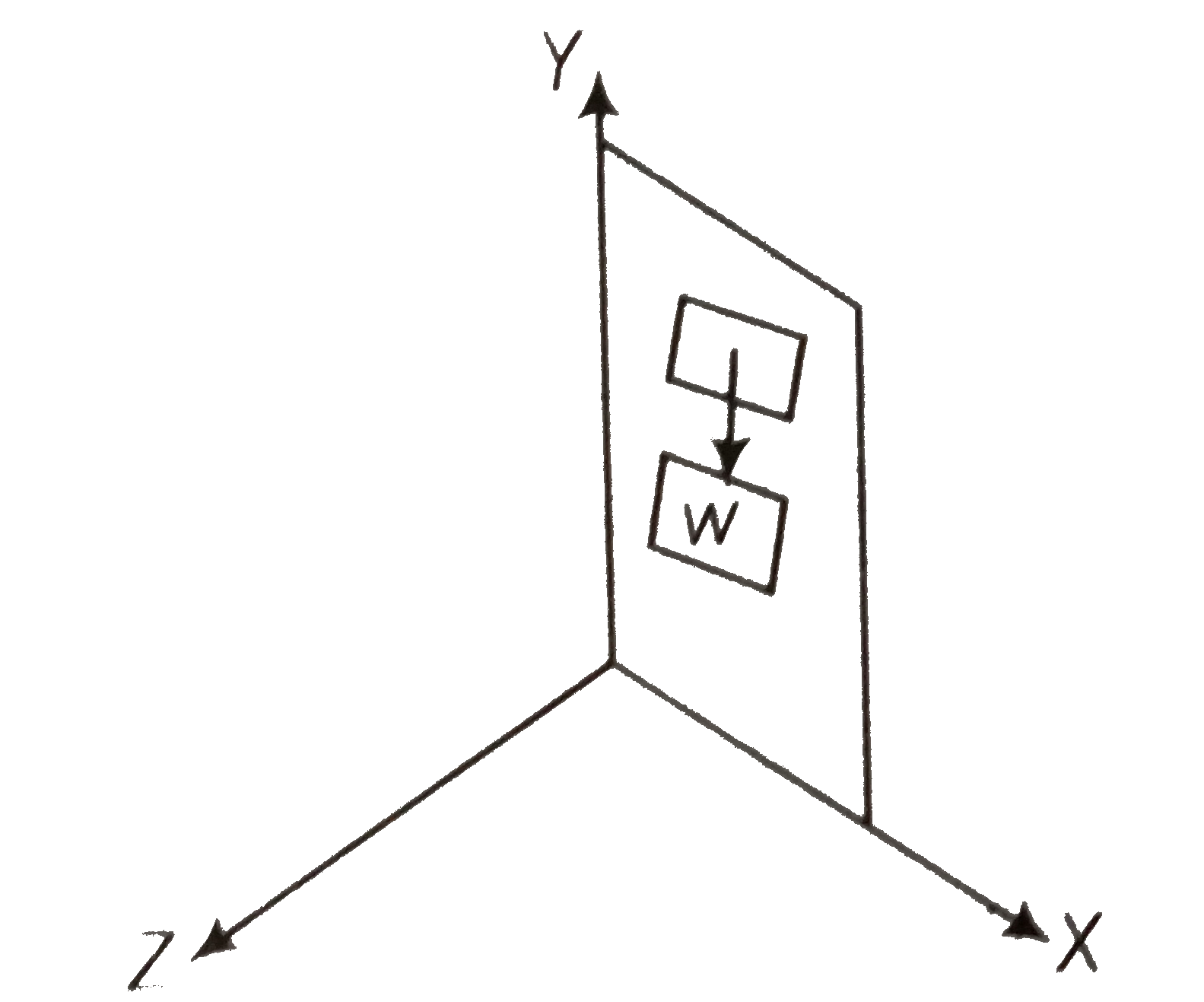
Consider the diagram , where weight of the door acts along negative y-axis.

A force can produce torque only a direction normal to itself as `tau=rxxF` so when the door is in the xy -plane the torque by gravity can only be along `+-` z direction never about an axis passing through y- direction .
Hence , the weight will not produce any torque about y-axis.
Promotional Banner

Topper's Solved these Questions

  • SYSTEM OF PARTICLES AND ROTATIONAL MOTION

    NCERT EXEMPLAR|Exercise Long answer type questions|12 Videos
  • OSCILLATIONS

    NCERT EXEMPLAR|Exercise MULTIPLE CHOICE QUESTIONS (MCQs)|40 Videos
  • THERMAL PROPERTIES OF MATTER

    NCERT EXEMPLAR|Exercise Very short Answer type Questions|15 Videos

Similar Questions

Explore conceptually related problems

Two particles of masses m and 2m are attached to the massless rod of length 2l as shown in figure. The rod is hinged at its midpoint O and is free to rotate in vertical plane about hinge. The minimum speed v at the given instant so that it can complete the circle.

A bullet of mass 10 g and speed 500 m//s is fired into a door and gets embedded exactly at the centre of the door. The door is 1.0 m wide and weight 12 kg . It is hinged at one end and rotates about a vertical axis practically without friction. Find the angular speed of the door just after the bullet embeds into it.(Hint. The moment of inertia of the door about the vertical axis at one end is ML^(2)//3)

When a body is hinged at a point and a force is acting on the body in such a way that the line of action of force is at some distance from the hinged point, the body will start rotating about the hinged point. The angular acceleration of the body can be calculated by finding the torque of that force about the hinged point. A disc of mass m and radius R is hinged at point A at its bottom and is free to rotate in the vertical plane. A force of magnitude F is acting on the ring at top most point. Component of reaction at the hinge in the vertical direction is

The figure shows three small spheres that rotate about a vertical axis. The perpendicular distance between the axis and the center of each sphere is given. Rank the three spheres according to their rotational inertia about that axis, greatest first.

When a body is hinged at a point and a force is acting on the body in such a way that the line of action of force is at some distance from the hinged point, the body will start rotating about the hinged point. The angular acceleration of the body can be calculated by finding the torque of that force about the hinged point. A disc of mass m and radius R is hinged at point A at its bottom and is free to rotate in the vertical plane. A force of magnitude F is acting on the ring at top most point. Component of reaction at the hinge in the horizontal direction is

The time taken by earth to complete one rotation about its axis is

When a body is hinged at a point and a force is acting on the body in such a way that the line of action of force is at some distance from the hinged point, the body will start rotating about the hinged point. The angular acceleration of the body can be calculated by finding the torque of that force about the hinged point. A disc of mass m and radius R is hinged at point A at its bottom and is free to rotate in the vertical plane. A force of magnitude F is acting on the ring at top most point. Tangential acceleration of the centre of mass is

If a horizontal cylindrical tube, partly filled with water is rapidly rotated about a vertical axis passing through its centre, the moment of inertia of the water about its axis will

How many degrees does the Earth rotate about its own axis in one hour?

NCERT EXEMPLAR-SYSTEM OF PARTICLES AND ROTATIONAL MOTION -very short answer type questions
  1. the centre of gravity of a body on the earth coincides with its...

    Text Solution

    |

  2. Why does a solid sphere have smaller moment of inertia than a hollow c...

    Text Solution

    |

  3. The variation of angular position theta, of a point on a rotating rigi...

    Text Solution

    |

  4. A uniform cube of mass m and side a is placed on a frictionless horizo...

    Text Solution

    |

  5. A uniform sphere of mass m and radius R is placed on a rough horizonta...

    Text Solution

    |

  6. The vector sum of a system of non-collinear forces acting on a rigid b...

    Text Solution

    |

  7. A wheel in uniform motion about an axis passing through its centr...

    Text Solution

    |

  8. A door is hinged at one and is free to rotate about a vertical axis [F...

    Text Solution

    |

  9. (n - 1) equal point masses each of mass m are placed at the vertices o...

    Text Solution

    |

  10. the centre of gravity of a body on the earth coincides with its...

    Text Solution

    |

  11. Why does a solid sphere have smaller moment of inertia than a hollow c...

    Text Solution

    |

  12. The variation of angular position theta, of a point on a rotating rigi...

    Text Solution

    |

  13. A unifrom cube of mass m and side a is placed on a frictionless...

    Text Solution

    |

  14. A unifrom sphere of mass m and radius R is placed on a rough hor...

    Text Solution

    |

  15. The vector sum of a system of non-collinear forces acting on a rigid b...

    Text Solution

    |

  16. A wheel in uniform motion about an axis passing through its centr...

    Text Solution

    |

  17. A door is hinged at one and is free to rotate about a vertical axis [F...

    Text Solution

    |

  18. (n - 1) equal point masses each of mass m are placed at the vertices o...

    Text Solution

    |

