Home
Class 11
PHYSICS
A stone of mass m is tied to an elastic ...

A stone of mass m is tied to an elastic string of negligble mass and spring constant k. The unstretched length of the string is L and has negligible mass. The other end of the string is fixed to a nail at a point p. Initially the stone is at the same level as the point P. The stone is dropped vertically from point P.
(a) Find the distance y from the top when the mass comes to rest for an instant, for the first time.
(b) What is the maximum velocity attained by the stone in this drop?
(c) What shall be the nature of the motion after the stone has reached its lowest point?

Text Solution

Verified by Experts
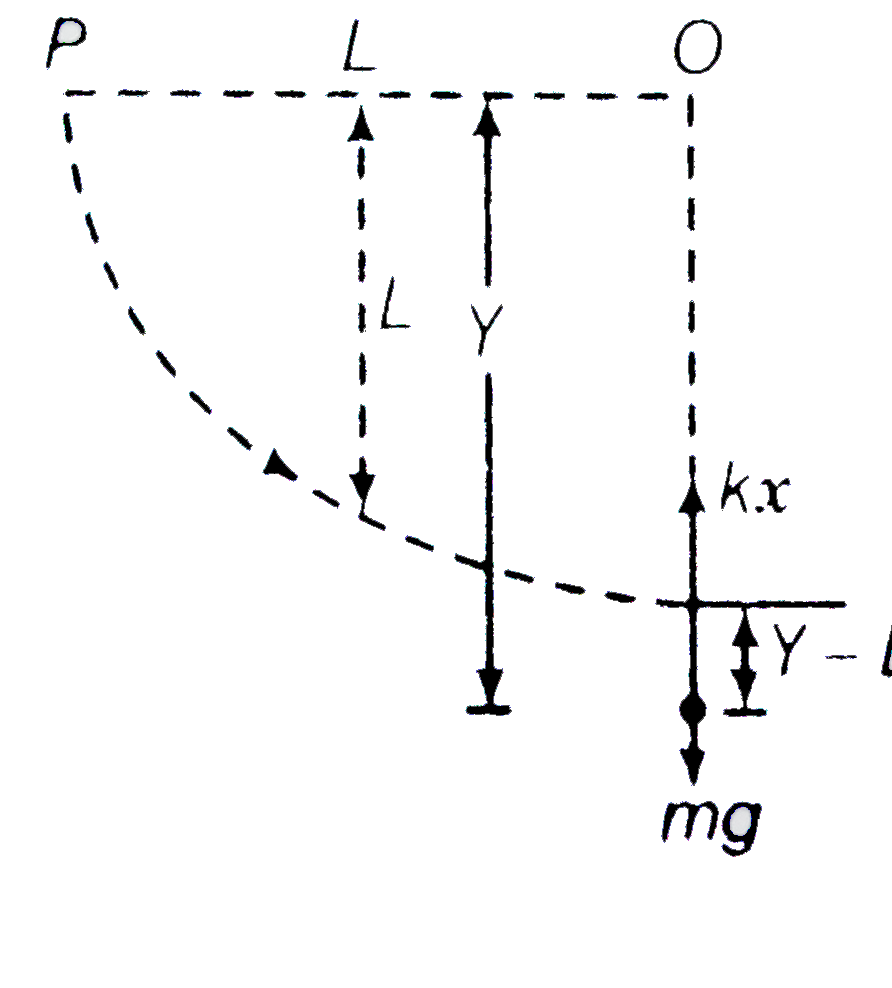
Consider the diagram the stone is dropped from point p.

Till the stone drops through a length L it will be in free fall.
After that the elasticity of the string will force it to a SHM.
Let the stone come to rest instantaneously at y.
The loss in PE of the stone is the PE stored in the stretched string.
`mgy=(1)/(2)k(y-L)^(2)`
`rArr" "mgy=(1)/(2)ky^(2)-kyL+(1)/(2)kL^(2)rArr(1)/(2)ky^(2)-(kL+mg)y+(1)/(4)kL^(2)=0`
`y=((kL+mg)pmsqrt((kL+mg)^(2)-k^(2)L^(2)))/(k)=((kL+mg)pmsqrt(2mgkL+m^(2)g^(2)))/(k)`
Retain the positive sign.
`therefore" "y=((kL+mg)+sqrt(2mgkL+m^(2)g^(2)))/(k)`
(b) In SHM, the maximum velocity is attained when the body passes, through the ''equilibrium, position'' i.e., when the instantaneous acceleration is zero. That is `mg-kx=0`, where x is the extension from L.
`rArr" "mg=kx`
Let the velocity be v. Then,
`(1)/(2)mv^(2)+(1)/(2)kx^(2)=mg(L+x)" (from conservation of energy)"`
`(1)/(2)mv^(2)=mg(L+x)-(1)/(2)kx^(2)`
Now, `mg=kxrArr x=(mg)/(k)`
`therefore" "(1)/(2)mv^(2)=mg(L+(mg)/(k))-(1)/(2)k(m^(2)g^(2))/(k^(2))=mgL+(m^(2)g^(2))/(k)-(1)/(2)(m^(2)g^(2))/(k)`
`(1)/(2)mv^(2)=mgL+(1)/(2)(m^(2)g^(2))/(k)`
`therefore" "v^(2)=2gL+mg^(2)//k`
`" "v=(2gL+mg^(2)//k)^(1//2)`
When stone is at the lowest position i.e., at instantaneous distance y from p, then equation of motion of the stone is
`(md^(2)y)/(dt^(2))=mg-k(y-L)rArr (d^(2)y)/(dt^(2))+(k)/(m)(y-L)-g=0`
Make a transformation of variables, `z=(k)/(m)(y-L)-g`
`therefore" "(d^(2)z)/(dt^(2))+(k)/(m)z=0`
It is differential equation of second order which represents SHM.
Comparing with equation `(d^(2)z)/(dt^(2))+omega^(2)z=0`
Angular frequency of harmonic motion `omega=sqrt((k)/(m))`
The solution of above equation will be of the type `z=A cos (omegat+phi)`, where `omega=sqrt((k)/(m))`
`y=(L+(mg)/(k))+A cos (omegat+phi)`
Thus, the stone will perform SHM with angular frequency `omega=sqrt(k//m)` about a point `y_(0)=L+(mg)/(k)`.
Promotional Banner

Topper's Solved these Questions

  • MECHANICAL PROPERTIES OF SOLIDS

    NCERT EXEMPLAR|Exercise LONG SHORT ANSWER TYPE QUESTION|16 Videos
  • MECHANICAL PROPERTIES OF FLUIDS

    NCERT EXEMPLAR|Exercise Long Answer Type Questions|3 Videos
  • MOTION IN A PLANE

    NCERT EXEMPLAR|Exercise Multiple Choice Questions|37 Videos

Similar Questions

Explore conceptually related problems

A stone of mass m is tied to a string of length l and rotated in a circle with a constant speed v . If the string is released, the stone flies

A stone of mass ied to a string of lengh l rotating along & a circular path with constant speed v. The torque on the stone is

A body of mass m is attached by an inelastic string to a suspended spring of spring constant k . Both the string and the spring have negligible mass and the string is inextensible and of length L . Initially, the mass m is at rest. The largest amplitude A_(max) , for which the string will remain taut throughout the motion is

A stone of mass m tied to a string of length l is rotated in a circle with the other end of the string as the centre. The speed of the stone is v. If the string breaks, the stone will move

A stone of a mass m tied to a string of length /is rotated in a circle with the other end of the string as the centre. The speed of the stone is V. If the string breaks, the stone will

A body of mass m is attached by an inelastic string to a suspended spring of spring constant k . Both the string and the spring have negligible mass and the string is inextensible and of length L . Initially, the mass m is at rest. Q. If the mass m is now raised up to point A (the top end of the string see fig. and allowed to fall from rest, the maximum extension of the spring in the subsequent motion will be

A body of mass m is attached by an inelastic string to a suspended spring of spring constant k . Both the string and the spring have negligible mass and the string is inextensible and of length L . Initially, the mass m is at rest. If the mass m , from the initial position of rest is pulled down a distance A and then released, assuming that the string remains taut throughout the motion, the maximum (downwards) acceleration of the oscillating body will be

A stone is tied to the end of a string of length 1 and whirled in a horizental circle. When the string breaks then stone

