Home
Class 11
PHYSICS
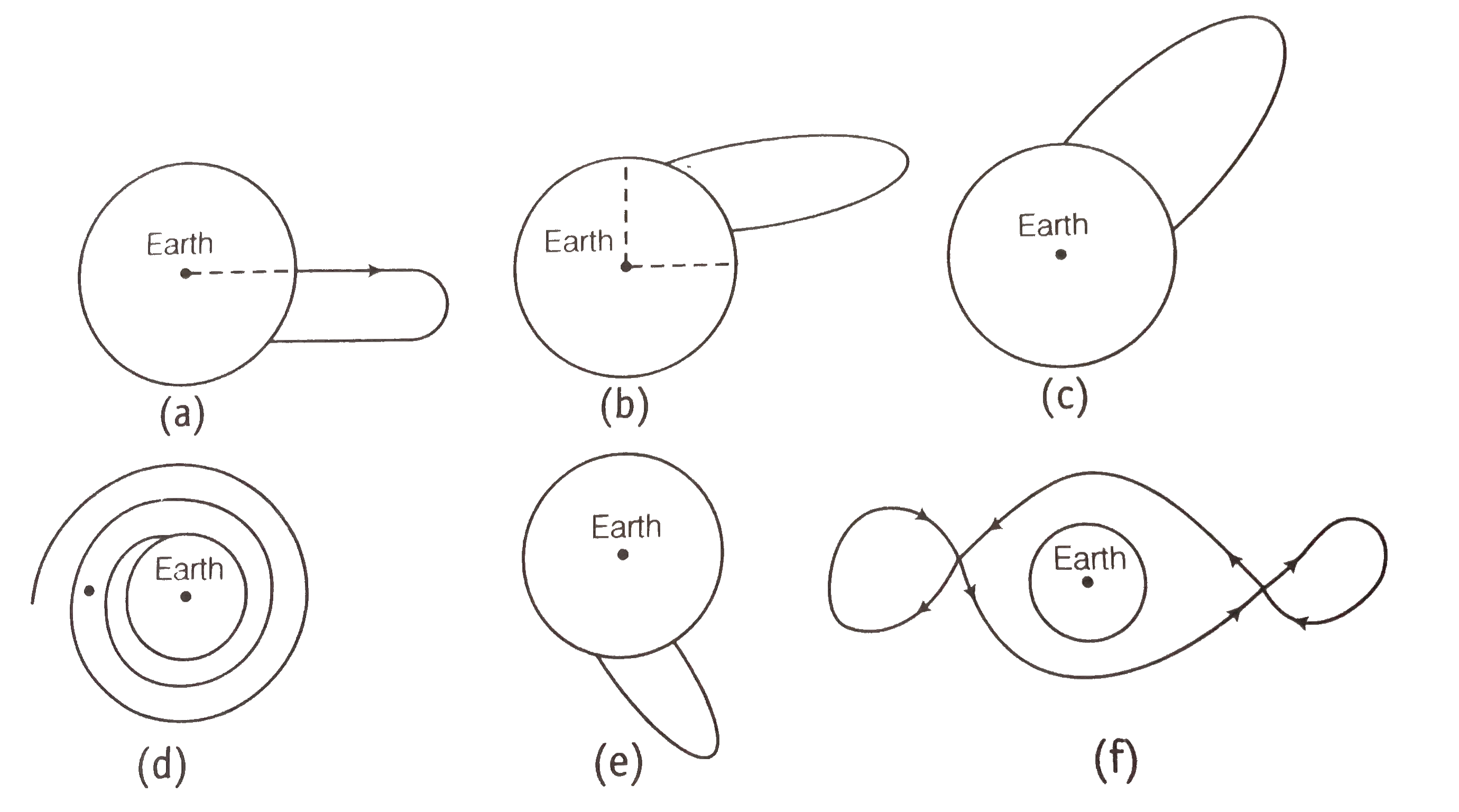
Shown are several cuves (fig. (a), (b), ...

Shown are several cuves (fig. (a), (b), (c), (d), (e), (f)]. Explain with reason, which ones amongst them can be possible trajectories traced by a projectile (neglect air friction).

Text Solution

Verified by Experts

The trajectory of a particle under gravitational force of the earth will be a conic section (for motion outside the earth) with the centre of the earth as a focus. Only (c) meets this requirement
Note. The trajectory of the particle depends upon the velocity of projection. Depending upon the magnitude and direction of velocity it may be parabolic or elliptical
Promotional Banner

Topper's Solved these Questions

  • GRAVITATION

    NCERT EXEMPLAR|Exercise Long Answer type question|5 Videos
  • GRAVITATION

    NCERT EXEMPLAR|Exercise Very short Answer type question|11 Videos
  • KINETIC THEORY

    NCERT EXEMPLAR|Exercise Multiple Choice Questions (MCQs)|31 Videos

Similar Questions

Explore conceptually related problems

If a, b, c, d, e, f are in AP, then (e-c) is equal to which one of the following?

The arrangement to store two magnets is shown by figures (a), (b), (c) and (d) in Fig. 13.2. Which one of them is the correct arrangement

Identify the products and explain their formation. (a) (b) ( c) (d) ( e) (f) (g) (h) (i) .

Assertion In projectile motion, the angle between instanteneous velocity vector and acceleration vector can be anything between o to pi (excluding the limiting case) Reason In projectile motion, acceleration vector is always pointing vertically downwards. (Neglect air friction.)

A=(a,b,c,d,e,f);B=(x,y,z:u) then total number of onto functions f:A rarr B possible are

In the system shown in fig., block A and C are placed on smooth floors and both have mass equal to m_(1) . Blocks B and D are identical having mass m_(2) each. Coefficient of friction Between A and B and that between C and D are both equal to mu . String and pulleys are light. A horizontal force F is applied on block C and is gradually increased. (a) Find the maximum value of F (call it F_(0) ) so that all the four blocks move with same acceleration. (b) Will the value of F_(0) increase or decrease if another block (E) of mass m_(2) is placed above block D and coefficient of friction between E and D is mu ?
