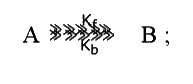
For a reversible first order reaction, `K_(f) =10^(-2) sec^(-1) and (B_(eq))/(A_(eq))=4," If "A_(0) =0.01 ML^(-1) and B_(0) =0`, what will be concentration of B after 30 sec ?
MOTION|Exercise SOLVED EXAMPLE (OBJECTIVE)|10 Videos
Chemical Kinetics
MOTION|Exercise SOLVED EXAMPLE (SUBJECTIVE)|24 Videos
CHEMICAL EQUILIBRIUM
MOTION|Exercise Exercise - 4|20 Videos
CLASSROOM PROBLEMS
MOTION|Exercise Electrochemistry|22 Videos
Similar Questions
Explore conceptually related problems
For a zero order reaction : A rarr 2B, initial rate of a reaction is 10^(-1)"M min"^(-1) . If concentration of 'A' is 0.1 after 120 sec then what would be concentration of B after 60 sec.
For the zero order reaction : A rarr P, K=10^(-2)("mol"//"litre")sec^(-1) If initial concentration of A is 0.3 M, then find concentration of A left after 10 sec.
The reaction A(g) to B(g) + 2C(g) is a first-order reaction with a rate constant of 2.303 xx 10^(-3)s^(-1) . Strating with 0.1 moles of 'A' in a 2 litre vessel, find the concentration of A after 301 sec when the reaction is allowed to take place at constant pressure at 300 K.
The specific rate constant for a first order reaction is 1 times 10^–3 sec^–1 . If the initial concentration of the reactant is 0.1 mole/lt, the rate of reaction mol l^–1 sec^–1 is: