Home
Class 12
CHEMISTRY
Which of the following reactions give ar...

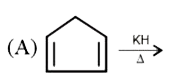
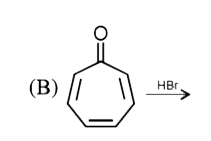
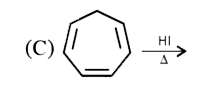
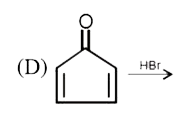
Which of the following reactions give aromatic compound ?

A

B

C

D

Text Solution

AI Generated Solution

The correct Answer is:

To determine which of the given reactions produces an aromatic compound, we need to apply Huckel's rule and check the conditions for aromaticity. Aromatic compounds must meet the following criteria: 1. The compound must be cyclic. 2. The compound must be planar (all atoms in the same plane). 3. The compound must have a continuous ring of p-orbitals (conjugation). 4. The compound must follow Huckel's rule, which states that it must have \(4n + 2\) π electrons, where \(n\) is a non-negative integer. Let's analyze each option step by step: ### Step 1: Analyze Option A - **Structure**: A five-membered ring with two double bonds. - **Reaction**: In the presence of K and heat, H⁻ will be generated, which can remove H⁺ from the ring. - **Resulting Structure**: This leads to a negatively charged carbon in the ring. - **Hybridization**: All double-bonded carbons are sp² hybridized, and the negative charge is also sp². - **Cyclic and Planar**: The structure is cyclic and planar. - **Count π Electrons**: - 2 double bonds contribute 4 π electrons (2 from each double bond). - The negative charge contributes 1 additional π electron. - Total = 5 π electrons. - **Conclusion**: This does not satisfy Huckel's rule (needs 6 π electrons). Thus, **not aromatic**. ### Step 2: Analyze Option B - **Structure**: A six-membered ring with alternating double bonds. - **Reaction**: HBr adds to the ring, forming a carbocation. - **Resulting Structure**: The carbocation retains the cyclic structure. - **Hybridization**: All carbons are sp² hybridized. - **Cyclic and Planar**: The structure is cyclic and planar. - **Count π Electrons**: - 3 double bonds contribute 6 π electrons. - **Conclusion**: This satisfies Huckel's rule (6 π electrons). Thus, **aromatic**. ### Step 3: Analyze Option C - **Structure**: A seven-membered ring with alternating double bonds. - **Reaction**: HI adds to the ring, forming a carbocation. - **Resulting Structure**: The carbocation retains the cyclic structure. - **Hybridization**: The carbocation will have sp³ hybridization. - **Cyclic and Planar**: The structure is cyclic but not planar due to sp³ hybridization. - **Count π Electrons**: - The structure has 4 π electrons (due to 2 double bonds). - **Conclusion**: This does not satisfy Huckel's rule (needs 6 π electrons). Thus, **not aromatic**. ### Step 4: Analyze Option D - **Structure**: A five-membered ring with a carbonyl group and HBr. - **Reaction**: HBr adds, forming a carbocation. - **Resulting Structure**: The carbocation retains the cyclic structure. - **Hybridization**: The carbocation will have sp³ hybridization. - **Cyclic and Planar**: The structure is cyclic but not planar due to sp³ hybridization. - **Count π Electrons**: - The structure has 4 π electrons. - **Conclusion**: This does not satisfy Huckel's rule (needs 6 π electrons). Thus, **not aromatic**. ### Final Conclusion From the analysis: - **Option B** is the only one that produces an aromatic compound.
Promotional Banner

Topper's Solved these Questions

Similar Questions

Explore conceptually related problems

Which of the following reactions give aromatic ion ?

Which of the following compounds are aromatic ?

Which of the following compound(s) is/are aromatic compounds ?

Which of the following is a benzenoid aromatic compound?

Which of the following is not an aromatic compound ?

Which of the following is not an aromatic compound ?

Which one of the following is an aromatic compound ?

Which of the following compounds is aromatic alcohol?
