

Home
Class 12
PHYSICS
The work functions of three metals A, B ...

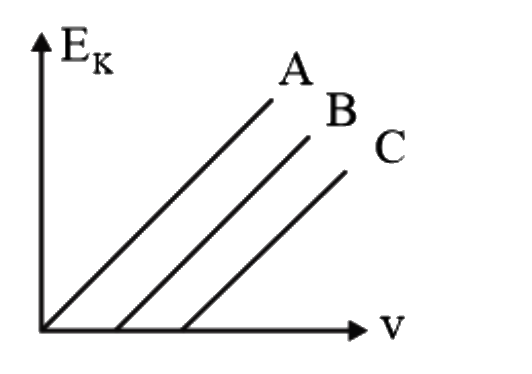
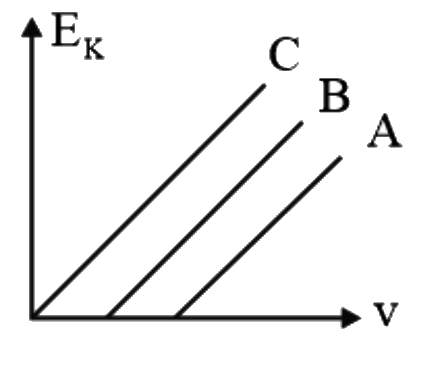
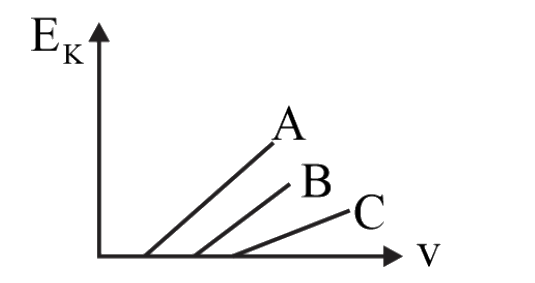
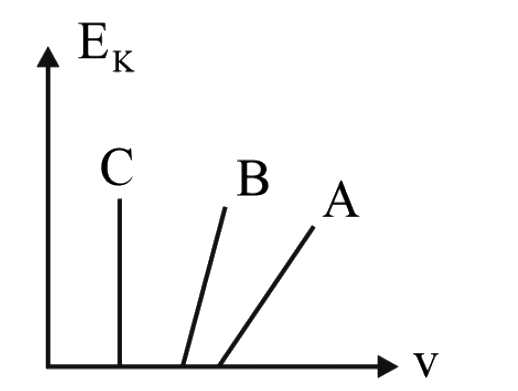
The work functions of three metals A, B and C are `W _A ,W_B and W_C` respectively . They are in decreasing order. The correct graph between kinetic energy and frequency V of incident radiation is

A

B

C

D

Text Solution

AI Generated Solution

The correct Answer is:
To solve the problem, we need to analyze the relationship between the kinetic energy (KE) of emitted electrons and the frequency (ν) of incident radiation based on the work functions of the metals A, B, and C. ### Step-by-Step Solution: 1. **Understanding Work Function**: - The work function (W) is the minimum energy required to remove an electron from the surface of a metal. - Given that the work functions of metals A, B, and C are in decreasing order: \[ W_A > W_B > W_C \] 2. **Photoelectric Equation**: - The kinetic energy of the emitted electrons can be described by the photoelectric equation: \[ KE = hν - W \] - Here, \(h\) is Planck's constant, \(ν\) is the frequency of the incident radiation, and \(W\) is the work function of the metal. 3. **Graphing Kinetic Energy vs. Frequency**: - Rearranging the photoelectric equation gives: \[ KE = hν - W \] - This equation is linear in the form \(y = mx + c\), where: - \(y\) is the kinetic energy (KE), - \(m\) is the slope (which is \(h\)), - \(x\) is the frequency (\(ν\)), - \(c\) is the y-intercept (which is \(-W\)). 4. **Identifying the Slopes and Intercepts**: - The slope \(h\) is constant for all three metals since it is a fundamental constant. - The y-intercept will be \(-W_A\), \(-W_B\), and \(-W_C\) for metals A, B, and C respectively. - Since \(W_A > W_B > W_C\), the intercepts will be: - Metal A: Most negative (lowest KE at low frequency), - Metal B: Less negative, - Metal C: Least negative (highest KE at low frequency). 5. **Drawing the Graphs**: - All three lines will have the same slope but different y-intercepts: - The line for metal A will start the lowest (most negative), - The line for metal B will be above metal A, - The line for metal C will be the highest (least negative). - The graph will look like this: - Line A (lowest) → Line B (middle) → Line C (highest). 6. **Conclusion**: - The correct graph will show three straight lines with the same slope but different y-intercepts, where the line for metal A is the lowest, followed by metal B, and then metal C at the top. ### Final Answer: The correct graph between kinetic energy and frequency of incident radiation is represented by three lines with the same slope but different y-intercepts, where the line for metal A is the lowest, followed by metal B, and then metal C.
Promotional Banner

Topper's Solved these Questions

  • NTA NEET SET 69

    NTA MOCK TESTS|Exercise PHYSICS|45 Videos
  • NTA NEET SET 71

    NTA MOCK TESTS|Exercise PHYSICS|45 Videos

Similar Questions

Explore conceptually related problems

According to Einstein's photoelectric equation , the graph between the kinetic energy of photoelectrons ejected and the frequency of incident radiation is

According to Einstein's photoelectric equation, the graph between kinetic energy of photoelectrons ejected and the frequency of the incident radiation is :

In the system shown, the blocks A,B and C are of weight 4W, W and W respectively. The system set free. The tension in the string connecting the blocks B and C is

the work function of metal is W and lamda is the wavelength of the incident radiation. There is no emission of photoelecrons when

When photons of energy hv fall on a metal plate, having a work function W, the maximum kinetic energy of the ejected photo electrons is K. What will be the maximum K.E. of the ejected photo electrons, from the same plate if the frequency of incident radiation is doubled ?

Ultraviolet radiations of different frequencies v_(1) are incident on two photosensitive materials having work functions W_(1) and W_(2) (W_(1) gt W_(2)) respectively. The kinetic energy of the emitted electrons is same in both the cases. Which one of the two radiations will be of higher frequency?

The resistance of the four arms A, B, C and D of a wheatstone bridge as shown in the figure are 10 Omega , 20 Omega , 30 Omega and 60 Omega respectively . The emf and internal resistance of the cell are 15 V and 2.5 Omega respectively . If the galvanometer resistance is 80 Omega then the net current drawn from the cell will be

NTA MOCK TESTS-NTA NEET SET 70-PHYSICS
  1. Calculate the energy equivalent of 1g of substance.

    Text Solution

    |

  2. The time period of a simple pendulum measured inside a stationary lift...

    Text Solution

    |

  3. A particle is subjected to two simple harmonic motions along x and y d...

    Text Solution

    |

  4. Wavelength of characteristic X-ray depends on which property of target...

    Text Solution

    |

  5. The work functions of three metals A, B and C are W A ,WB and WC resp...

    Text Solution

    |

  6. Two water pipes P and Q having diameters 2 xx 10^(-2) m and 4 xx 10^(...

    Text Solution

    |

  7. A hydraulic automobile life has input and output pistons with diameter...

    Text Solution

    |

  8. If the distance between the virtual image from Its real object is 60 c...

    Text Solution

    |

  9. Two thin equiconvex lenses each of focal length 0.2 m are placed coaxi...

    Text Solution

    |

  10. A uniform disc of mass M and radius R is hinged at its centre C . A fo...

    Text Solution

    |

  11. Two balls of mass m and 4m are connected by a rod of length L. The mas...

    Text Solution

    |

  12. Two identical p-n junctions may be connected in series in which a batt...

    Text Solution

    |

  13. A reverse biased diode is

    Text Solution

    |

  14. A liquid of density 0.85 g//cm^(3) flows through a calorimeter at the ...

    Text Solution

    |

  15. The pressure on a square plate is measured by measuring the force on t...

    Text Solution

    |

  16. A single slit Fraunhofer diffraction pattern is formed with white lig...

    Text Solution

    |

  17. In a Young's double slit experiment the intensity at a point where tha...

    Text Solution

    |

  18. A siren emitting a sound of frequency 800 Hz moves away from an observ...

    Text Solution

    |

  19. An observer starts moving with unifrom acceleration a towards a statio...

    Text Solution

    |

  20. A bead of mass m can slide without friction on a fixed circular horizo...

    Text Solution

    |