Home
Class 12
PHYSICS
For a body moving with uniform accelerat...

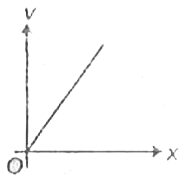
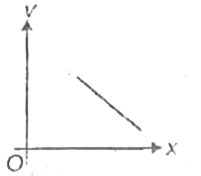
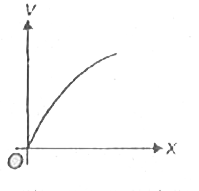
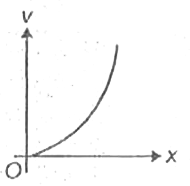
For a body moving with uniform acceleration along straight line, the variation of its velocity (v) with position (x) is best represented by

A

B

C

D

Text Solution

AI Generated Solution

The correct Answer is:

To solve the problem of how the velocity (v) of a body moving with uniform acceleration varies with its position (x), we can follow these steps: ### Step 1: Understand the relationship between acceleration, velocity, and position. For a body moving with uniform acceleration, we know that acceleration (a) is constant. The relationship between velocity (v), acceleration (a), and position (x) can be derived from the basic kinematic equations. ### Step 2: Use the definition of acceleration. Acceleration is defined as the rate of change of velocity with respect to time: \[ a = \frac{dv}{dt} \] ### Step 3: Express acceleration in terms of velocity and position. Using the chain rule, we can express acceleration in terms of velocity and position: \[ a = \frac{dv}{dt} = \frac{dv}{dx} \cdot \frac{dx}{dt} = v \frac{dv}{dx} \] Thus, we can rewrite the acceleration as: \[ a = v \frac{dv}{dx} \] ### Step 4: Relate acceleration to the change in velocity. Since acceleration is constant, we can set it equal to a constant value (let's denote it as \( C \)): \[ v \frac{dv}{dx} = C \] ### Step 5: Rearrange and integrate. Rearranging gives us: \[ v \, dv = C \, dx \] Now, we can integrate both sides. The left side integrates from the initial velocity \( 0 \) to \( v \), and the right side integrates from the initial position \( 0 \) to \( x \): \[ \int_0^v v \, dv = \int_0^x C \, dx \] ### Step 6: Perform the integration. The left side becomes: \[ \frac{v^2}{2} \Big|_0^v = \frac{v^2}{2} \] The right side becomes: \[ C x \Big|_0^x = C x \] Thus, we have: \[ \frac{v^2}{2} = C x \] ### Step 7: Solve for velocity. Multiplying both sides by 2 gives: \[ v^2 = 2Cx \] ### Step 8: Identify the relationship. This equation \( v^2 = 2Cx \) indicates that the relationship between velocity and position is quadratic. If we rearrange it, we can express it as: \[ v^2 = 2C x \] This is similar to the standard form of a parabola \( y^2 = 4Ax \), where \( A \) is a constant. ### Conclusion: The variation of velocity (v) with position (x) for a body moving with uniform acceleration is best represented by a parabolic curve, specifically \( v^2 \) as a function of \( x \). ---
Promotional Banner

Topper's Solved these Questions

  • MOTION IN A STRAIGHT LINE

    AAKASH INSTITUTE|Exercise ASSIGNMENT (SECTION - B)|33 Videos
  • MOTION IN A STRAIGHT LINE

    AAKASH INSTITUTE|Exercise ASSIGNMENT (SECTION - C)|37 Videos
  • MOTION IN A STRAIGHT LINE

    AAKASH INSTITUTE|Exercise EXERCISE|30 Videos
  • MOTION IN A PLANE

    AAKASH INSTITUTE|Exercise Assignement section -J (Aakash Challengers Questions)|4 Videos
  • MOTION IN STRAIGHT LINE

    AAKASH INSTITUTE|Exercise Assignment (SECTION - J)|2 Videos

Similar Questions

Explore conceptually related problems

A body A starts from rest and moves with a uniform acceleration along a straight line. Another body B has some initial velocity and moves with larger acceleration than that of A . The correct velocity time graphs

A particle is moving with uniform acceleration along a straight line "ABC" .Its velocity at A and B are 6m/s" and "9m/s respectively. If AB:BC=5:16" then its velocity at C is

A particle is moving with uniform acceleration along a straight line ABC. Its velocity at A and B are 6 m/s and 9 m/s respectively if AB:BC=5:16 then its velocity at C is

A particle moving with uniform acceleration from A to B along a straight line has velcities v_(1) and v_(2) at A and B respectively. If C is the mid-point between A and B then determine the velocity of the particle at C . .

A body starting from rest moves along a string line with a constant acceleration The variation of speed (v) with distance (s) is repressed by the graph

An object is moving with uniform acceleration a. Its initial velocity is u and after time t its velocity is v. The equation of its motion is v = u + at. The velocity (along y-axis) time (along x-axis) graph shall be a straight line

AAKASH INSTITUTE-MOTION IN A STRAIGHT LINE-ASSIGNMENT (SECTION - A)
  1. A boy throws balls into air at regular interval of 2 second. The next ...

    Text Solution

    |

  2. A ball projected from ground vertically upward is at same height at ti...

    Text Solution

    |

  3. For a body moving with uniform acceleration along straight line, the v...

    Text Solution

    |

  4. The position - time graph for a particle moving along a straight line ...

    Text Solution

    |

  5. The position - time graph for a body moving along a straight line betw...

    Text Solution

    |

  6. Which of the following graph for a body moving along a straight line i...

    Text Solution

    |

  7. A body is projected vertically upward from ground. If we neglect the e...

    Text Solution

    |

  8. Which of the following position-time graphs correctly represents two m...

    Text Solution

    |

  9. The displacement - time graph for two particles A and B is as follows....

    Text Solution

    |

  10. For the acceleration - time (a - t) graph shown in figure, the change ...

    Text Solution

    |

  11. Figure shows the graph of x - coordinate of a particle moving along x ...

    Text Solution

    |

  12. Position - time graph for a particle is shown in figure. Starting from...

    Text Solution

    |

  13. The velocity versus time graph of a body moving in a straight line is ...

    Text Solution

    |

  14. Acceleration - time graph for a particle is given in figure. If it sta...

    Text Solution

    |

  15. Figure shows the position of a particle moving on the x - axis as a fu...

    Text Solution

    |

  16. A particle moves along x - axis in such a way that its x - co - ordina...

    Text Solution

    |

  17. Two balls are projected upward simultaneously with speeds 40 m/s and 6...

    Text Solution

    |

  18. The position (x) of a particle moving along x - axis veries with time ...

    Text Solution

    |

  19. The position (x) - time (t) graph for a particle moving along a straig...

    Text Solution

    |

  20. A ball is dropped from a height h above ground. Neglect the air resist...

    Text Solution

    |
