

Home
Class 12
PHYSICS
Two blocks A and B of masses m and 2m re...

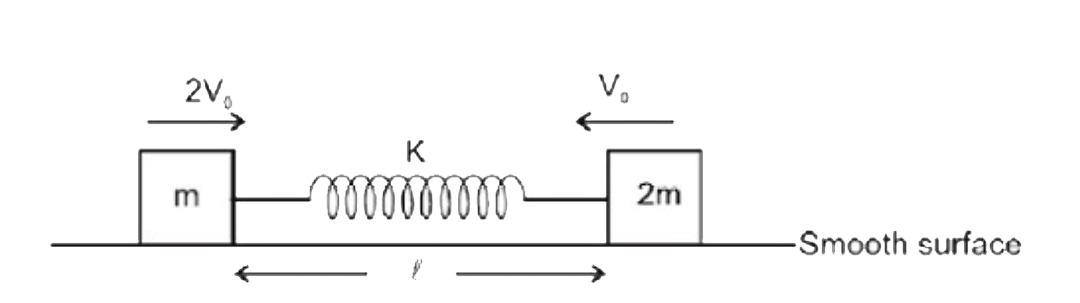
Two blocks A and B of masses m and 2m respectively, attached at opposite ends of a spring of constant K, placed on a smooth horizontal surface. Spring is initially at its natural length l. A is given a velocity `2V_(0)` and B given velocity `V_(0)` as shown.

Maximum separation between m and centre of mass of the system will be :

A

`(l)/(3)+sqrt((8mV_(0)^(2))/(3K))`

B

`(l)/(3)+sqrt((2mV_(0)^(2))/(3K))`

C

`(2l)/(3)+sqrt((2mV_(0)^(2))/(3K))`

D

`(2l)/(3)+sqrt((8mV_(0)^(2))/(3K))`

Text Solution

Verified by Experts

The correct Answer is:
D
Promotional Banner

Topper's Solved these Questions

  • NTA JEE MOCK TEST 86

    NTA MOCK TESTS|Exercise PHYSICS|25 Videos
  • NTA JEE MOCK TEST 88

    NTA MOCK TESTS|Exercise PHYSICS|25 Videos

Similar Questions

Explore conceptually related problems

Two blocks A and B of mass m and 2m respectively are connected by a light spring of force constant k. They are placed on a smooth horizontal surface. Spring is stretched by a length x and then released. Find the relative velocity of the blocks when the spring comes to its natural length

Two blocks A and B of masses m and 2m, respectively , are connected by a massless spring of force constant k and are placed on a smooth horizontal plane. The spring is stretched by an amount x and then released . The relative velocity of the blocks when the spring comes to its natural length is

A dumbbell consists of two balls A and B of mass m=1 kg and connected by a spring. The whole system is placed on a smooth horizontal surface as shown in the figure. Initially the spring is at its natural length, the ball B is imparted a velocity v_(0)=8/(sqrt(7))m//s in the direction shown. The spring constant of the spring is adjusted so that the length of the spring at maximum elongation is twice that of the natural, length of the spring. Find the maximum potential energy stored (in Joule) in the spring during the motion.

The two blocks A and B of same mass connected to a spring and placed on a smooth surface. They are given velocities (as shown in the figure) when the spring is in its natural length :

Two blocks of masses in and 4m lie on a smooth horizontal surface connected with a spring in its natural length. Mass m is given velocity v_(0) through an impulse as shown in Fig. Which of the following is not true about subsequent motion?

Two blocks A and B of the same mass are connected to a light spring and placed on a smooth horizontal surface B is given velocity v_(0) (as shown in the figure) when the spring is in natural length. In the subsequent motion.

Two blocks A and B of mass 2 m and m respectively are connected to a massless spring of spring constant K. if A and B moving on the horizontal frictionless surface with velocity v to right. If A collides with C of mass m elastically and head on, then the maximum compressions of the spring will be

Two blocks A and B of masses m and 2m are connected by a massless spring of natural length L and spring constant k . The blocks are intially resting on a smooth horizontal floor with the spring at its natural length , as shown . A third identical block C of mass m moves on the floor with a speed v_(0) along the line joining A and B and collides elastically with A . FInd (a) the velocity of c.m. of system (block A + B + spri ng) and (b) the minimum compression of spring.

Two blocks A and B of mass m and 2m respectively are connected by a massless spring of spring constant K . This system lies over a smooth horizontal surface. At t=0 the bolck A has velocity u towards right as shown while the speed of block B is zero, and the length of spring is equal to its natural length at that at that instant. {:(,"Column I",,"Column II"),((A),"The velocity of block A",(P),"can never be zero"),((B),"The velocity of block B",(Q),"may be zero at certain instants of time"),((C),"The kinetic energy of system of two block",(R),"is minimum at maximum compression of spring"),((D),"The potential energy of spring",(S),"is maximum at maximum extension of spring"):}

A block A of mass m is placed over a plank B of mass 2m plank B is placed over a smooth horizontal surface .The coefficient of friction between A and B is 0.4 Block A is given a velocity v_(0) toward right Find acceleration (in ms^(-2) of B relative to A

NTA MOCK TESTS-NTA JEE MOCK TEST 87-PHYSICS
  1. A T.V. tower has a height of 100m. How much population is covered by T...

    Text Solution

    |

  2. A highly rigid cubical block (A) of small mass (M) and slide (L) is fi...

    Text Solution

    |

  3. Two blocks A and B of masses m and 2m respectively, attached at opposi...

    Text Solution

    |

  4. Consider an ideal gas confined in an isolated closed chamber. As the g...

    Text Solution

    |

  5. When the temperature of a black body increases, it is observed that th...

    Text Solution

    |

  6. A radioactive material decays by simulataneous emission of two particl...

    Text Solution

    |

  7. A voltmeter of variable ranges 3V, 15V, 150 V is to designed by connec...

    Text Solution

    |

  8. If two lenses of +5 dioptres are mounted at some distance apart, the e...

    Text Solution

    |

  9. Find the ratio of energies of photons produced due to transition of el...

    Text Solution

    |

  10. A block of mass m is kept on an inclined plane of a lift moving down w...

    Text Solution

    |

  11. A parallel plate capacitor of area A, plate separation d and capacitan...

    Text Solution

    |

  12. In a conical pendulum arrangement, a string of length 1 m is fixed at ...

    Text Solution

    |

  13. Let M be the mass and L be the length of a thin uniform rod. In first ...

    Text Solution

    |

  14. A red bulb and violet bulb of equal power emits n(R ) and n(v) number ...

    Text Solution

    |

  15. A body is thrown from the surface of the earth with velocity u m/s. Th...

    Text Solution

    |

  16. A cyclist is moving with a constant acceleration of 1.2 m/s2 on a stra...

    Text Solution

    |

  17. If the earth shrinks such that its density becomes 8 times to the pres...

    Text Solution

    |

  18. Water from a tap emerges vertically downwards with an initial velocity...

    Text Solution

    |

  19. An 80muC charge is given to the 4muF capacitor in the circuit shown in...

    Text Solution

    |

  20. A proton moves with a speed of 5.0times10^(6)ms^(-1) along the x -axis...

    Text Solution

    |