Home
Class 12
PHYSICS
Two plates of some mass are attached rig...

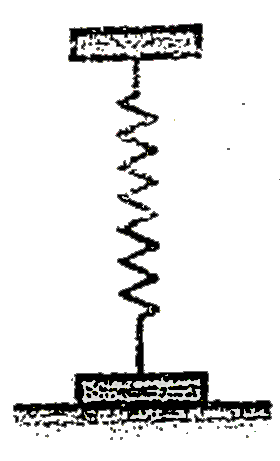
Two plates of some mass are attached rigidly to the two ends of a spring as shown in figure. One of the two ends of a spring s shown in figure. One of the plates resets on a horizontal surface to the other rusults a compression `y` of the spring when it is in equilibrium state. The further minimum compression required, so that when the force causing compression is removed the lower plate is lifted off the surface, will be :

A

`0.5 y`

B

`3y`

C

`2y`

D

`y`

Text Solution

Verified by Experts

The correct Answer is:
C


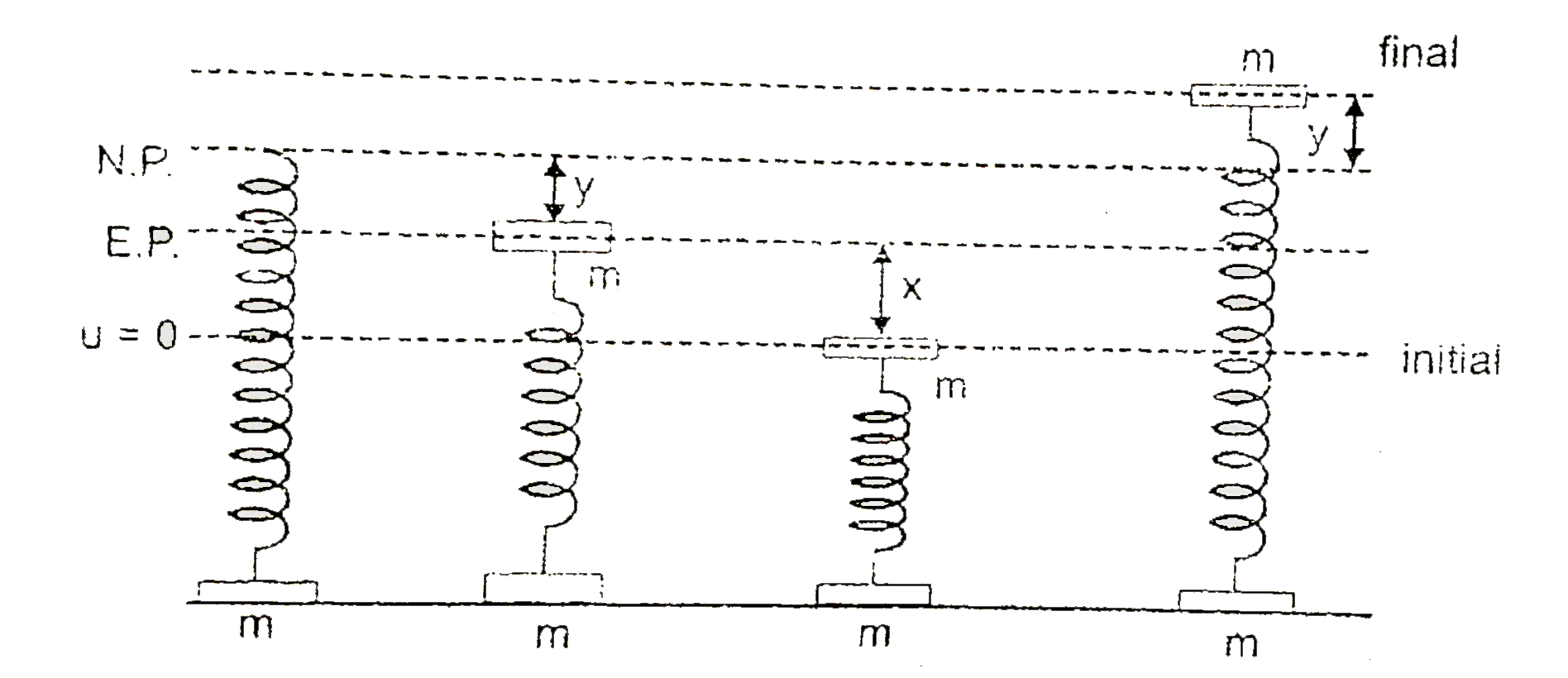
Let upper block is pushed down by `x`, at equilibrium `mg = ky`, i.e, weight of upper of upper block is balanced by spring When it is deformed bu `y`, upper block will perform `SHM` with amplitude `x` equilibrium position, lower block will leave surface when spring is extended by `y`, means upper block is at distance `2y` from its mean position. That should be upper extreme position of upper block. So amplitude `x = 2y`
Alternate
at equilibrium of upper block `mg = ky`
lower plate will leave the surface if the extension in spring is `y`
Let upper plate is displaaced by `x` downward and left
so by energy conservation between compressed to extended positions
`0 + (1)/(2) k (x + y)^(2) = mg(x + 2y) = (1)/(2) ky^(2)`
`rArr (1)/(2) kx^(2) + (1)/(2) ky^(2) + kxy = mgx + mg2y + (1)/(2) ky^(2) rArr x = 2y`
Promotional Banner

Topper's Solved these Questions

  • SIMPLE HARMONIC MOTION

    RESONANCE|Exercise Exercise- 2, PART - II|1 Videos
  • SIMPLE HARMONIC MOTION

    RESONANCE|Exercise Exercise- 2, PART - III|12 Videos
  • SIMPLE HARMONIC MOTION

    RESONANCE|Exercise Exercise- 1, PART - II|37 Videos
  • SEMICONDUCTORS

    RESONANCE|Exercise Exercise 3|88 Videos
  • TEST PAPERS

    RESONANCE|Exercise FST-3|30 Videos

Similar Questions

Explore conceptually related problems

Two discs, each having mass m , are attached rigidly to the ends of a vertical spring. One of the discs rests on a horizontal surface and the other produces a compression x_0 on the spring when it is in equilibrium. How much further must the spring be compressed so that when the force causing compression is removed, the extension of the spring will be able to lift the lower disc off the table?

Two masses m and 2m are attached to two ends of an ideal spring as shown in figure. When thye spring is in the compressed state, the energy of the spring is 60 J, if the spring is released, then at its natural length

Two masses m_(1) and m_(2) are attached to a spring balance S as shown in figure. m_(1) gt m_(2) then the reading of spring balance will be . .

All surfaces shown in figure are smooth system is released with the spring unstretched In equilibrium, compression in the spring will be

Two masses are connected by a spring as shown in the figure. One of the masses was given velocity v = 2 k, as shown in figure where 'k' is the spring constant. Then maximum extension in the spring will be

All surfaces shown in figure are smooth. System is released with the spring instretched. In equilibrium, compression in the spring will be

Two blocks of masses 6 kg and 3 kg are attached to the two ends of a massless spring of spring constant 2 pi^(2) N//m . If spring is compressed and released on a smooth horizontal surface then find the time period (in seconds) of each block.

Find maximum compression is the spring from the given figure.

A block of mass m is attached to one end of a mass less spring of spring constant k. the other end of spring is fixed to a wall the block can move on a horizontal rough surface. The coefficient of friction between the block and the surface is mu then the compession of the spring for which maximum extension of the spring becomes half of maximum compression is .

RESONANCE-SIMPLE HARMONIC MOTION -Exercise- 2, PART - I
  1. The potential energy of a peticle of mass 'm' situated in a unidimensi...

    Text Solution

    |

  2. A solid ball of mass m is made to fail from a height H on a pan suspen...

    Text Solution

    |

  3. Two plates of some mass are attached rigidly to the two ends of a spri...

    Text Solution

    |

  4. Two springs, each of spring constant k, are attached to a block of mas...

    Text Solution

    |

  5. The right block in figure moces at a speed V towards the left block pl...

    Text Solution

    |

  6. The bob of a simple pendulum of length L is released at time t = 0 fro...

    Text Solution

    |

  7. The period of small oscillations of a simple pendulum of length l if i...

    Text Solution

    |

  8. A simple pendulum , a physical pendulum, a torsional pendulum and a sp...

    Text Solution

    |

  9. A rod of mass M and length L is hinged at its one end and carries a pa...

    Text Solution

    |

  10. A particle moves along the X-axis according to the equation x = 10 sin...

    Text Solution

    |

  11. The amplitide of a particle due to superposition of following S.H.Ms. ...

    Text Solution

    |

  12. Two particles P and Q describe S.H.M. of same amplitude a, same freque...

    Text Solution

    |

  13. A street car moves rectilinearly from station A (here car stops) to th...

    Text Solution

    |

  14. A particle is oscillating in a stright line about a centre of force O,...

    Text Solution

    |

  15. Assuming all the surfaces to be smoth, if the time period of motion of...

    Text Solution

    |

  16. A particle of mass m is attached with three springs A,B and C of equal...

    Text Solution

    |

  17. In the figure shown mass 2m is at rest and in equilibrium. A particle ...

    Text Solution

    |

  18. For given spring mass system, if the time period of small oscillations...

    Text Solution

    |

  19. For the arrangement shown in figure, the spring is initially compresse...

    Text Solution

    |

  20. A 1kg block is eecuting simpe hrmonic motion of ampliltude 0.1 m m on ...

    Text Solution

    |

