Home
Class 12
PHYSICS
A street car moves rectilinearly from st...

A street car moves rectilinearly from station `A` (here car stops) to the next station `B` (here also car stops) with an acceleration varying according to the law `f = a - bx`, where `a` and `b` are positive constants and `x` is the distance from station `A`. If the maximum distance between the two stations is `x = (Na)/(b)` then find `N`.

Text Solution

Verified by Experts

The correct Answer is:
2

`f = a - bx`
For maximum velocity, acceleration should be zero.
i.e. `a - bx = 0 rArr x = (a)/(b)`
`:.` At `x = (a)/(b)`, the particle has its maximum velocity
`f = (vdv)/(dx) = a - bx rArr (v^(2))/(2) = ax - (bx^(2))/(2) + c`
At `x = 0 , v = 0 rArr c = 0`
Substituting : `x = (a)/(b) ,` gives
`v_(max) = (a)/(sqrt(b))`
Also, the velocity of the car should become zero at station `B`.
i.e. `ax - (bx^(2))/(2) = 0 rArr x = 0 , x = ((2a)/(b))`
`:.` Distance between the two stations is `(2a)(b)`
`:. N = 2`
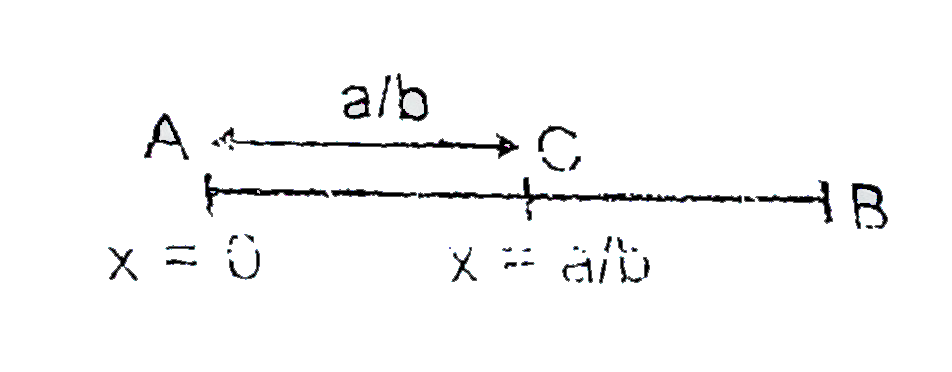
Alternate : `f = a - bx` means particle will do `SHM`.
At mean position , `f = 0`
`rArr x = (a)/(b) rArr`
In the figure shown, `'C'` is the mean positions and `A` & `B` are extreme positions
`:. x_(max) = (2a)/(b)`
Promotional Banner

Topper's Solved these Questions

  • SIMPLE HARMONIC MOTION

    RESONANCE|Exercise Exercise- 2, PART - II|1 Videos
  • SIMPLE HARMONIC MOTION

    RESONANCE|Exercise Exercise- 2, PART - III|12 Videos
  • SIMPLE HARMONIC MOTION

    RESONANCE|Exercise Exercise- 1, PART - II|37 Videos
  • SEMICONDUCTORS

    RESONANCE|Exercise Exercise 3|88 Videos
  • TEST PAPERS

    RESONANCE|Exercise FST-3|30 Videos

Similar Questions

Explore conceptually related problems

A street car moves rectilinearly from station A to the next station B (from rest to rest) with an acceleration varying according to the law f = a-bx, where a and b are constants and x is the distance from station A. The distance between the two stations and the maximum velocity are

A street car moves rectilinearly from station A to the next station B with an acceleration varying according to the law f=a-bx , where a and b are constants and x is the distance from station A. The distance between the two stations & the maximum velocity are :

The speed v of a car moving on a straight road changes according to equation, v^2 = 1 + bx , where a and b are positive constants. Then the magnitude of acceleration in the course of such motion : (x is the distance travelled).

While travelling from one station to another , a car travels 75 "km north" , 60 "km north - east" and 20 "km east" . The minimum distance between the two station is

A train starts from station A and reaches B 15 minutes late when it moves with 40 km/hr and 24 minutes late when it goes 30 km/hr. The distance between the two stations is

A train starts from rest and moves with uniform acceleration alpha for some time and acquires a velocity v it then moves with constant velocity for some time and then decelerates at rate beta and finally comes to rest at the next station. If L is distance between two stations then total time of travel is

A car starts moving from rest on a horizontal ground such that the position vector of car with respect to its starting point is given as vec(r) = b t hat(i) - c t^(2) hat(j) , where a and b are position constants, direction (x and y axes) intersect at the starting point of car (origin). Find: (a) The equation of the trajectory of car y = f(x) . (b) The angle between direction of velocity and acceleration of car as a function of time theta = f (t) . (c) Average velocity of car over first t seconds of motion

A car is moving on a straight road. The velocity of the car varies with time as shown in the figure. Initially (at t=0), the car was at x=0 , where, x is the position of the car at any time 't'. The maximum displacement from the starting position will be :-

RESONANCE-SIMPLE HARMONIC MOTION -Exercise- 2, PART - I
  1. The bob of a simple pendulum of length L is released at time t = 0 fro...

    Text Solution

    |

  2. The period of small oscillations of a simple pendulum of length l if i...

    Text Solution

    |

  3. A simple pendulum , a physical pendulum, a torsional pendulum and a sp...

    Text Solution

    |

  4. A rod of mass M and length L is hinged at its one end and carries a pa...

    Text Solution

    |

  5. A particle moves along the X-axis according to the equation x = 10 sin...

    Text Solution

    |

  6. The amplitide of a particle due to superposition of following S.H.Ms. ...

    Text Solution

    |

  7. Two particles P and Q describe S.H.M. of same amplitude a, same freque...

    Text Solution

    |

  8. A street car moves rectilinearly from station A (here car stops) to th...

    Text Solution

    |

  9. A particle is oscillating in a stright line about a centre of force O,...

    Text Solution

    |

  10. Assuming all the surfaces to be smoth, if the time period of motion of...

    Text Solution

    |

  11. A particle of mass m is attached with three springs A,B and C of equal...

    Text Solution

    |

  12. In the figure shown mass 2m is at rest and in equilibrium. A particle ...

    Text Solution

    |

  13. For given spring mass system, if the time period of small oscillations...

    Text Solution

    |

  14. For the arrangement shown in figure, the spring is initially compresse...

    Text Solution

    |

  15. A 1kg block is eecuting simpe hrmonic motion of ampliltude 0.1 m m on ...

    Text Solution

    |

  16. The period of oscillation of a simple pendulum of length L suspended f...

    Text Solution

    |

  17. Figure shown the kinetic energy K of a pendulum versus. its angle thet...

    Text Solution

    |

  18. The bob of a simple pendulum executm simple harmonic motion in water w...

    Text Solution

    |

  19. A solid sphere of radius R is floating in a liquid of density sigma wi...

    Text Solution

    |

  20. If the angular frequency of small oscillations of a thin uniform verti...

    Text Solution

    |

