Text Solution
Verified by Experts
The correct Answer is:



Topper's Solved these Questions
GEOMATRICAL OPTICS
RESONANCE|Exercise Exercise-3|79 VideosGEOMATRICAL OPTICS
RESONANCE|Exercise Advance level Problems|35 VideosGEOMATRICAL OPTICS
RESONANCE|Exercise Exercise-1|142 VideosEXPERIMENTAL PHYSICS
RESONANCE|Exercise PART -II|10 VideosGRAVITATION
RESONANCE|Exercise HIGH LEVEL PROBLEMS|16 Videos
Similar Questions
Explore conceptually related problems
RESONANCE-GEOMATRICAL OPTICS -Exercise-2
- Mirror in the arrangement shown in figure is moving up with speed 8 cm...
Text Solution
|
- A point object is placed on principal axis of a concave mirror of radi...
Text Solution
|
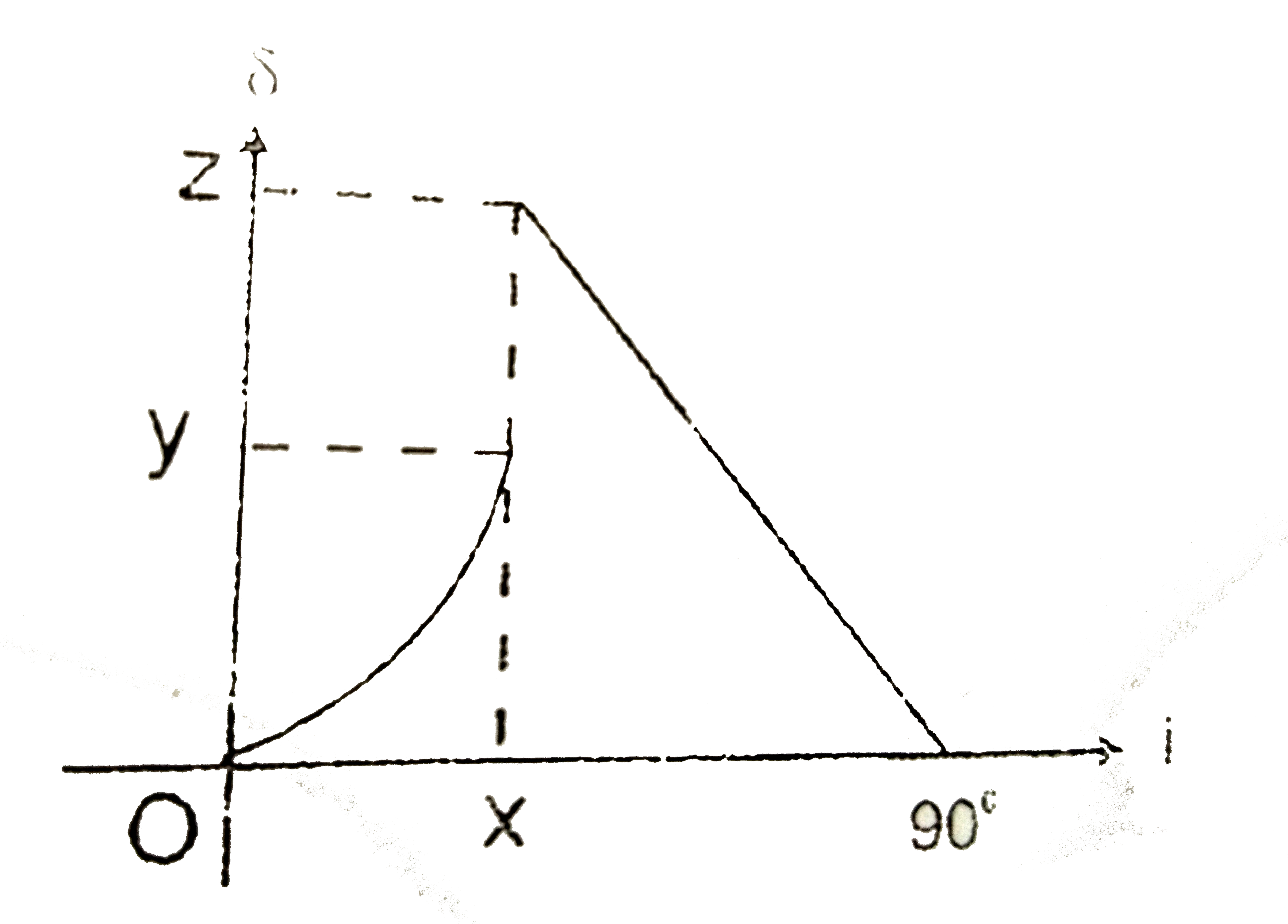
- Light is incident from glass to are. The variation of the angle of dev...
Text Solution
|
- A hemispherical portion of the surface of a solid glass sphere (mu = 1...
Text Solution
|
- In the figure, a point object O is placed in air. A spherical boundry ...
Text Solution
|
- A glass hemispher of refractive index 4//3 and of radius 4 cm is place...
Text Solution
|
- A converging lens of focal length 15 cm and a converging mirror of foc...
Text Solution
|
- An object of height h(0)=1 cm is moved along principal axis of a conve...
Text Solution
|
- Object O is kept in air in fron of a thin plano convex lens of radius ...
Text Solution
|
- A symmetrical converging convex lens of focal length 10 cm & diverging...
Text Solution
|
- An object O is kept in air and a lens of focal length 10 cm (in air) i...
Text Solution
|
- A stationary observer O looking at a fish F in water (mu(w)=4//3) thro...
Text Solution
|
- The dispersive power of the material of a lens is 0.04 and the focal l...
Text Solution
|
- The image (of a real object) formed by a concave mirror is twice the s...
Text Solution
|
- Which of the following statements are incorrect for spherical mirror.
Text Solution
|
- A ray of monochromatic light is incident on the plane surface of separ...
Text Solution
|
- For refractin of light through a prism
Text Solution
|
- An equilateral prism deviates a ray through 40^@ for two angles of inc...
Text Solution
|
- Two refracting media are separated by a spherical interfaces as shown ...
Text Solution
|
- The values of d(1) & d(2) for final rays to be parallel to the princip...
Text Solution
|