Home
Class 12
PHYSICS
If a symmetrical bi-concave thin lens is...

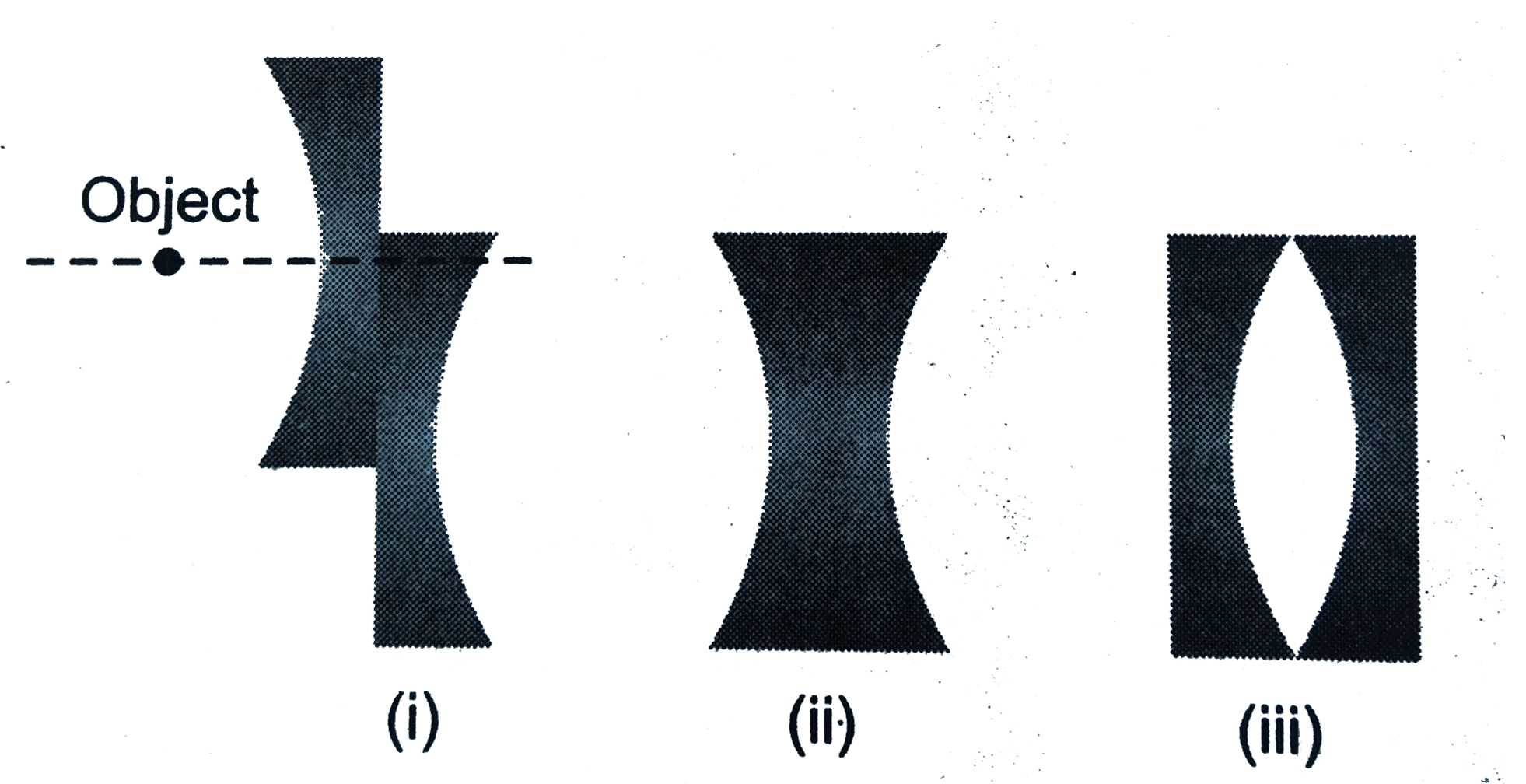
If a symmetrical bi-concave thin lens is cut into two identical halves, and they are placed in different ways as shown, then

A

three images will be formed in case `(i)`

B

tow inamges will be formed in the case `(i)`

C

the ratio of focal lengths in `(ii)`&`(iii)` is `1`

D

the ratio of focal lengths in `(ii)`&`(iii)` is `2`

Text Solution

Verified by Experts

The correct Answer is:

a,c

N//a
Promotional Banner

Topper's Solved these Questions

  • GEOMATRICAL OPTICS

    RESONANCE|Exercise Exercise-3|79 Videos
  • GEOMATRICAL OPTICS

    RESONANCE|Exercise Advance level Problems|35 Videos
  • GEOMATRICAL OPTICS

    RESONANCE|Exercise Exercise-1|142 Videos
  • EXPERIMENTAL PHYSICS

    RESONANCE|Exercise PART -II|10 Videos
  • GRAVITATION

    RESONANCE|Exercise HIGH LEVEL PROBLEMS|16 Videos

Similar Questions

Explore conceptually related problems

8 identical book are to be place in 4 identical shelf. Find the number of different ways can be done

There is symmetric bi-convex lens and it is cut in two pieces by a plane containing principal axis. If power of the original lens is 10 D then what will be the power of each part ?

There is a symmetric bi-convex lens and it is cut in two equal parts by a plane passing through the centre of lens and perpendicular to its principal axis. If power of original lens is 10 D then what will be the power of each part of the lens ?

A symmetric doule convex lens is cut in two equal parts by a plane perpendiculr to the pricipal axis. If the power of the original lens was 4D, the power of a cut lens will be

A symmetric doule convex lens is cut in two equal parts by a plane perpendiculr to the pricipal axis. If the power of the original lens was 4D, the power of a cut lens will be

In the figure (i) a thin lens of focal length 10cm is shown. The lens is cut into two equal parts, and the parts are arranged as shown in the figure (ii). An object AB of height 1cm is placed at distance of 7.5cm from the arrangement. The height of the final image will be:

In Billet's Lens Arrangement, a convex lens of focal length 50 cm is cut along the diameter into two indentical halves Å and B and in the process a layer C of the lens thickness 1 mm is lost. Then the two halves A and B are put together to form a composite lens. Now, infront of this composite lens a source of light emitting wavelength lambda = 6000 Å is placed at a distance of 25 cm as shown in the figure. Behind the lens there is a screen at a distance 50 cm from it. Find the fringe width fo the interference pattern obtained on the screen.

RESONANCE-GEOMATRICAL OPTICS -Exercise-2
  1. The values of d(1) & d(2) for final rays to be parallel to the princip...

    Text Solution

    |

  2. An object O is kept infront of a converging lens of focal length 30 cm...

    Text Solution

    |

  3. If a symmetrical bi-concave thin lens is cut into two identical halves...

    Text Solution

    |

  4. A narrow beam of white light enters slab having parallel faces.

    Text Solution

    |

  5. By properly combining two prisms made of different materials, it is po...

    Text Solution

    |

  6. A plane mirror M is arranged parallel to a wall W at a distance l from...

    Text Solution

    |

  7. A man washign to get a picture of a Zebra photographed a white donkey ...

    Text Solution

    |

  8. An equiconvex lens of refractive index n(2) is placed such that the re...

    Text Solution

    |

  9. In the figure shown , a point object O is placed in air on the princip...

    Text Solution

    |

  10. An object is kept on the principal axis of a convex mirror of focal le...

    Text Solution

    |

  11. A real object is placed infront of a convex mirror (focal length f). I...

    Text Solution

    |

  12. A small air bubble is trapped inside a transparent cube of size 12 cm...

    Text Solution

    |

  13. A parallel beam of light is incident normally on the flat surface of a...

    Text Solution

    |

  14. The image of a white object in with light formed by a lens is usually ...

    Text Solution

    |

  15. The image of a white object in with light formed by a lens is usually ...

    Text Solution

    |

  16. The image of a white object in with light formed by a lens is usually ...

    Text Solution

    |

  17. The image of a white object in with light formed by a lens is usually ...

    Text Solution

    |

  18. The image of a white object in with light formed by a lens is usually ...

    Text Solution

    |

  19. The ciliary muscles of eye control the curvature of the lens in the ey...

    Text Solution

    |

  20. The ciliary muscles of eye control the curvature of the lens in the ey...

    Text Solution

    |
