Home
Class 12
PHYSICS
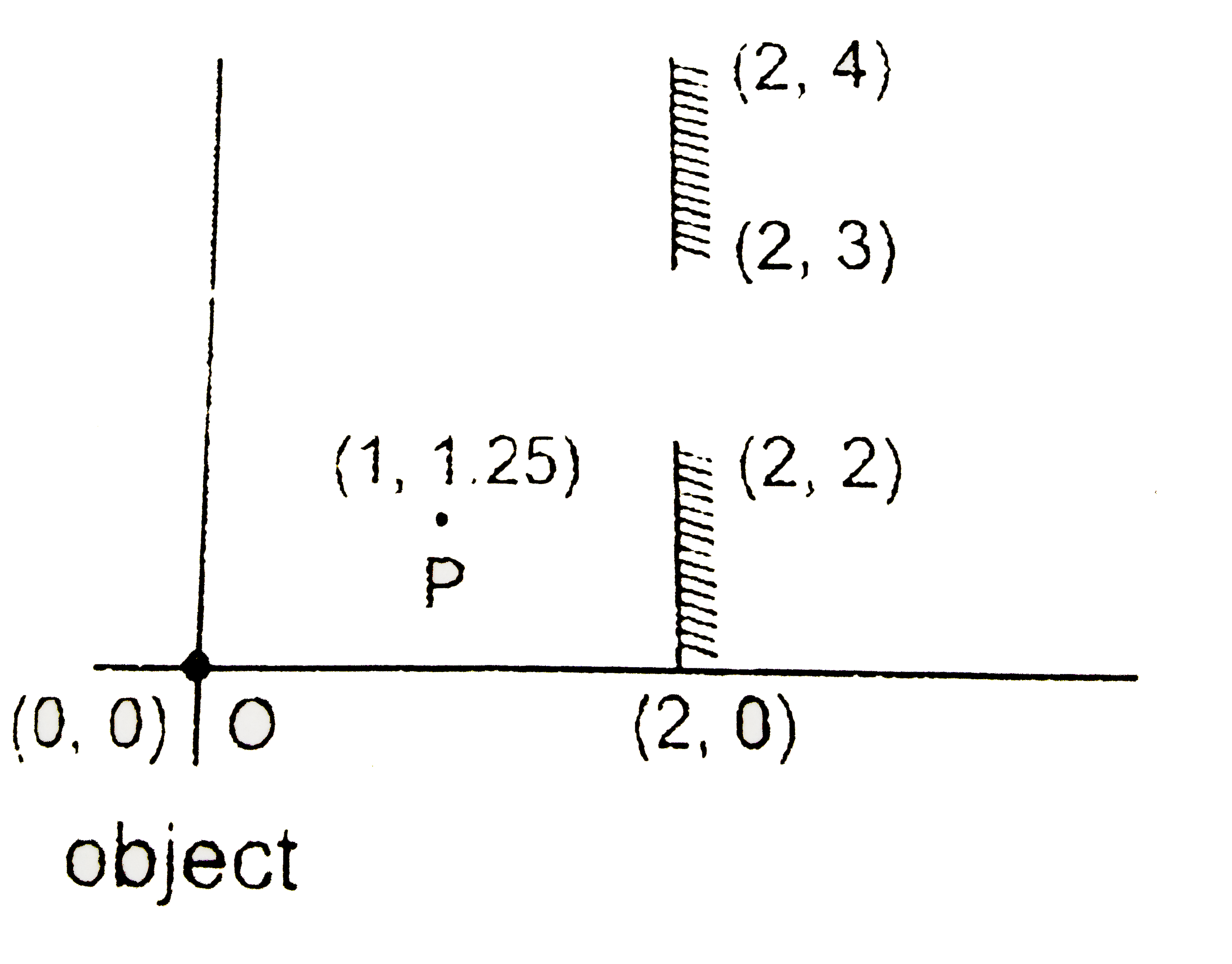
Two plane mirrros are placed as shown i...

Two plane mirrros are placed as shown in the figure and a point object `'O'` is placed at the orgin
(a) How many images will be formed.
(b) Find the positon(s) of image(s)
(c) Will the incident ray passing through a pont `'P' (1,1,25)` take part in image formation.

Text Solution

Verified by Experts

The correct Answer is:

(a) `1`; (b) `(4,0)`; (c) No

NA
Promotional Banner

Topper's Solved these Questions

  • GEOMATRICAL OPTICS

    RESONANCE|Exercise Exercise-2|63 Videos
  • GEOMATRICAL OPTICS

    RESONANCE|Exercise Exercise-3|79 Videos
  • GEOMATRICAL OPTICS

    RESONANCE|Exercise Problem|33 Videos
  • EXPERIMENTAL PHYSICS

    RESONANCE|Exercise PART -II|10 Videos
  • GRAVITATION

    RESONANCE|Exercise HIGH LEVEL PROBLEMS|16 Videos

Similar Questions

Explore conceptually related problems

Three plane mirrors are kept as shown in the Figure A point object (O) is kept at the centroid of the triangle seen in the Figure. How many images will be formed?

Two plane mirrors are placed at some angle. There are five images formed when an object is placed symmetrically between them . Find the angle between the mirrors.

A convex lens is made up of three different materials as shown in the figure. For a point object placed on its axis, the number of images formed are

A plane mirror and a concave mirror are arranged as shown in figure and O is a point object, Find the position of image formed by two reflection, first one talking place at concve mirror.

When an object is placed between O and F_(1) in front of a convex lens, the image formed

Two convex lenses placed in contact form the image of a distant object at P. If the lens B is moved to the right, the image will

Two convex lenses placed in contact form the image of a distant object at P. If the lens B is moved to the right, the image will

A lens shown in Fig. 6(b).75 is made of two different materials. A point object is placed on the principal axis of the lens. How many images will be obtained ?

RESONANCE-GEOMATRICAL OPTICS -Exercise-1
  1. A light ray is incident on a plane mirror, which after getting refl...

    Text Solution

    |

  2. Sun rays are incident at an angle of 24^(@) with the horizon. How ca...

    Text Solution

    |

  3. Two plane mirrros are placed as shown in the figure and a point objec...

    Text Solution

    |

  4. A point object is placed (0,0) and a plane mirror 'M' is placed, incl...

    Text Solution

    |

  5. A rod of length 5cm lies along the principle axis of a concave mirrro...

    Text Solution

    |

  6. A point source is at a distance 35cm on the optical axos from a sph...

    Text Solution

    |

  7. Find the diameter of the image of the moon formed by a spherical conc...

    Text Solution

    |

  8. The radius of curvature of a convex spherical mirror is 1.2m. How fa...

    Text Solution

    |

  9. A converging beam of light rays in incident on a concave spherical ...

    Text Solution

    |

  10. A point object is placed on the principle axis at 60cm in fornt ...

    Text Solution

    |

  11. A man uses a concave mirror for shaving. He keeps his face at a dist...

    Text Solution

    |

  12. Two spherical mirros (convex and concave) having the same focal leng...

    Text Solution

    |

  13. A light ray falling an agnle of 60^(@) with the surface of a clean ...

    Text Solution

    |

  14. A light ray is incident at 45^(@) on a glass slab. The slab is 3cm thi...

    Text Solution

    |

  15. In the given figure an abserve in air (n=1) sees the botoom of a bre...

    Text Solution

    |

  16. In the given figure rasy incident on an interface would converge 10c...

    Text Solution

    |

  17. A fish is rising up vertically inside a pond with velocity 4 cm/s and ...

    Text Solution

    |

  18. Find the apparednt distance between the observer and the object shwon ...

    Text Solution

    |

  19. Find the apparent depth of object of the object seen by observe A (in...

    Text Solution

    |

  20. Locate the image fo the point P as seen by the eye in the figure.

    Text Solution

    |
