Home
Class 12
PHYSICS
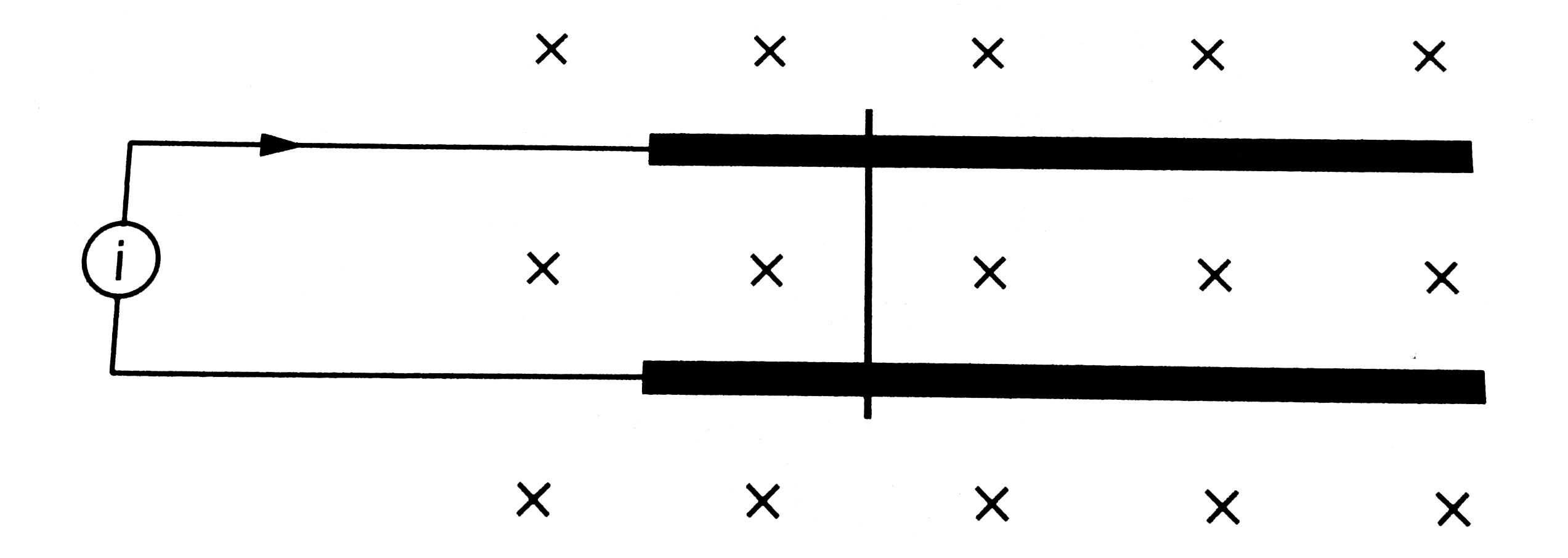
Shows two long metal rails placed horizo...

Shows two long metal rails placed horizontally and parallel to each other at a separation i. A uniform magnetic field b exists in the vertically downward direction. A wire of mass m can slide on the rails. The rails are connected to a constant current source which drives a current I in the circuirt. The friction coefficient between the rails and the wire is `mu`. (a) What should be the minimum value of `mu` which can prevent the wire from sliding on the rails? (b) Describe the motion of the wire if the value of `mu` is half the value found in the previous part.

Text Solution

Verified by Experts

(a) The force on the wire due to the magnetic field is
It acts towards right in the given figure if the wire does not slide on the rails the force of friction by the rails should be equal to `F`. If `mu`be the minimum coeffiecient of firmction which can prevent sliding this force is also equal to mu mg . Thus
(b) if the friction coeffiecient is `mu=mu_(.0)/2=(lyB)/(2mg)`, the wire will slide towards right.The frictional by the rails is
`f=mumg=(lyB)/2`toward left.
The resultant force is `lyB-(lyB)/2=(lyB)/2`towards right. The acceleration will be `a=(lyB)/(2m)` The wire will slide towards right this acceleration.
Promotional Banner

Topper's Solved these Questions

  • ELECTRODYNAMICS

    RESONANCE|Exercise PROBLEM|12 Videos
  • ELECTRODYNAMICS

    RESONANCE|Exercise Exercise-1 PART-1|81 Videos
  • ELECTRO MAGNETIC WAVES

    RESONANCE|Exercise Exercise 3|27 Videos
  • ELECTROMAGNETIC INDUCTION

    RESONANCE|Exercise A.l.P|19 Videos

Similar Questions

Explore conceptually related problems

Figure shows a wire sliding on two parallel, conducting rails placed at a separation L . A magnetic field B exists in a direction perpendicular to the plane of the rails. What force is necessary to keep the wire moving at a constant velocity V ?

Figure shows a wire of resistance R sliding on two parallel, conducting fixed thick rails placed at a separation l. A magnetic fild B exist in a direction perpendicular to the plane of the rails. The wire is moving with a constant velocity v. Find current through the wire

A straight wire of length l can slide on two parallel plastic rails kept in a horizontal plane with a separation d. The coefficient of friction between the wire and the rails is mu . If the wire carries a current I, what minimum magnetic field should exist in the space in order to slide the wire on the rails.

A pair of long, smooth, parallel, horizontal, conducting rails are joined to a cell at one end. There are no external electric or magnetic fields. A metal rod is placed on the rails. The rod will

Two long parallel conducting horizontal rails are connected by a conducting wire at one end. A uniform magnetic field B (directed vertically downwards) exists in the region of space. A light uniform ring of diameter d which is practically equal to separation between the rails is placed over the rails as shown in Fig. If resistance of ring be (lambda) per unit length The current in the wire MN is

Two long parallel conducting horizontal rails are connected by a conducting wire at one end. A uniform magnetic field B (directed vertically downwards) exists in the region of space. A light uniform ring of diameter d which is practically equal to separation between the rails is placed over the rails as shown in Fig. If resistance of ring be (lambda) per unit length The force required to pull the ring with uniform velocity v is

A conductor bar with mass m and length L slides over horizontal rails that are connected to a voltage source. The voltage source maintains a constant current I in the rails and bar, and constant, uniform, vertical magnetic field vecB fills the region between the rails (as shown in Fig.) If the bar has mass m, find the distance d that the bar must move along the rails from rest to attain speed v.

RESONANCE-ELECTRODYNAMICS-Advanced level problems
  1. Shows two long metal rails placed horizontally and parallel to each ot...

    Text Solution

    |

  2. Calculate the magnetic moment of a thin wire with a current I=0.8 A, w...

    Text Solution

    |

  3. A small charged ball having mass m and charge q is suspended from a ri...

    Text Solution

    |

  4. The figure shows a conductor of weight 1.0 N& length L=0.5 m placed on...

    Text Solution

    |

  5. Four long wires each carrying current I as shown in the are placed at ...

    Text Solution

    |

  6. A solenoid of length 0.4m and having 500 turns of wire carries a curre...

    Text Solution

    |

  7. A uniformly charged ring of radius 0.1 m rotates at a frequency of 10^...

    Text Solution

    |

  8. The current density bar(J) inside a long, solid cylindrical wire of ra...

    Text Solution

    |

  9. A neutral particle is at rest in a uniform magnetic field vecB.At t=0,...

    Text Solution

    |

  10. A non-uniform magnetic field vecB=B(0)(1+y/d)(-hatk) is present in reg...

    Text Solution

    |

  11. A neutral atom of atomic mass number 100 which is stationary at the or...

    Text Solution

    |

  12. In the figure shown a positively charged particle of charge q and mass...

    Text Solution

    |

  13. A thin beam of charged particles in incident normally on the boundry o...

    Text Solution

    |

  14. An electron moving with velocity vecv(1)=1hati m//s at a point in a ma...

    Text Solution

    |

  15. An electron is shot into one end of a solenoid.As it enters the unifor...

    Text Solution

    |

  16. At time t(1), an electron is sent along the positive direction of x-ax...

    Text Solution

    |

  17. In the figure shown an infinitely long wire carries a current I(1) and...

    Text Solution

    |

  18. A loop PQR formed by three identical uniform conducting rods each of l...

    Text Solution

    |

  19. In order to impatt an angular velocity to an earth satellite the geoma...

    Text Solution

    |

  20. The given fig.shows a coil bent with AB=BC=CD=DE=EF=FG=GH=HA=1 m and c...

    Text Solution

    |

  21. A charged particle +q of mass m is placed at a distance d from another...

    Text Solution

    |
