Home
Class 12
MATHS
Two blocks on horizontal ground are conn...

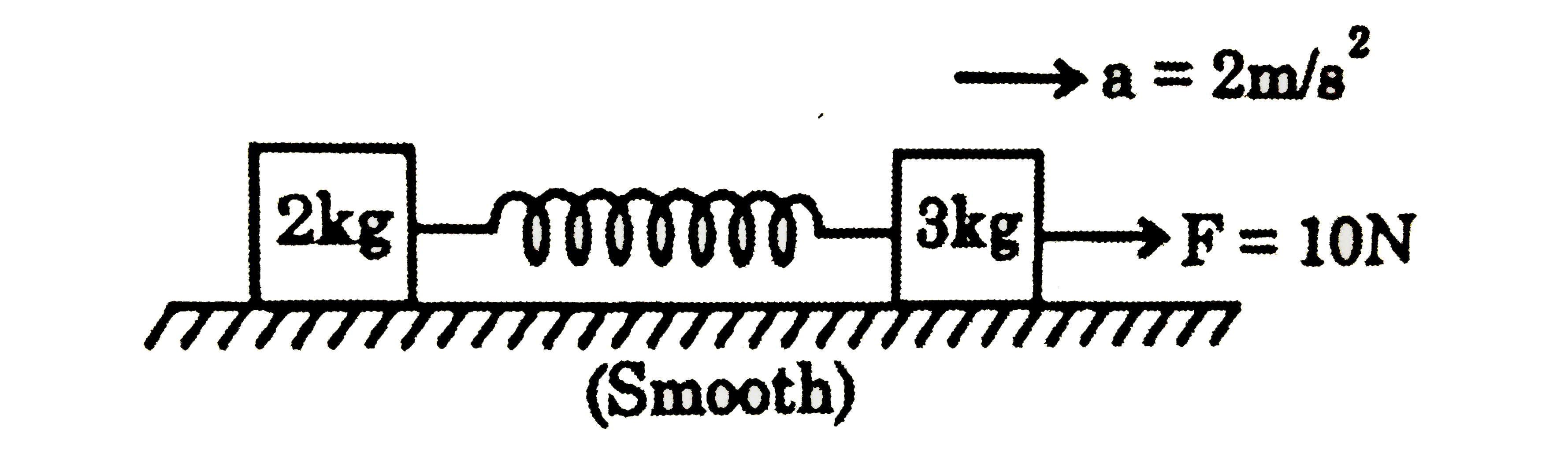
Two blocks on horizontal ground are connected by a spring. At an instant, acceleration of 3kg while being pulled by 10N force is `2 m//s^2`

A

Spring is in elongated state

B

Magnitude of spring force is 4N

C

Acceleration of 2kg block at that instant is `2m//s^2`

D

Spring is in compressed state

Text Solution

Verified by Experts

The correct Answer is:

A,B,C
Promotional Banner

Topper's Solved these Questions

Similar Questions

Explore conceptually related problems

Two blocks of masses 10 kg and 20 kg are connected by a massless spring and are placed on a smooth horizontal surface. A force of 200 N is applied on 20 kg mass as shown in the diagram. At the instant, the acceleration of 10 kg mass is 12ms^(-2) , the acceleration of 20 kg mass is:

Two blocks of masses m and M are placed on a horizontal frictionless table connected by light spring as shown in figure. The Mass M is pulled to the right with a force F It the acceleration of mass m is a then the acceleration of M will be .

Two block of masses 2 kg and 3 kg are connected by string of length 1m . At any instant the velocitities of block of mass 2kg and 3 kg is 5 m//s in opposite direction and perpendicular to the length of string and is also parallel to horizontal table.

Two blocks of mass 10 kg and 2 kg are connected by an ideal spring of spring constant K = 800 N//m and the system is placed on a horizontal surface as shown. The coefficient of friction between 10 kg block and surface is 0.5 but friction is absent between 2 kg and the surface. Initially blocks are at rest and spring is relaxed. The 2 kg block is displaced to elongate the spring by 1 cm and is then released. (a) Will 10 kg block move subsequently? (b) Draw a graph representing variation of magnitude of frictional force on 10 kg block with time. Time t is measured from that instant when 2 kg block is released to move.

Two blocks of mass 10 kg and 2 kg are connected by an ideal spring of spring constant 1000 N/m and the system is placed on a horizontal surface as shown. The coefficient of friction between 10 kg block and surface is 0.5 but friction is assumed to be absent between 2 kg and surface. Initially blocks are at rest and spring is unstretched then 2 kg block is displaced by 1 cm to elongate the spring then released. Then the graph representing magnitude of frictional force on 10 kg block and time t is : (Time t is measured from that instant when 2 kg block is released to move)

Two blocks of masses m = 2 kg and m = 8 kg are connected to a spring of force constant K = 1 kN//m . The spring is compressed by 20 cm and the two blocks are held in this position by a string. The system is placed on a horizontal smooth surface and given a velocity u = 3 m//s perpendicular to the spring. The string snaps while moving. Find the speed of the block of mass m when the spring regains its natural length.

Two blocks A(3 kg) and B(2 kg) resting on a smooth horizontal surface is connected by a spring of stiffness 480N//m . Initially the spring is underformed and a velocity of 2 m//s is imparted to A along the line of the spring away from B. The maximum extension in meters of the spring during subsequent motion is :-

Two blocks of masses m_(1) =1kg and m_(2) = 2kg are connected by a spring of spring constant k = 24 N/m and placed on a frictionless horizontal surface. The block m_(1) is imparted an initial velocity v_(0) = 12cm/s to the right. The amplitude of osciallation is
