Home
Class 12
PHYSICS
A point charges Q is moving in a circula...

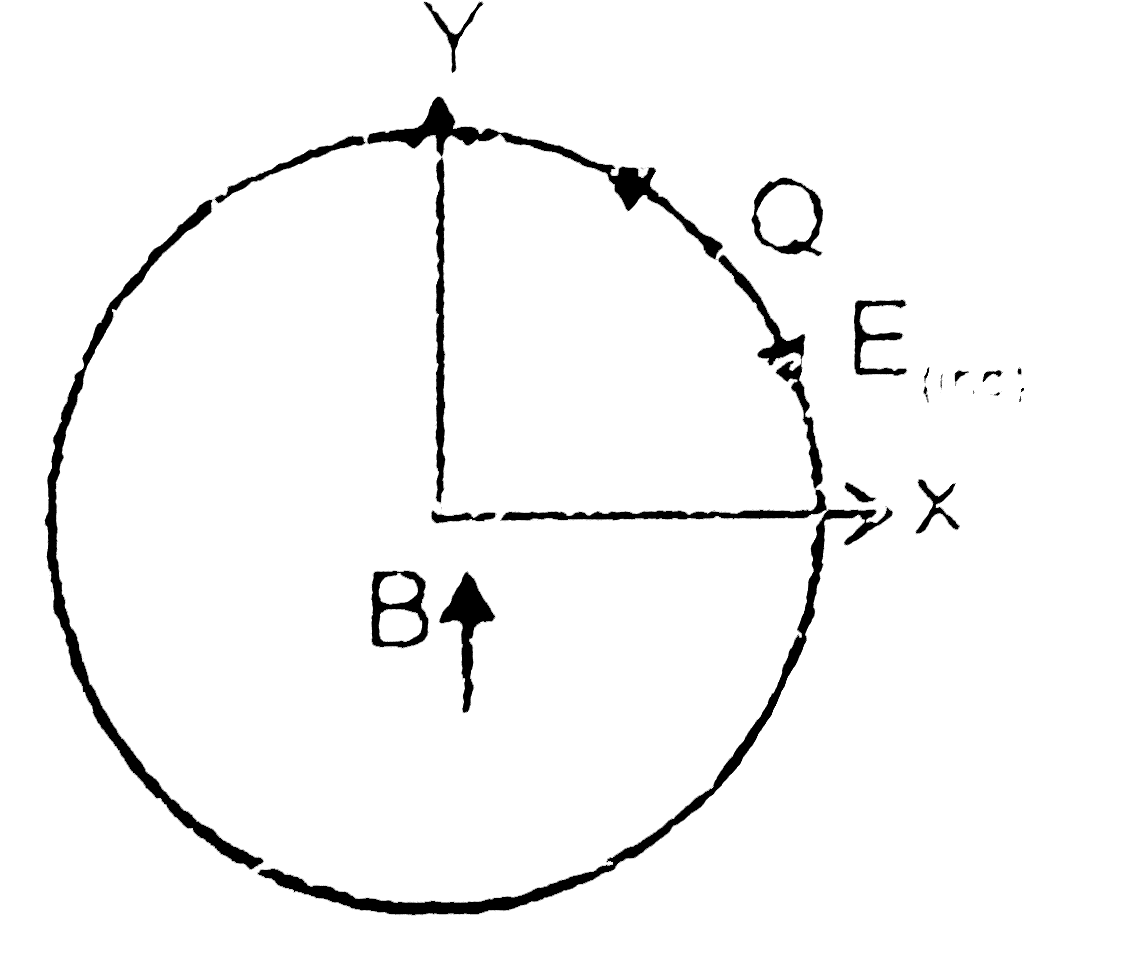
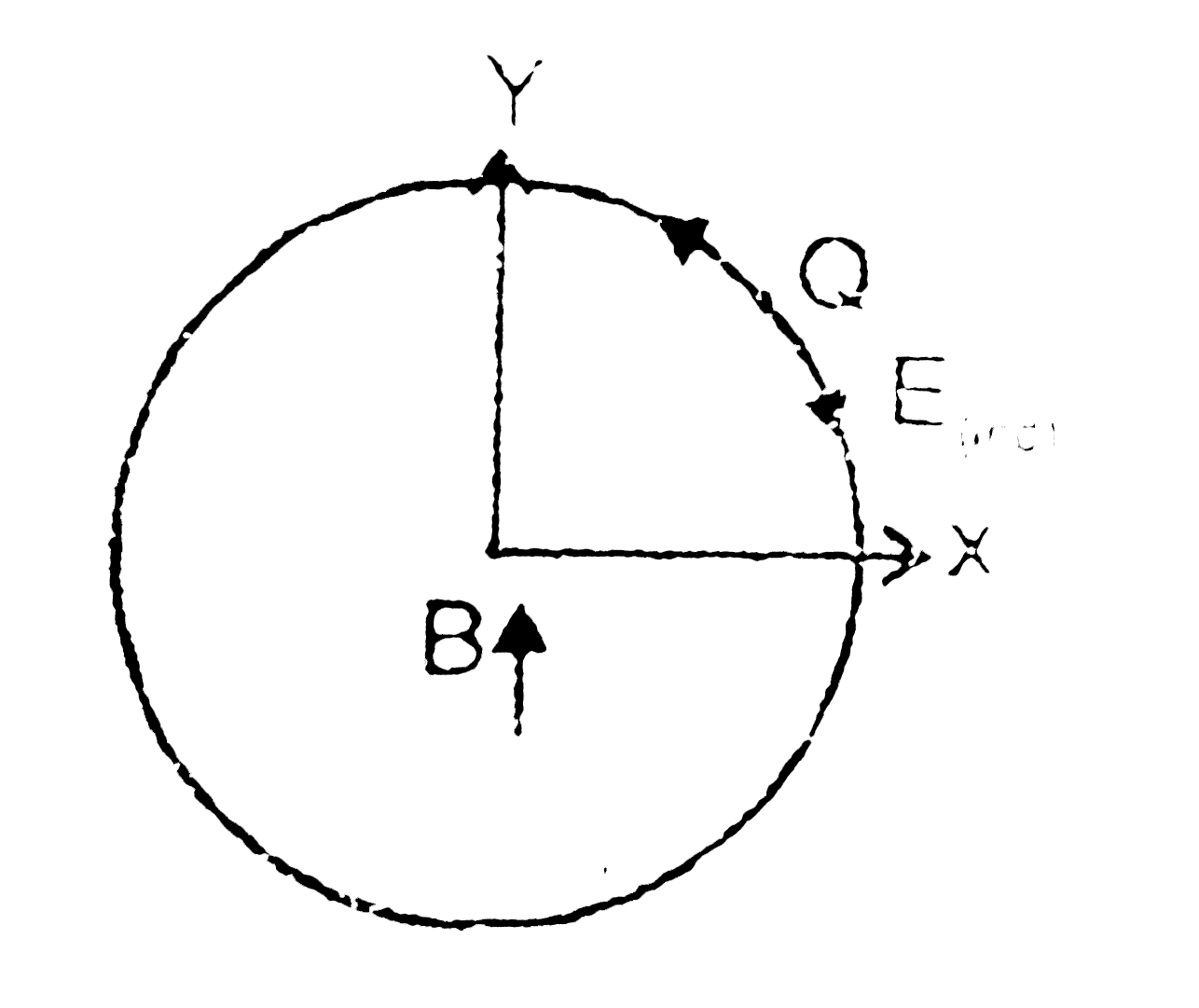
A point charges Q is moving in a circular orbit of radius R in the x-y plane with an angular velocity `omega`. This can be considered as equivalent to a loop carrying a steady current `(Q omega)/(2 pi)`. S uniform magnetic field along the positive z-axis is now switched on, which increases at a constant rate from 0 to B in one second. Assume that the radius of hte orbit remains constant. The application of hte magnetic field induces an emf in the orbit. The induced emf is defined as the work done by an induced electric field in moving a unit positive charge around a closed loop. It si known that, for an orbiting charge, the magnetic dipole moment is proportional to the angular momentum with a porportionality constant `lambda`.
The charge in the magnetic dipole moment associated with the orbit. at the end of the time interval of hte magnetic field charge, is

A

`-gammaBQR^(2)`

B

`-gamma(BQR^(2))/2`

C

`gamma(BQR^(2))/2`

D

`gammaBQR^(2)`

Text Solution

Verified by Experts

The correct Answer is:
B

Megnetic dipole moment `M=gamma J`
`DeltaM=gammaDeltaJ`…(i)
`(DeltaJ)/(Deltat)=-Q(dB)/(dt).R/2R. rArrDeltaJ=-(QB)/2R^(2) rArr "so" DeltaM=(gammaQBR^(2))/2`
Alternate
`M/L=Q/(2m)`
`M=(Qomega)/(2pi)piR^(2)=(QomegaR^(2))/2`.
induced electric field is opposite to the `omega` so the charge is retarded.
`omega'=omega-alphat`
`omega'=omega-(QB)/2 1 , (a_(1)=QE//m),(alpha=(QE)/(mR)=Q/Rxx(BR)/(2m)=(QB)/(2m))`
`M_(f)=(Qomega'R^(2))/2=Q(omega-(QB)/(2m))R^(2)/2`
`Deltam=M_(f)-M_(i)=(QomegaR^(2))/2-(Q^(2)BR^(2))/(4m)-(QomegaR^(2))/(2)=-gamma(BQR^(2))/2`
Alternate
`M/L=Q/(2m)`
`M=(Qomega)/(2pi)piR^(2)=(QomegaR^(2))/2`.
`omega'=omega-alphat`
`omega'=omega-(QB)/2 1 , (a_(1)=QE//m),(alpha=(QE)/(mR)=Q/Rxx(BR)/(2m)=(QB)/(2m))`
`M_(f)=(Qomega'R^(2))/2=Q(omega-(QB)/(2m))R^(2)/2`
`Deltam=M_(f)-M_(i)=(QomegaR^(2))/2-(Q^(2)BR^(2))/(4m)-(QomegaR^(2))/(2)=-gamma(BQR^(2))/2`

Promotional Banner

Topper's Solved these Questions

  • ELECTROMAGNETIC INDUCTION

    RESONANCE|Exercise Exercis-3 PART 2|16 Videos
  • ELECTROMAGNETIC INDUCTION

    RESONANCE|Exercise Exercis-3 PART 3|16 Videos
  • ELECTROMAGNETIC INDUCTION

    RESONANCE|Exercise Exercis-2 PART 4|6 Videos
  • ELECTRODYNAMICS

    RESONANCE|Exercise Advanced level problems|31 Videos
  • ELECTROSTATICS

    RESONANCE|Exercise HLP|39 Videos

Similar Questions

Explore conceptually related problems

A point charges Q is moving in a circular orbit of radius R in the x-y plane with an angular velocity omega . This can be considered as equivalent to a loop carrying a steady current (Q omega)/(2 pi) . S uniform magnetic field along the positive z-axis is now switched on, which increases at a constant rate from 0 to B in one second. Assume that the radius of hte orbit remains constant. The application of hte magnetic field induces an emf in the orbit. The induced emf is defined as the work done by an induced electric field in moving a unit positive charge around a closed loop. It si known that, for an orbiting charge, the magnetic dipole moment is proportional to the angular momentum with a porportionality constant lambda . The magnitude of the induced electric field in the orbit at any instant of time during the time interval of the mangnetic field change is

A particle moving along a circule path of radius 'r' with uniform angular velocity omega . Its angular acceleration is

The magnetic momenrt of a circular orbit of radius 'r' carrying a charge 'q' and rotating with velocity v is given by .

A particle of charge q and mass m moves in a circular orbit of radius r with angular speed omega . The ratio of the magnitude of its magnetic moment to that of its angular momentum depends on

An electron of charge e , revolves round in an orbit of radius r with a uniform angular velocity omega . The magnetic dipole moment of the electron in the orbit is

A particle of the charged q and mass m moves in a circular orbit of radius r with angular speed omega . The ratio of the magnitude of its magnetic moment to that of its angular momentum depends on

A particle of charge q and mass m moves in a circular orbit or radius r with angular speed omega . The ratio of the magnitude of its magnetic moment to that of its angular momentum depends on

RESONANCE-ELECTROMAGNETIC INDUCTION-Exercis-3 PART 1
  1. An infinitely long cylinder is kept parallel to an uniform magnetic fi...

    Text Solution

    |

  2. The capacitor of capacitance C can be charged (with the help of a resi...

    Text Solution

    |

  3. The capacitor of capacitance C can be charged (with the help of a resi...

    Text Solution

    |

  4. In the given circuit the capacitor (C) may be charged through resistan...

    Text Solution

    |

  5. Modern trains are based on Maglev technology in which trains are magne...

    Text Solution

    |

  6. Modern trains are based on Maglev technology in which trains are magne...

    Text Solution

    |

  7. Modern trains are based on Maglev technology in which trains are magne...

    Text Solution

    |

  8. Statement-1: A vertical iron rod has ciol of wire wound over it at the...

    Text Solution

    |

  9. The figure shows certain wire segments joined together to form a copla...

    Text Solution

    |

  10. Two metallic rings A and B identical in shape and size but having diff...

    Text Solution

    |

  11. Electrical resistance of certain materials, known as superconductors, ...

    Text Solution

    |

  12. Electrical resistance of certain materials, known as superconductors, ...

    Text Solution

    |

  13. A long circular tube of length 10 m and radius 0.3 m carries a curre...

    Text Solution

    |

  14. Which of the field patterns given below is valid for electric field as...

    Text Solution

    |

  15. A circular wire loop of radius R is placed in the x-y plane centered a...

    Text Solution

    |

  16. A current carrying infinitely long wire is kept along the diameter of ...

    Text Solution

    |

  17. A point charges Q is moving in a circular orbit of radius R in the x-y...

    Text Solution

    |

  18. A point charges Q is moving in a circular orbit of radius R in the x-y...

    Text Solution

    |